
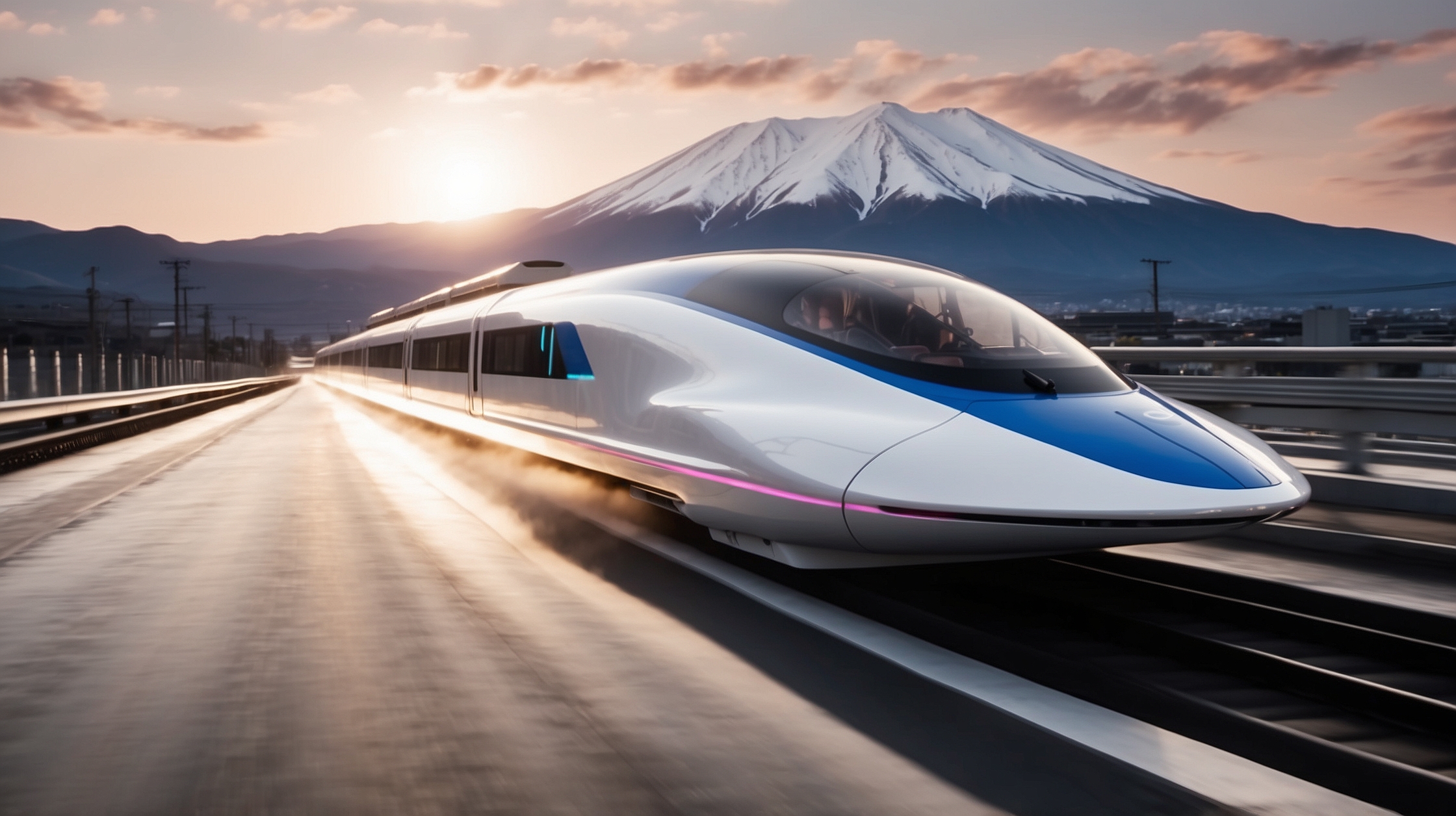
Japan has just pushed the boundaries of high-speed transportation once again. In a remarkable engineering achievement, the country’s next-generation **magnetic levitation (maglev) train** reached a breathtaking top speed of **603 kilometers per hour (375 mph)**, setting a new world record for rail vehicles. This isn’t just a milestone in train travel—it’s a moment that could redefine the limits of how fast people and goods can be transported on land.
Engineered by Central Japan Railway Company (JR Central), the new maglev prototype—known officially as the **L0 (L-zero) Series**—achieved this record-breaking feat during a test run on the company’s dedicated maglev test track in Yamanashi Prefecture. The accomplishment surpasses all previous train speed records, including the maglev’s own earlier milestone of 590 km/h. With regular service projected for the late 2020s, this technology could soon change the way we think about high-speed rail.
Japan has long been at the forefront of train travel innovation—from the introduction of the **Shinkansen bullet trains** in the 1960s to today’s next-gen magnetic levitation marvel. The new maglev not only improves on speed but promises reduced friction, lower noise, and enhanced safety compared to traditional rolling stock.
Japan’s Record-Breaking Maglev at a Glance
| Technology Type | Magnetic Levitation (Maglev) |
| Top Speed Achieved | 603 km/h (375 mph) |
| Company Behind | Central Japan Railway Company (JR Central) |
| Train Model | L0 Series Maglev |
| Location of Test | Yamanashi Maglev Test Line, Japan |
| Planned Commercial Launch | Late 2020s (Tokyo to Nagoya) |
A new benchmark for train technology
This isn’t the first time JR Central has made global headlines with its revolutionary train technology. But achieving a speed of **603 km/h** on land—nearly half the speed of sound—is an unprecedented leap. While maglevs rely on magnetic forces to “float” above the tracks, eliminating contact and drastically reducing drag, the degree of engineering control required to sustain such speeds safely is nothing short of extraordinary.
The L0 Series prototype features a streamlined nose stretching over 15 meters long, designed to minimize air resistance. Unlike traditional trains that ride on wheels, this maglev uses superconducting magnets to levitate approximately **10 centimeters above the guideway**, allowing nearly frictionless movement.
“Going beyond 600 km/h isn’t just symbolic—it represents an entirely new transportation paradigm.”
— Hiroshi Nakamura, Chief Engineer, JR Central
When technology translates to public service
Speed records are impressive, but the real challenge lies in translating this blistering performance into **daily passenger service**. JR Central is planning to deploy the L0 Series maglev on the future **Chūō Shinkansen line**, connecting Tokyo and Nagoya in about **40 minutes**—less than half the time of the current Shinkansen.
The first phase is expected to begin commercial operation by **2027**, with plans to eventually **extend service to Osaka**, reducing the total journey from Tokyo to Osaka—currently around 2.5 hours—to just over 1 hour.
Infrastructure challenges ahead
Building a maglev line of this magnitude is a massive undertaking. Unlike conventional trains, maglev systems require dedicated infrastructure, since they can’t run on existing tracks. Japan is investing billions in constructing **buried tunnels**, elevated viaducts, and power systems specifically tailored for this advanced form of transport.
About **90% of the Chūō Shinkansen line** from Tokyo to Nagoya will be **underground or in tunnels**, a factor that increases costs but also minimizes impact on existing communities and the environment. The overall cost for the initial leg is projected at around **9 trillion yen (over $80 billion)**.
“It’s an engineering marvel, but also a logistical one. Tunneling through mountains while maintaining magnetic alignment is as challenging as the train itself.”
— Dr. Ken Watanabe, Professor of Transportation Engineering
Environmental efficiency and power considerations
At first glance, a train speeding at over 600 km/h may not seem energy-efficient, but the maglev’s **non-contact propulsion** significantly cuts down on mechanical energy loss. Additionally, regenerative braking systems help to reclaim energy during slow-downs.
However, the system does require substantial power, particularly for the onboard superconducting magnets that must operate at **cryogenic temperatures**. JR Central has promised to operate the system with a focus on **sustainable energy sources**, and is exploring partnerships with **renewable energy** providers to reduce the maglev’s carbon footprint.
Comparing winners and losers in the global transit race
| Winners | Losers |
|---|---|
| High-speed railway passengers | Short-haul airlines |
| Clean transit advocates | Traditional rail operators (possibly) |
| Japanese rail industry | Countries without maglev infrastructure |
Global implications and future adoption
Japan’s maglev success isn’t just a national triumph—it raises the bar worldwide. Several countries have expressed interest in the technology, including the **United States, China**, and various European nations. However, the high costs and technical complexities make deployment steep compared to conventional high-speed rail.
Still, as urban centers grow and short-haul air travel becomes increasingly problematic from both congestion and environmental perspectives, **maglev systems offer a compelling alternative**. Japan’s prototype may soon become the gold standard, inspiring a global re-thinking of land transport capabilities.
Public excitement and test rider reactions
During public test rides, passengers described the experience as “smooth” and “almost eerie” due to the **lack of track noise**. Acceleration and deceleration were said to be surprisingly gentle, a testament to the precision of maglev engineering.
“I couldn’t feel any bumping or rattling. It was like floating through the air on rails.”
— Ayumi Tanaka, Maglev Test Rider
How Japan stays ahead in the innovation curve
Japan’s transportation system has always reflected its dedication to **technological advancement**, **safety**, and **efficiency**. The maglev project continues that tradition, leveraging decades of research in electromagnetic propulsion, materials science, and tunnel construction.
As innovation races forward, Japan remains laser-focused on making sure that technology serves the people—not just pie-in-the-sky science fiction, but **real and reliable public infrastructure**.
Frequently Asked Questions
What is the top speed of Japan’s next-gen maglev train?
The L0 Series maglev train reached a maximum speed of 603 km/h (375 mph) during test runs.
When will the maglev be available for public use?
Commercial service is expected to begin by 2027 between Tokyo and Nagoya.
How does the maglev train work?
It uses superconducting magnets to levitate above the tracks, allowing it to travel without friction and at higher speeds than conventional trains.
What is the significance of this new speed record?
It sets a new world record for rail vehicles and demonstrates the viability of extremely high-speed land transport.
Is the maglev environmentally friendly?
Yes, it offers reduced mechanical wear and energy efficiency, especially when powered by renewable sources.
How long will it take to travel from Tokyo to Nagoya on the maglev?
Approximately 40 minutes, compared to around 90 minutes on current bullet trains.
Will the maglev replace the Shinkansen?
No, it will complement existing high-speed rail networks by offering even faster routes on specific corridors.
Which countries are considering adopting maglev technology?
Countries like the USA, China, and Germany have shown interest in building or upgrading to maglev systems.


