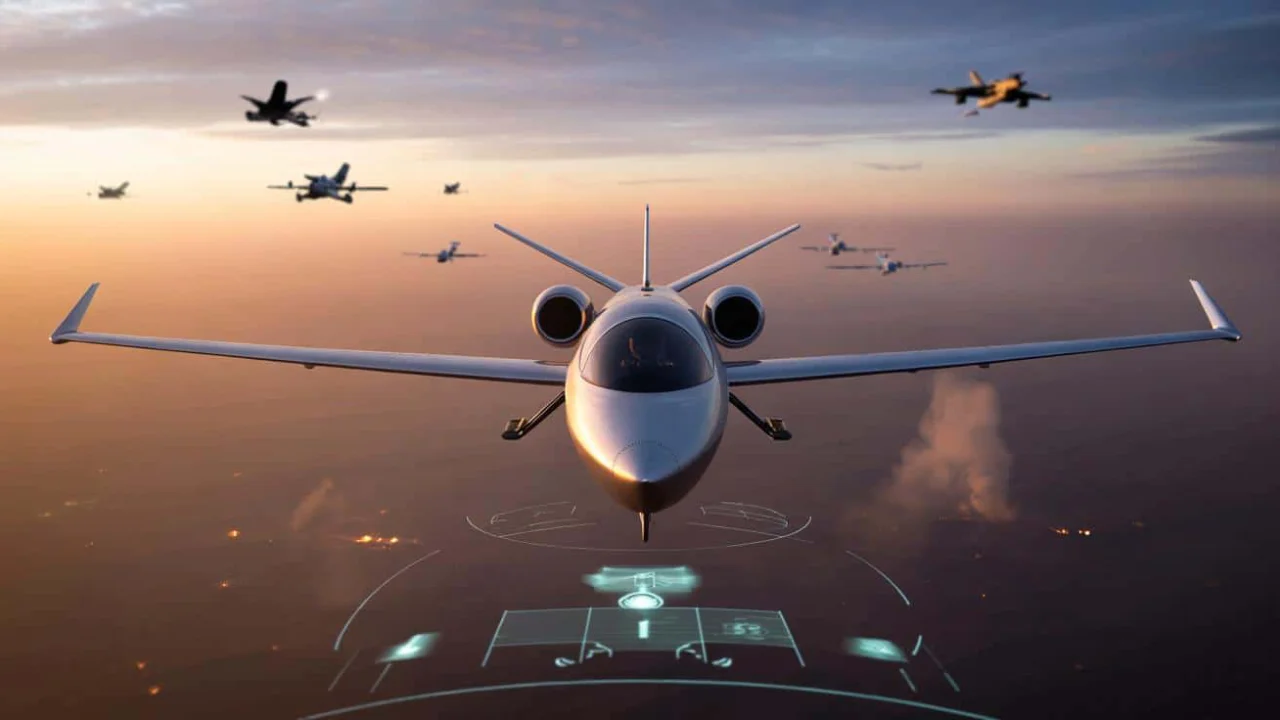
Captain Sarah Martinez watched through her binoculars as three small dots appeared on the horizon, moving faster than birds should move. Her radio crackled to life: “Multiple drones approaching from the northeast.” Just eighteen months ago, she would have reached for expensive missiles or called in air support. Today, she simply nodded to her crew chief, who pressed a button inside their Stryker vehicle.
No explosion followed. No smoke trail streaked across the sky. The three dots simply stopped moving and fell like stones into the desert sand below. “Targets neutralized,” came the calm voice from inside the armored vehicle. Sarah had just witnessed America’s newest laser weapon system in action—a technology that’s quietly revolutionizing how armies think about air defense.
This isn’t science fiction anymore. The DE M-SHORAD system mounted on Stryker vehicles is destroying drones with invisible beams of concentrated light, and it’s doing so at distances that would make traditional gunners jealous.
When Star Wars Technology Meets Real Battlefields
The Stryker 8×8 armored vehicle looks ordinary from the outside. Soldiers have been using these workhorses across Europe and the Middle East for years. But mount a 50-kilowatt solid-state laser weapon on its roof, and you’ve got something that would make Luke Skywalker proud.
The DE M-SHORAD (Directed Energy Maneuver – Short Range Air Defense) system turns any Stryker into a silent drone killer. Recent tests in Oklahoma proved the system can track and destroy unmanned aircraft at ranges beyond 5 kilometers—all without making a sound.
“The laser focuses energy on the most vulnerable parts of a drone,” explains former Air Defense Artillery officer Colonel James Patterson. “Wings, sensors, propellers—these components can’t handle sustained heat. A few seconds of focused energy and the drone simply stops working.”
Unlike traditional missile systems, the laser weapon can engage multiple targets in rapid succession. The crew stays buttoned up inside the vehicle while the system silently eliminates threats overhead. To anyone watching from a distance, the Stryker appears to be doing nothing at all.
The Numbers Behind America’s Silent Drone Hunter
Here’s what makes this laser weapon system so revolutionary for modern warfare:
| Feature | Specification | Advantage |
|---|---|---|
| Range | 5+ kilometers | Engages threats before they reach critical areas |
| Power Output | 50 kilowatts | Sufficient to disable most small aircraft |
| Ammunition Cost | Price of diesel fuel | Eliminates expensive missiles for cheap targets |
| Engagement Time | 2-5 seconds per target | Rapid-fire capability against drone swarms |
| Noise Level | Silent operation | Doesn’t reveal position to enemies |
The system’s power comes from lithium nickel cobalt aluminum batteries stored inside the Stryker. A diesel generator continuously recharges these batteries, creating what military engineers call “infinite ammunition” as long as fuel lasts.
Key operational advantages include:
- No physical projectiles to store or transport
- Invisible beam gives no warning to approaching threats
- Can engage multiple targets without reloading
- Silent operation maintains tactical stealth
- Weather-resistant operation in various conditions
“Traditional air defense meant carrying expensive missiles that cost more than the drones they’re shooting down,” notes defense analyst Dr. Rebecca Torres. “This laser weapon flips that equation completely.”
Why This Changes Everything for Future Warfare
The economics of drone warfare have created a massive headache for military planners. Enemy drones can cost a few hundred dollars to build, but the missiles used to destroy them often cost six figures. Do the math on a swarm attack with dozens of cheap drones, and you’ll see why generals are excited about laser weapons.
The DE M-SHORAD system solves this cost imbalance. Each “shot” costs roughly the same as a few liters of diesel fuel—maybe a couple of dollars instead of thousands. The laser weapon can fire repeatedly without depleting expensive ammunition stockpiles.
This technology also addresses the growing threat of drone swarms. Traditional missile systems need time to reload between shots. The laser weapon can pivot from target to target almost instantly, making it ideal for scenarios where dozens of drones approach simultaneously.
“We’re seeing drone attacks in Ukraine, Gaza, and other conflict zones where cheap unmanned aircraft overwhelm traditional defenses,” explains former Pentagon official Dr. Michael Chen. “Laser weapons give defenders a way to fight quantity with quality.”
The silence factor adds another tactical advantage. Traditional air defense systems announce their presence with loud explosions and visible missile trails. The laser weapon operates invisibly, allowing defenders to eliminate threats without revealing their positions.
Real-World Impact Beyond the Battlefield
This laser weapon technology isn’t just changing military tactics—it’s reshaping entire defense strategies. Countries investing in swarm drone attacks may need to recalculate their approach when facing silent, cost-effective laser defenses.
The system’s effectiveness could influence international arms sales and defense partnerships. Nations with advanced laser weapon capabilities may find themselves in higher demand as security partners.
For military personnel, the technology reduces the logistical burden of ammunition resupply in combat zones. Troops no longer need to worry about running out of expensive missiles during extended engagements.
“This represents a fundamental shift in how we think about air defense,” observes retired General Patricia Williams. “When your ammunition is essentially unlimited and each shot costs pennies, you can afford to engage every threat, no matter how small.”
The quiet operation also benefits civilian areas near military installations. Unlike explosive intercepts that create noise and debris, laser weapon engagements happen silently and cleanly.
Looking ahead, successful deployment of these systems could accelerate development of more powerful laser weapons for larger threats. The technology proves that directed energy systems work in real-world conditions, potentially opening doors to anti-missile and anti-aircraft applications.
FAQs
How does the laser weapon actually destroy drones?
The laser focuses intense heat on critical drone components like sensors, wings, or propellers, causing them to malfunction or burn through within seconds.
Can the laser weapon work in bad weather?
Heavy rain or thick fog can reduce effectiveness, but the system remains operational in most weather conditions that allow normal military operations.
How many drones can one Stryker vehicle engage?
As long as fuel lasts for the generator, the system can theoretically engage unlimited targets since it doesn’t use traditional ammunition.
Is the laser visible to the human eye?
No, the laser operates at wavelengths invisible to human vision, making the beam undetectable without special equipment.
How much does each laser shot cost compared to a missile?
Each laser engagement costs roughly equivalent to a few liters of diesel fuel, compared to missiles that can cost $100,000 or more.
Can enemies detect when the laser weapon is being used?
The silent, invisible operation makes detection extremely difficult without specialized sensors, giving defending forces a significant tactical advantage.