
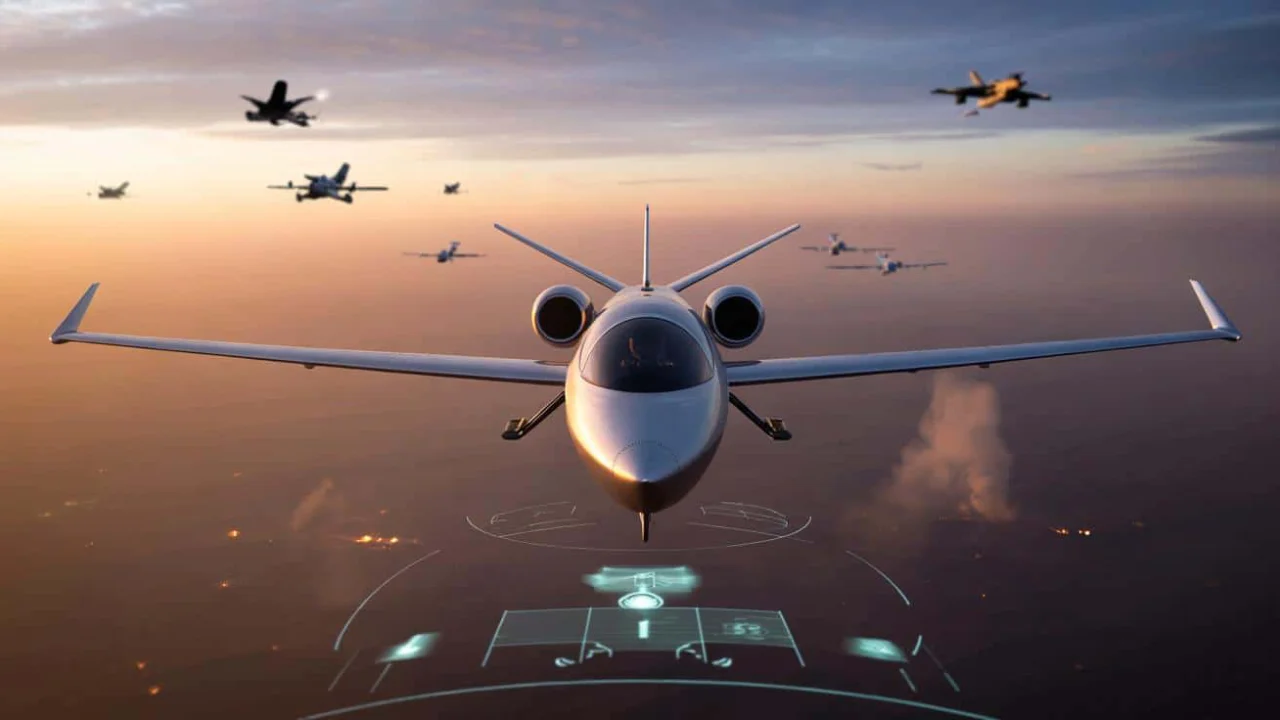
Lieutenant Sarah Martinez gripped the control stick of her F-16, watching the radar screen light up with enemy contacts. But something felt different this time. Flying alongside her wasn’t another pilot—it was an autonomous combat drone, making split-second tactical decisions without any human input. As enemy missiles streaked toward them, the drone executed a perfect defensive maneuver she’d never seen before, saving both their lives.
That scenario isn’t science fiction anymore. It’s happening right now in military test facilities around the world, and it’s about to change everything we know about air combat.
The age of fully autonomous combat drones has quietly arrived, and it’s moving faster than anyone expected. What started as remote-controlled aircraft requiring constant human oversight has evolved into something that can think, react, and fight entirely on its own.
The Vanguard: A Wolf in Sheep’s Clothing
At first glance, the Model 437 “Vanguard” looks like any corporate jet you might see at a private airport. But this unassuming aircraft, built by Scaled Composites and Northrop Grumman, represents a revolutionary leap in military technology.
The Vanguard is what engineers call an “optionally piloted” aircraft. That means it can operate with a human pilot on board, or it can fly completely autonomously, controlled entirely by artificial intelligence. This flexibility makes it the perfect testing ground for the next generation of combat autonomy.
“We’re not just building another drone,” explains Dr. James Patterson, a former Air Force test pilot now working on autonomous systems. “We’re creating a platform that can evolve and learn, adapting to new threats in real-time without human intervention.”
Northrop Grumman has turned the Vanguard into the centerpiece of their “Beacon” initiative—essentially an airborne app store for combat AI. Instead of building a new autonomous combat drone for every military application, companies can now plug their software directly into this single platform and test it under real flying conditions.
This approach treats the aircraft itself as reusable hardware while the autonomy software becomes the real product. The result? Development cycles that used to take years can now be completed in months.
Breaking Speed Records in Development
Here’s what should make every military planner take notice: the Vanguard went from concept to flying hardware in just 21 months. In an industry where new aircraft typically take a decade or more to develop, that timeline is nothing short of revolutionary.
The secret weapon behind this speed is something called “digital engineering.” Every component of the aircraft was designed, tested, and virtually assembled in computer software before anyone touched actual metal.
| Traditional Development | Digital Engineering Approach |
|---|---|
| 10+ years concept to flight | 21 months concept to flight |
| 15-20% of parts need rework | Less than 1% of parts need changes |
| Multiple physical prototypes | Single digital twin model |
| Extensive testing phases | Virtual testing and validation |
The results speak for themselves. Fewer than 1% of wing parts needed changes after manufacturing, compared to the traditional 15-20% that would normally require reworking. Parts arrived at the factory already perfectly matched to their neighboring components, eliminating costly alignment errors and lengthy re-machining processes.
“The precision we’re achieving through digital engineering is game-changing,” notes Maria Rodriguez, a defense industry analyst. “We’re seeing error rates drop to levels that were impossible just five years ago.”
Technical Specifications That Pack a Punch
Don’t let the business jet appearance fool you—the Vanguard is built for serious combat applications. The aircraft measures approximately 12.5 meters in length with a similar wingspan, powered by a Pratt & Whitney 535-series engine that delivers more than 15,000 newtons of thrust.
But the real innovation lies in its modular design philosophy. Key features include:
- Flexible payload bay that can accommodate various weapon systems
- Advanced sensor packages for autonomous target identification
- High-bandwidth data links for swarm coordination
- Redundant AI processing systems for mission-critical decisions
- Electronic warfare capabilities for hostile environment operations
The autonomous combat drone can operate in contested airspace where human pilots might be overwhelmed by the speed and complexity of modern threats. Its AI systems can process thousands of data points per second, making tactical decisions faster than any human could react.
Reshaping Military Strategy and Global Power
The implications extend far beyond just having another type of military aircraft. Autonomous combat drones are fundamentally changing how nations think about air power and military strategy.
Countries can now field sophisticated air assets without risking pilot lives or requiring years of expensive pilot training. A single operator could potentially manage multiple autonomous combat drones simultaneously, multiplying force effectiveness while reducing personnel requirements.
“We’re witnessing the biggest shift in air combat since the introduction of jet engines,” argues retired General Michael Thompson, who oversaw drone operations during his military career. “Nations that master this technology first will have a decisive advantage.”
The economic implications are equally significant. Traditional fighter jets cost hundreds of millions of dollars each and require extensive support infrastructure. Autonomous combat drones, while still expensive, offer better cost-effectiveness and can operate from more austere bases with minimal support staff.
However, this technological leap also raises serious questions about accountability and rules of engagement. When an autonomous combat drone makes a life-or-death decision without human input, who bears responsibility for the consequences?
International military experts are scrambling to develop new doctrines and treaties to govern the use of fully autonomous weapons systems. The technology is advancing faster than the legal and ethical frameworks designed to control it.
What This Means for the Future of Warfare
We’re standing at the threshold of a new era in military aviation. The combination of rapid development cycles, modular AI systems, and autonomous decision-making capabilities is creating possibilities that seemed like science fiction just a few years ago.
Military forces worldwide are taking notice. The U.S. Air Force has already begun incorporating similar digital engineering approaches into other major programs, including the B-21 Raider stealth bomber. This suggests that the Vanguard’s development model is becoming the new standard for military aviation projects.
The ripple effects will likely extend to civilian aviation as well. Technologies developed for autonomous combat drones often find their way into commercial applications, potentially revolutionizing everything from cargo delivery to passenger transport.
As Lieutenant Martinez discovered in her training flight, the future of air combat isn’t about replacing human pilots entirely—it’s about creating partnerships between human intelligence and artificial intelligence that are more effective than either could be alone.
FAQs
How does an autonomous combat drone make decisions without human input?
The drone uses advanced AI algorithms that process sensor data in real-time, comparing situations against vast databases of tactical scenarios to make split-second decisions about targets and threats.
Can autonomous combat drones be hacked or controlled by enemies?
Modern autonomous drones include multiple layers of cybersecurity protection and can operate independently even if communications are jammed, though no system is completely immune to sophisticated cyber attacks.
How fast can these drones be produced compared to traditional fighter jets?
Using digital engineering methods, autonomous combat drones can be developed in 21 months versus 10+ years for traditional aircraft, dramatically accelerating military modernization timelines.
What happens if an autonomous drone makes a mistake and hits the wrong target?
This remains one of the biggest challenges in autonomous weapons development, with military and legal experts still working to establish clear accountability frameworks and rules of engagement.
Will autonomous combat drones completely replace human pilots?
Rather than replacement, the focus is on creating human-AI partnerships where autonomous drones work alongside human pilots, each contributing their unique strengths to mission success.
How much do these autonomous combat drones cost compared to traditional fighter jets?
While still expensive, autonomous drones typically cost significantly less than manned fighters and require much smaller support crews, making them more cost-effective for many military applications.


