
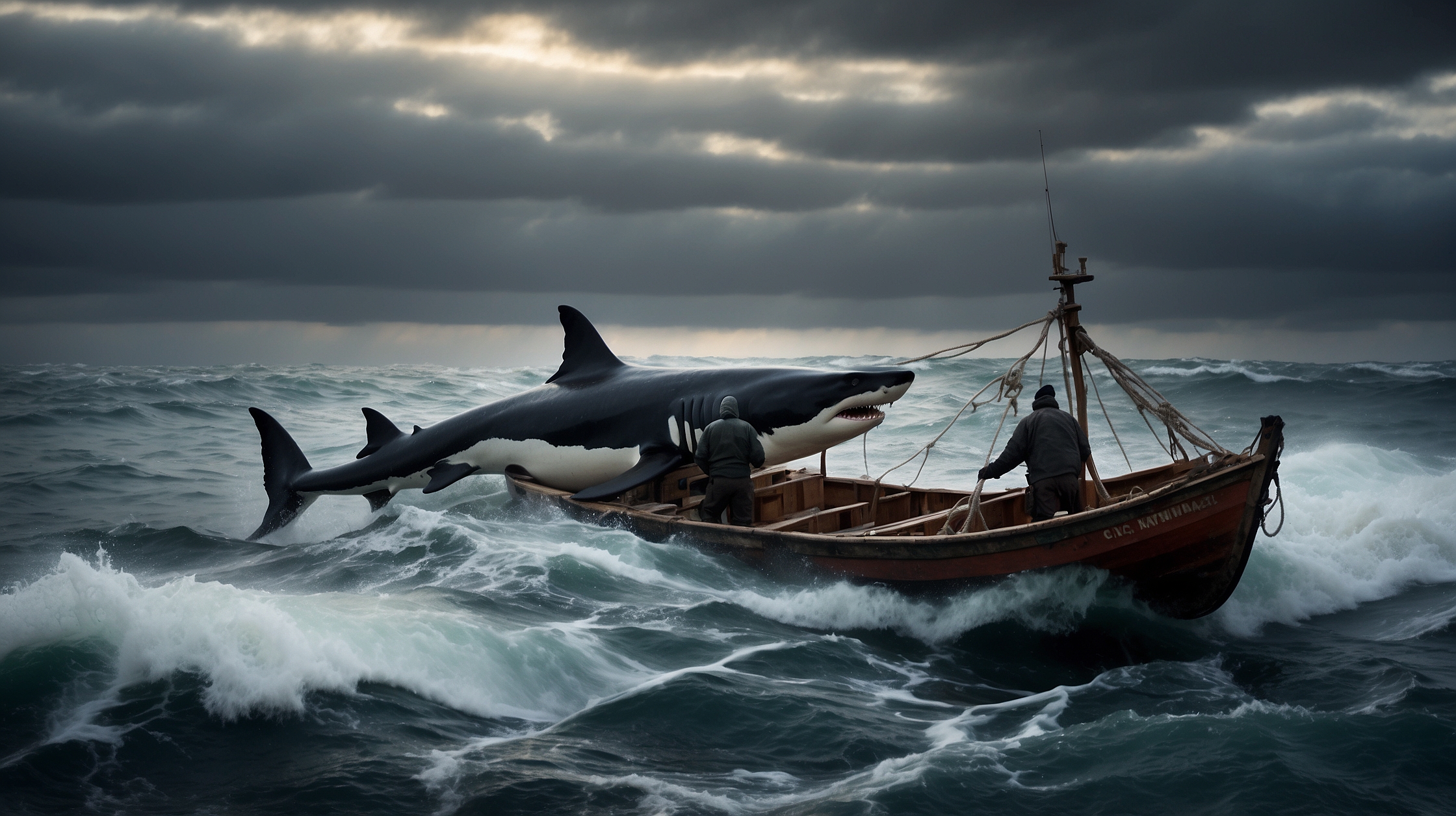
The high seas have once again become a stage for a bizarre and terrifying mystery, this time involving a supposed shark attack that was later blamed on a group of killer whales, causing marine experts and sea captains alike to raise serious questions. In a jaw-dropping incident near the coast, fishermen initially reported a massive shark attack that severed their anchor rope, only for subsequent investigations and viral footage to suggest that a pod of orcas might actually be responsible. The discrepancy has sparked public disbelief, with the fishermen being accused of fabrication as marine biologists and the wider boating community delve deeper into what appears to be a case of mistaken marine identity or potentially even a purposeful cover-up.
The chaos unfolded during what was supposed to be a routine fishing expedition when a dramatic event turned the crew’s calm operation into a frenzied scramble. As tensions climbed and footage began circulating, accusations flew — were the fishermen trying to avoid liability or legal scrutiny? Or were they genuinely caught off guard by an evolution in orca behavior that the scientific community has failed to keep up with? The unsettling episode has raised concerns regarding increasing aggressive interactions between marine predators and human vessels, contributing to a gathering storm of debate and skepticism online and at maritime regulatory boards.
Key details from the mysterious marine encounter
| Detail | Description |
|---|---|
| Incident Location | Coastal waters, exact coordinates undisclosed for vessel safety |
| Initial Claim | Anchor rope severed by a shark |
| Revised Explanation | Pod of orcas believed to be responsible |
| Evidence | Viral video footage, crew testimonies, marine damage analysis |
| Current Investigation | Joint review by marine biologists and coast guard associations |
The video that changed everything
Initially brushed off as an unfortunate yet not uncommon shark encounter, the story took a sharp turn when a viral video began circulating on social media platforms showing glimpses of the encounter. The short clips appeared to show multiple dorsal fins breaching the surface, followed by strange movements consistent with orca behavior rather than sharks. This caused a firestorm of speculation, forcing the fishermen to publicly revise their claim — something that did not sit well with either maritime authorities or public opinion.
According to marine damage specialists, the frayed patterns on the broken rope resemble more of the blunt trauma that killer whales can inflict using their enormous jaws and social coordination, rather than the sharp, serrated cuts typically associated with sharks. This evidence added fuel to the already growing speculation, leading to a formal investigation to determine what really unraveled at sea that day.
“This isn’t the first time we’ve seen orcas interact aggressively with boats, but this case is particularly bold… or odd based on the conflicting stories.”
— Dr. Emily Santos, Marine Biologist
A deeper look at recent orca behavior shifts
Recent years have showcased a noticeable increase in abnormal orca behavior, especially among pods in the North Atlantic. Several ship captains have reported coordinated attacks on rudders, anchor chains, and even hulls. Although rare, such aggression is becoming increasingly documented by researchers and has led to ongoing studies into whether environmental changes or food scarcity may be fueling behavioral changes in these apex predators.
In this specific case, the orcas demonstrated an unusually focused effort on the anchor system, something that could suggest past experiences or even learned behavior from prior interactions with fishing vessels. Evidence now suggests these intelligent creatures are displaying increasingly strategic behavior, perhaps treating boats as threats or obstacles in their hunting grounds.
“We have underestimated just how intelligent and adaptive orcas are. They’re learning faster than we can research them.”
— Dr. Mitchell Lane, Cetacean Specialist
Why the fishermen changed their story
The shift in the fishermen’s narrative — from shark to orca — has opened the door to a brutal wave of criticism. Initially trying to downplay the incident may have been an attempt to avoid liability or an overstep in judgment made amid panic. However, once visual evidence emerged, the cover no longer held. The coast guard has not ruled out penalizing the crew for misreporting potentially dangerous marine navigation hazards, though no formal charges have been suggested yet.
According to members of the crew, fear and lack of clarity in the moment led them to assume a shark was responsible, as sharks are a more commonly reported hazard. But as one crew member noted, “The way it happened — and how quickly — we weren’t thinking clearly. We saw the aftermath, and it looked like a bite. Seeing the video later shocked us more than anyone.”
“When you add public scrutiny and digital media to the mix, it’s no longer just about reporting an incident — it’s about answering to the global courtroom.”
— Karen Blake, Maritime Policy Analyst
Impact on regional fisheries and boaters
This event has not only stirred curiosity but also fear among other commercial and recreational seafarers. Maritime associations in the region are issuing advisories on potential orca interactions and urging all captains to record and report unusual behavior to the central marine observatory. Insurance firms are likewise taking a second look at coverage for such incidents, especially given the increasing prevalence of orca-centric claims in policy renewals across the North Atlantic and specific Pacific routes.
Even though no one was injured in this particular altercation, the aggressive nature of the event situates it among a concerning trend. Additional emphasis is being placed on training fishermen and other boat operators on how to deter orcas using non-harmful methods and noise disruptors while minimizing net and rope exposure during docking maneuvers.
Winners and losers from the evolving orca encounters
| Winners | Losers |
|---|---|
| Marine researchers gaining more data from incidents | Fishermen facing public backlash and credibility issues |
| Conservation groups highlighting the need for species protection | Insurers seeing rising claims and unanticipated liabilities |
| Media outlets benefiting from viewer interest and engagement | Local tourism operators concerned about boat safety perception |
What this could mean for global maritime policies
As more cases stack up, governments may be pressured into amending maritime safety rules to account for evolving behavioral patterns in marine wildlife. Current frameworks largely blame human error for such incidents, but this event might highlight a new classification: wildlife aggression. If such a category is formalized, it could revolutionize insurance claims, maritime law, and risk management protocols on a global scale.
International bodies such as the IMO (International Maritime Organization) may need to revisit navigation codes, especially for vessels operating in known whale migration paths. Regulations requiring real-time wildlife tracking and interoperability between research organizations and commercial fleets may soon be under discussion.
“This is not about blaming fishermen or orcas — it’s about creating a system that can interpret what’s happening out there and adapt safety measures accordingly.”
— Janus Field, Maritime Risk Council Chair
Frequently asked questions (FAQs)
What actually damaged the anchor rope?
While the initial report blamed a shark, video analysis and expert reviews suggest that a pod of orcas may have been responsible by attacking or entangling the rope deliberately.
Why would orcas attack a fishing boat?
Orcas might perceive boats as competitors for food or may be demonstrating learned behavior from increasing interactions with human vessels.
Are orca attacks on boats common?
They are still considered rare, but such encounters have been increasing over the past few years, especially in certain geographic zones like the North Atlantic and Iberian waters.
Could this have been a coordinated orca behavior?
Yes, orcas are highly intelligent and social animals capable of coordinating attacks or maneuvers, especially those targeting boat components like rudders or anchors.
Is anyone penalizing the fishermen for changing their story?
No formal penalties have been imposed yet, but authorities are considering whether misreporting falls under any actionable maritime regulations.
How can boats protect themselves from such incidents?
Using acoustic deterrents, avoiding known pod regions, and reducing exposed equipment in orca-dense areas are current best practices recommended by experts.


