
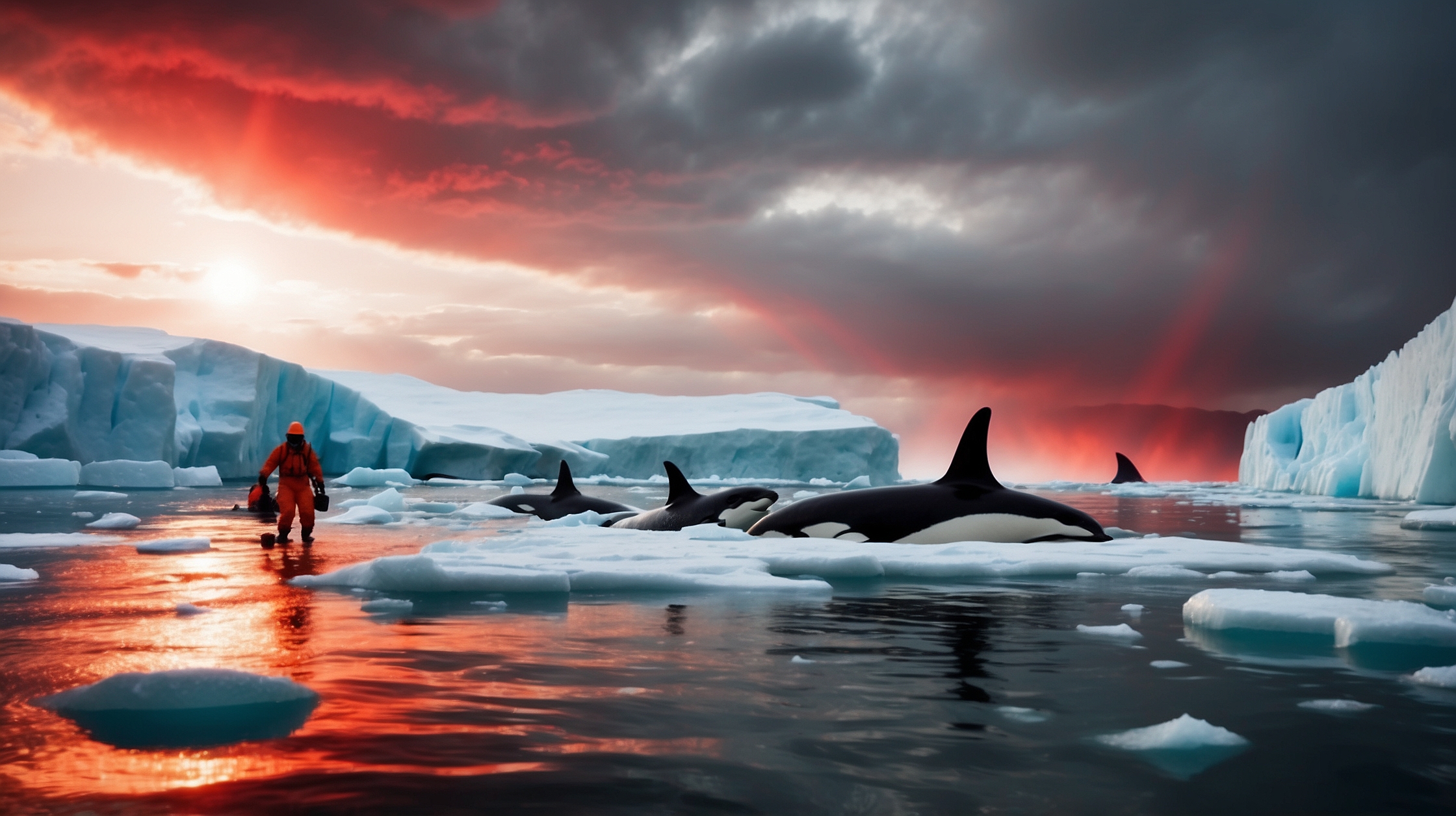
A state of emergency has been declared in Greenland following unprecedented sightings of orcas breaching near rapidly melting ice shelves. The sudden presence of these apex predators so close to fragile glacial zones has triggered alarm among scientists, local authorities, and global climate observers. The sightings mark a deeply unsettling shift in the Arctic ecosystem, driven by increasing temperatures and accelerated ice melt due to climate change.
Researchers stationed near the Sermersooq region first identified unusual orca activity during the early spring melt, a time when these waters would traditionally remain covered with thick, impenetrable ice. This alarming development underscores how fast the Arctic is transforming. Orcas, typically seen in sub-Arctic waters, are venturing further north—drawn by open waters and shifts in marine prey populations that are moving as a result of ocean warming.
Greenlandic authorities responded swiftly, issuing an emergency decree that places conservation and research teams on high alert. There are now real concerns that these changes could destabilize already vulnerable ice shelves and disrupt traditional marine life patterns critical to both indigenous communities and global ecological stability.
What we know so far about the Greenland orca emergency
| Event | Emergency declared in Greenland due to orca sightings near melting ice shelves |
|---|---|
| Location | Eastern coastline near Sermersooq, Greenland |
| Timeline | Early Spring through mid-May 2024 |
| Species Involved | Orcinus orca (killer whale), local seal species, narwhals |
| Main Concern | Rapid climate change enabling orca intrusion into glacial habitats |
| Ecological Impact | Potential collapse of marine food webs, ice shelf destabilization |
| Authorities Involved | Greenland Government, Arctic Marine Research Coalition, Local Inuit Councils |
What changed this year
The influx of orcas into Greenland’s high Arctic waters is not merely a surprising occurrence—it’s a symptom of a much broader environmental crisis. Historically, killer whales have been restricted by the thick Arctic sea ice dividing the northern tip of Greenland from open ocean fisheries. But in 2024, satellite imaging and on-site monitoring recorded earlier and more aggressive thawing of key ice shelves.
The Sermilik and Helheim glaciers shed ice at volumes 12% higher than typical spring averages. Warmer sub-surface seawater, mostly originating from Atlantic currents that are now reaching further north, is rapidly thinning the base of these ice masses. This reduction in ice has opened navigable channels previously impassable by large marine mammals like orcas.
“We are observing predators entering domains where they’ve never been dominant before. What concerns us most is what this means for glacial erosion and species displacement.”
—Dr. Annika Søndergaard, Glaciologist, Arctic Marine Research Coalition
Why orcas pose special risks in fragile Arctic regions
Orcas are known for their intelligence and coordinated hunting tactics. In their typical habitats, they control the top of the food chain. In the Arctic, their sudden appearance poses a direct threat to endemic species such as narwhals, seals, and Arctic cod—many of which have few defenses against such efficient predators.
The entry of orcas is also linked to glacial destabilization. When marine predators breach coastal hunting zones near the base of ice shelves, their movements result in under-ice disturbances, potentially provoking faster breakups of already vulnerable ice sheets. In regions where these glaciers serve as freshwater reservoirs and habitat stabilizers, the consequences can be exponential.
The rapid northward expansion of marine predators
This year, orca sightings were reported as far north as Scoresby Sound—an expanse that has traditionally been frozen year-round. Marine biologists now confirm that key species such as mackerel and herring have also moved northward, chased by warmer ocean temperatures. This climate-induced prey shift further incentivizes predators like orcas to migrate beyond their historical ranges.
“This is not just a biological shift—it’s a planetary red flag. These changes in migratory routes and feeding grounds are fundamentally rewriting Arctic ecology.”
—Luis Reinhardt, Marine Ecologist, Nordic Climate Institute
With rising ocean temperatures of up to 2.1 degrees Celsius above historical norms in some fjords this year, the food web is being reorganized at an alarming pace. This poses serious threats to biodiversity and endangers long-standing ecological equilibria.
Implications for Greenland’s Indigenous communities
For native Greenlandic communities, marine life is not merely an environmental concern—it is central to identity, lifestyle, and livelihood. The hunting of seals and narwhals, regulated through traditional quotas, provides a major source of food and culture. The invasion of orcas places unusual stress on these traditions.
Local hunter associations have already reported decreased sightings of narwhals, whom they believe are fleeing to deeper and less accessible fjords to avoid predatory pods. Furthermore, the increased risk of glacial calving makes certain sea routes dangerous or entirely inaccessible for community fishing and transport.
“The landscape we’ve depended on for centuries is vanishing before our eyes. We may not recognize Greenland’s coasts in a few years.”
—Mikka Aqqaluk, Spokesperson, Inuit Circumpolar Council
Emergency measures being implemented
In response to mounting threats, Greenland’s emergency declaration includes new research funding, glacial monitoring, and predator tracking initiatives. Drones and sonar buoys have been deployed to monitor orca pods and their impact on sensitive marine zones. Air and sea patrols are being coordinated with conservation groups to track shifts in iceberg mobility and marine mammal populations.
Additionally, the government has initiated dialogue with Indigenous councils to incorporate traditional knowledge into ecosystem management strategies. Proposals are on the table to temporarily restrict certain fishing and hunting routes to protect both humans and animals from unintended conflict during this ecological transition.
Ecological winners and losers in Greenland’s shifting climate
| Winners | Losers |
|---|---|
| Orcas (expanded feeding grounds) | Narwhals (being hunted out of native zones) |
| Atlantic fish species moving north (e.g., herring) | Seals and sea birds dependent on ice-edge ecology |
| Warmer-water microorganisms | Ice algae, plankton species sensitive to temperature shifts |
| Shipping and potential mineral exploration interests | Indigenous community traditions and food security |
What lies ahead for Greenland and the wider Arctic
With global climate models predicting even greater ice loss in coming years, the Arctic is at a crucial inflection point. What was once another warning scenario is now unfolding in real time. As warming accelerates, scientists expect more tropical and temperate species to reach the Arctic waters, further altering the delicate balance of ecosystems.
While emergency protocols and increased research investments offer some hope, experts urge for urgent international climate cooperation to reduce emissions, protect fragile zones, and support the communities and species already affected by this transformation.
Frequently Asked Questions
Why are orcas being seen near Greenland’s melting ice shelves?
Due to rising temperatures and rapid sea ice melt, orcas are gaining access to Arctic regions previously unreachable. They’re following prey species that have also migrated further north due to warming waters.
Is Greenland’s ecosystem at immediate risk from orca activity?
Yes. The presence of orcas disrupts existing food chains and can contribute to stress on vulnerable species like seals and narwhals. It may also indirectly impact ice shelf stability.
What does the emergency declaration in Greenland involve?
It includes enhanced monitoring of marine predators, funding scientific research, deploying surveillance technologies, and coordinating with Indigenous groups to mitigate ecological and cultural impacts.
How does this affect Indigenous Greenlandic communities?
The shift in marine species already threatens traditional hunting practices and food security. Travel routes across ice are also becoming increasingly dangerous due to unpredictable calving.
Are these changes really due to climate change?
Yes. Most scientists agree that Greenland’s increasingly warm waters and rapid ice shelf melting are directly tied to human-induced climate change and global warming patterns.
Could this pattern spread to other Arctic regions?
Absolutely. Neighboring Arctic zones, particularly in Northern Canada and Siberia, are likely to see similar ecological shifts as ice coverage continues to decline yearly.


