
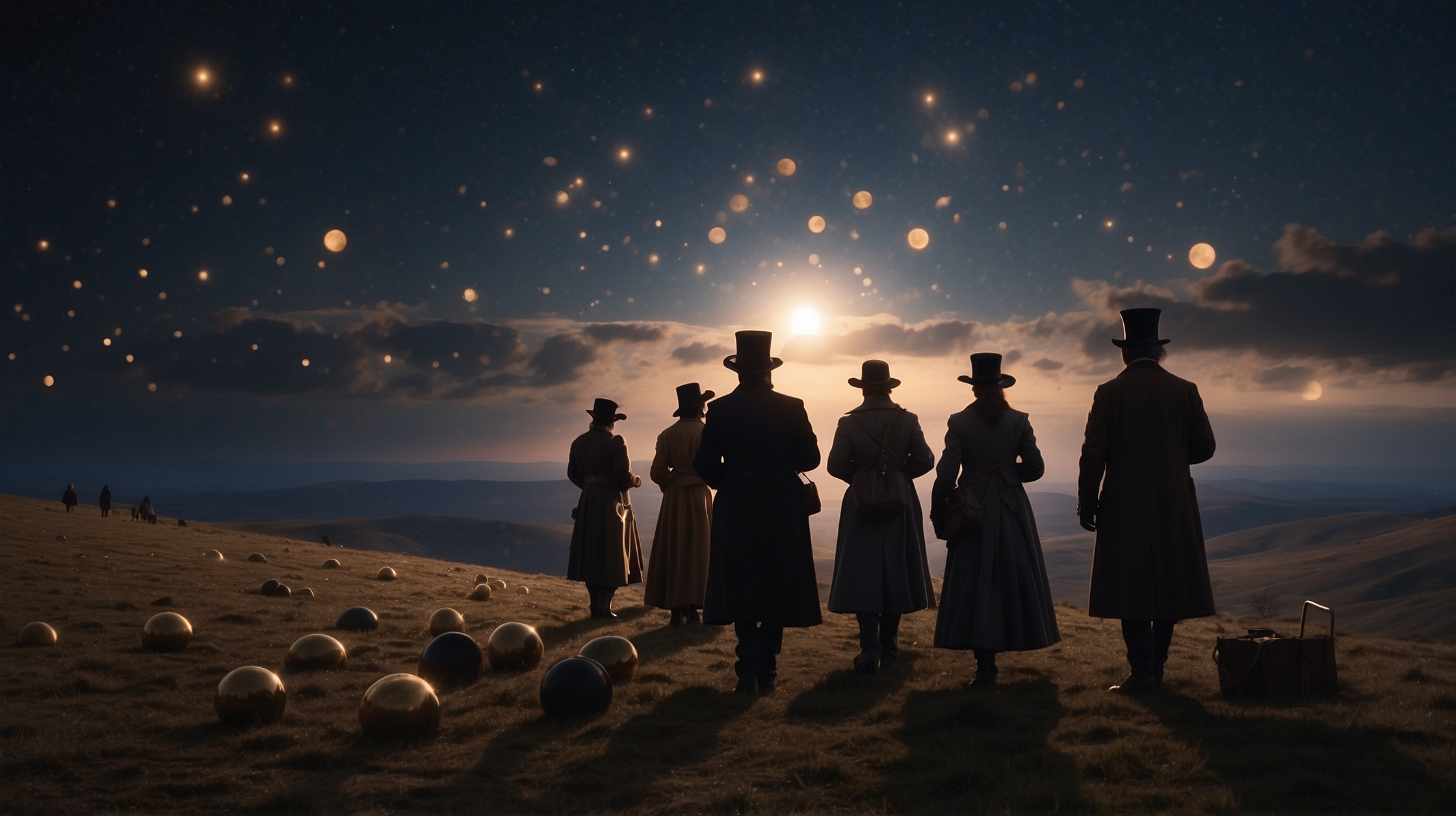
The total solar eclipse that swept across southern Europe and northern Africa on December 22, 1870, continues to captivate scientists and historians alike, more than 150 years later. Often referred to as the “Eclipse of the Century,” this celestial spectacle not only dazzled viewers with its visual grandeur, but it also marked a pivotal moment in astronomical science. Researchers now acknowledge that the 1870 eclipse was a foundational milestone that spurred technological advances, reshaped observational strategies, and solidified the astronomical community’s role in public education and international collaboration.
Despite photography being in its early stages and scientific instruments still developing, astronomers made bold attempts to capture and analyze the eclipse. Their efforts brought critical insights into phenomena such as the solar corona and prominences—features of the sun that remain central to solar research today. This particular eclipse also featured dramatic environmental changes, including sudden plunges in daylight and temperature, which sparked further investigations into atmospheric reactions during solar occultations. Today, astronomers continue revisiting this event, not merely for its historical grandeur but for its scientific consequences that laid the groundwork for modern solar studies.
Key facts about the 1870 solar eclipse
| Attribute | Details |
|---|---|
| Date of Eclipse | December 22, 1870 |
| Type | Total Solar Eclipse |
| Regions Affected | Southern Europe, Northern Africa |
| Notable Observers | British Astronomical Team led by prominent scientists of that era |
| Scientific Milestones | Observations of solar corona, prominences, and early eclipse photography attempts |
Why the 1870 eclipse mattered more than most
The 1870 eclipse wasn’t just another solar event—it was a perfect mix of astronomical rarity and scientific opportunity. Coming at a time when the public was becoming increasingly interested in science, it offered researchers a chance to demonstrate the predictive power and observational sophistication of astronomy. The event occurred during a relatively peaceful period in European history, which allowed multiple expeditions to be launched across the continent for maximum coverage.
Scientists used the eclipse as a test case for new methods such as rapid photographic exposure and spectroscopy. Although the technology yielded mixed results, what was learned helped refine eclipse research for decades to come. The British expedition to Sicily, in particular, became notable for its attempts to photograph the “diamond ring effect”—a fleeting phenomenon seen at the beginning and end of totality. While clouds obscured some observations, the expedition’s documentation helped set the precedent for future international efforts to chase eclipses.
Technological efforts and scientific breakthroughs
In 1870, scientists did not have access to modern lenses, digital sensors, or high-speed transportation. Despite these constraints, the eclipse saw unprecedented preparation involving railways, steamships, and a flurry of letters coordinating logistics. For the first time, multiple scientific instruments, including telescopes and cameras equipped with special filters, were used in tandem to capture intricate solar features.
A significant breakthrough was the use of **spectroscopes** to analyze the **solar corona**, an outer atmosphere of the Sun visible only during total eclipses. While the corona’s composition remained a mystery, early spectral data hinted at the presence of unknown elements, paving the way for later discoveries such as **coronium**—a phenomenon later explained through highly ionized iron.
“The eclipse of 1870 marked the beginning of a new era. It was the first time we systematically approached celestial events using precision instruments.”
— Dr. Alan Crossfield, astronomer and eclipse historian
Impact on public engagement and science communication
Another noteworthy aspect of the 1870 eclipse was its **impact on public understanding of science**. Newspapers, pamphlets, and public lectures flourished in the months leading up to the event. For many people in Europe and parts of Africa, it was the first time they were encouraged to witness a natural phenomenon not as superstition, but as a predictive marvel of science.
Educational events were organized at observatories, town halls, and universities. Scientists published detailed guides on how to observe the eclipse safely using makeshift pinhole viewers or colored glass—decades before commercial eclipse glasses became common. These actions set a template for how scientific communities engage with the public during astronomical events even today.
Challenges faced by the observing teams
Despite their meticulous planning, the teams involved in observing the 1870 eclipse encountered numerous obstacles. The expedition to **Sicily**, for example, was thwarted by **heavy cloud cover**, forcing rushed adjustments in instruments and limited visibility during the peak of totality. Other teams stationed across **Spain** and **Algeria** faced similar meteorological threats, highlighting the **unpredictability** of field-based astronomy.
Logistical issues further complicated matters. One British team’s **equipment was delayed at customs**, preventing setup in time for key moments of totality. Ironically, these difficulties underscored the importance of **redundancy in scientific missions**, a lesson still applied by modern NASA launch protocols and global eclipse coordination teams.
“We may consider the 1870 eclipse as a prototype of planetary-scale observational science. With dozens of teams dispersed and synchronized, it was one of the earliest examples of international space collaboration—even if Earth-bound.”
— Professor Mireille DuPont, Director of Solar Sciences, Paris Observatory
The legacy in modern solar astronomy
Though the 1870 solar eclipse passed centuries ago, its echoes are found in every major **solar research initiative** that followed. The attempts to record the shape and changes in the solar corona inspired intensified research during subsequent eclipses in 1900, 1919 (which famously confirmed Einstein’s theory of general relativity), and into contemporary space-based observatories like the Solar and Heliospheric Observatory (SOHO).
Furthermore, the interdisciplinary nature of the observations helped pioneer how **astronomy intersects with meteorology, photography, and physics**. Today, sophisticated simulations used to understand plasma dynamics and sunspot formation owe their groundwork to data collected under much less favorable conditions—some of it dating back to that very 1870 eclipse.
Winners and losers of the 1870 eclipse observation
| Winners | Losers |
|---|---|
| Astronomers pushing the frontier of solar science | Observers thwarted by weather conditions |
| Science communicators and educators | Expeditions facing transportation or customs delays |
| Early adopters of astrophotography | Technologies that failed due to eclipse brevity |
Short FAQs about the 1870 “Eclipse of the Century”
Why is the 1870 eclipse still remembered today?
It was one of the most coordinated early scientific efforts to observe a total eclipse and attempted to integrate photography, spectroscopy, and public science outreach.
Where was the best visibility for the 1870 eclipse?
Southern Europe and parts of Northern Africa, with key observing teams stationed throughout Sicily, Spain, and Algeria.
Did they succeed in photographing the eclipse?
Results were mixed; several teams faced weather issues, but some partial successes laid the foundation for future eclipse imaging.
What scientific discoveries came from this eclipse?
Preliminary spectroscopic data of the solar corona and refined positional astronomy data that improved models of solar motion.
How did the public react to the 1870 eclipse?
The public was highly engaged, aided by growing trust in science. Educational materials and lectures helped citizens approach the event scientifically.
Were there international collaborations during this eclipse?
Yes, multiple countries mobilized expeditions. It marked a significant moment in transnational scientific cooperation.
What challenges did scientists face during the eclipse?
Primarily weather issues, logistical mishaps, and technological limitations surrounding exposure times and atmospheric distortions.
Did the 1870 eclipse lead to lasting scientific practices?
Absolutely. The event helped shape preparedness protocols, methods for multidisciplinary observation, and deeper exploration into solar physics.


