
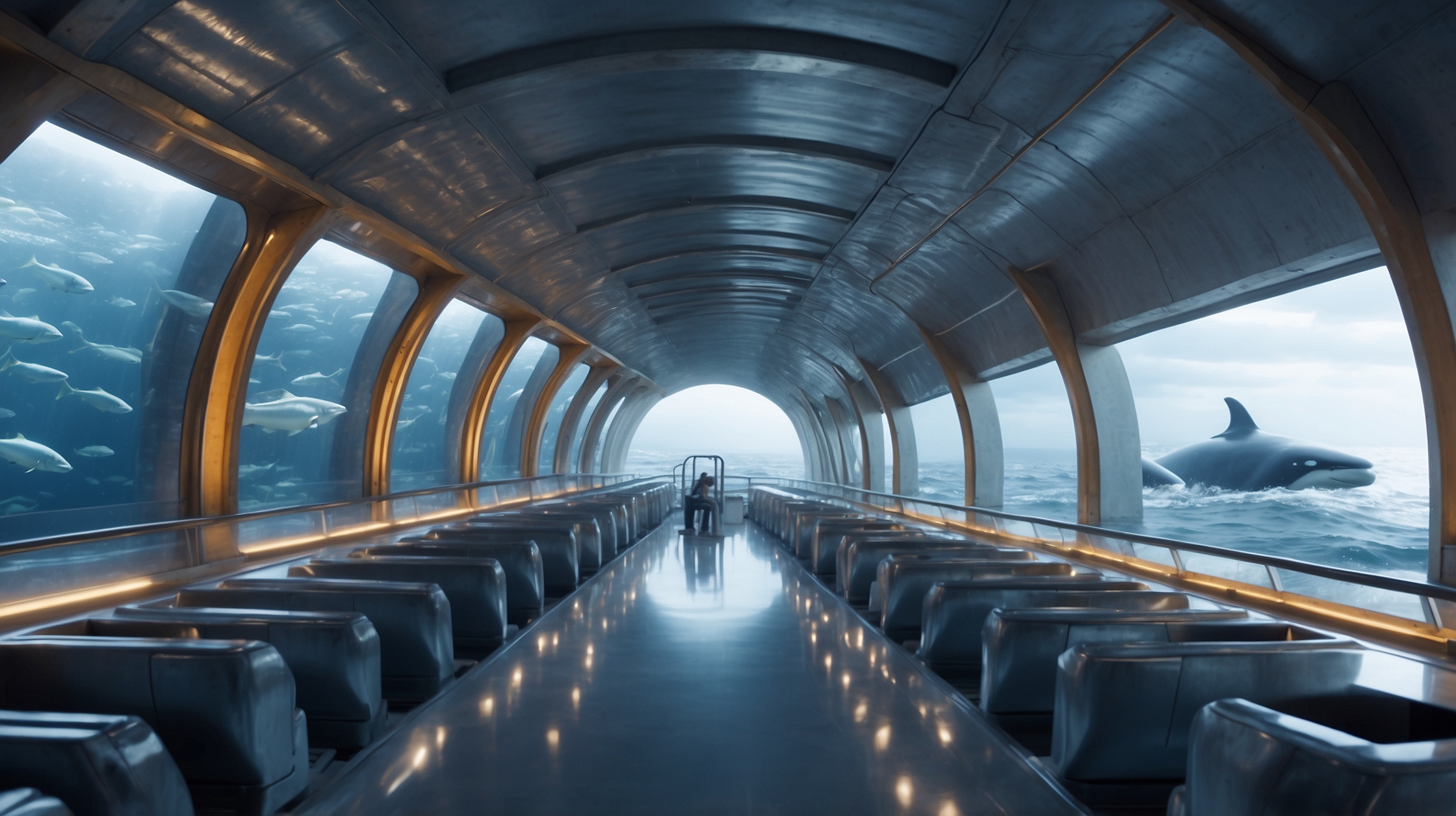
In a bold stride toward the future of transportation, an ambitious infrastructure project is tunneling its way beneath the sea to link two continents with a revolutionary high-speed rail line. Engineers, planners, and international leaders are converging their efforts to carve a path through the watery depths between Europe and Asia—or, more precisely, between mainland China and Taiwan. Although deeply rooted in geopolitical complexities, the project’s technological achievements and transformative potential cannot be overstated.
The planned underwater high-speed rail tunnel would span roughly 135 kilometers, surpassing even the length of the famed Channel Tunnel connecting England and France. Once completed, the tunnel will not only break global engineering records but also redefine the possibilities of regional connectivity and economic integration. Designed to operate at speeds of up to 350 km/h, the underwater route marks a monumental leap in rail transport. The project seamlessly blends cutting-edge tunnel boring technology with high-speed rail ingenuity, presenting a powerful example of how civil engineering can transcend natural and political boundaries.
Overview of the underwater high-speed rail tunnel
| Project Name | Underwater High-Speed Rail Tunnel |
| Purpose | To connect mainland China and Taiwan via high-speed rail |
| Projected Length | Approximately 135 kilometers (84 miles) |
| Top Speed | Up to 350 km/h (217 mph) |
| Status | Under planning and early construction phase |
| Estimated Completion | To be announced; likely beyond 2030 |
| Main Construction Challenge | Deep-sea tunneling and tectonic activity in the Taiwan Strait |
| Key Benefit | Significantly reduced travel time between the two regions |
A marvel of modern engineering
Constructing an undersea tunnel of this magnitude presents a suite of technological challenges. The Taiwan Strait, the location of this proposed corridor, is not just geopolitically sensitive—it is also geologically active. Engineers must address complex seismic conditions, challenging ocean currents, and varying seabed compositions. Innovative tunnel-boring machines (TBMs) equipped with AI monitoring systems are expected to play a pivotal role in neutralizing these hazards.
Moreover, advanced waterproofing materials, shock-resistant tunnel linings, and integrated safety systems are all key components of the proposed architectural design. The tunnel will reportedly feature emergency evacuation pathways, real-time environmental sensors, and cross-passages similar to what exists in other major underwater tunnels but optimized for greater lengths and pressure profiles.
“This project is as much a diplomatic signal as it is an engineering feat. It proves that with political will and modern tools, even the most ambitious connectivity projects are possible.”
— Dr. Emily Zhao, Infrastructure Policy Analyst
What this means for regional trade and mobility
Once operational, the underwater high-speed rail tunnel could serve as a game-changer for trade and passenger transport across East Asia. Currently, passengers and goods traveling between Taiwan and China rely heavily on air and sea routes, which are more susceptible to weather disruptions and logistical delays. High-speed rail promises extremely efficient, low-emission, all-weather connectivity.
Such infrastructure would shorten travel time across the strait to under an hour, enhancing tourism, business travel, and cargo logistics. Economic analysts suggest this could create a ripple effect across regional economies, bolstering sectors like manufacturing, hospitality, and retail through reduced costs and wider market access.
“This tunnel could reshape the economic geography of East Asia, allowing integrated supply chains that rival those of Europe.”
— Prof. Jianwei Liu, Economist at East Asia Institute
Geopolitical implications under the surface
Despite the engineering enthusiasm, the project’s location between mainland China and Taiwan places it at the center of geopolitical debates. Taiwan has not officially endorsed the tunnel, and any construction across the Taiwan Strait will inevitably raise questions related to sovereignty and jurisdiction. Experts argue that for the tunnel to proceed smoothly, bilateral negotiations will be crucial, preferably under international oversight.
Nevertheless, proponents believe infrastructure investments such as this can serve as a form of “peace-building through connectivity,” opening new avenues for dialogue and economic collaboration. If completed, the tunnel would symbolize not just physical linkage but also a softening of political lines, however cautiously optimistic that may sound today.
Innovations driving the deep-sea construction
To bring this underwater marvel to life, engineers are deploying state-of-the-art technologies rarely seen in civil constructions. Innovations include AI-controlled pressure management, robotic concrete extruders for consistent tunnel linings, and nanotech-based corrosion-resistant materials aimed to ensure long-term structural integrity in saltwater environments.
Additionally, international consultancy firms are studying similar mega-subsea infrastructures around the world, including the Channel Tunnel and the Seikan Tunnel in Japan, to integrate best practices and avoid previously known pitfalls like water seepage and maintenance delays.
“By adapting lessons from past undersea tunnels, we’re building a new generation of transport systems engineered for the challenges of the next century.”
— Michael Grant, Head Civil Engineer (Placeholder)
Environmental concerns and sustainability efforts
As with any large-scale construction project, environmental sustainability is a key concern. Marine researchers are actively studying the projected impact of the tunnel on underwater ecosystems in the Taiwan Strait, which is home to migratory fish, coral beds, and other biodiversity hotspots.
Early reports suggest that a combination of strategic tunneling routes and construction regulation compliance could minimize damage. In addition, the shift from short-haul air travel to electric high-speed trains would significantly reduce annual carbon emissions over time, contributing to regional climate goals.
Economic boosts and future expansion plans
If successfully completed, the tunnel could open the door to a broader pan-Asian high-speed rail network. China has already invested heavily in expanding its rail infrastructure within its territories. Leveraging this underwater link, a future Asian rail corridor stretching into Southeast Asia and even South Asia becomes a plausible vision.
Analysts predict a surge in real estate, job creation, and construction sector growth, especially in port cities and rail hubs on both sides of the project. Local governments are also positioning themselves to attract spin-off investments in industrial parks, smart logistics centers, and tourism infrastructure developments surrounding the rail line.
Who wins and who might lose from the tunnel project
| Winners | Losers |
|---|---|
| Commuters seeking faster travel times | Airlines operating short-haul regional routes |
| Exporters benefiting from efficient logistics | Environmental conservationists if mitigation fails |
| Tourism sectors in connected cities | Small ferry businesses |
| Infrastructure and construction firms | Unprepared local stakeholders opposed to development |
Short FAQs about the underwater high-speed rail tunnel
What is the planned route of the tunnel?
The tunnel is planned to connect mainland China and Taiwan across the Taiwan Strait, although the exact points of entry and exit are yet to be finalized.
How long will the tunnel be?
The projected length of the tunnel is approximately 135 kilometers, making it the longest underwater tunnel of its kind if completed.
What is the expected speed of the trains?
The high-speed rail trains are expected to run at speeds up to 350 km/h (217 mph), drastically reducing travel time.
When is the tunnel expected to be completed?
There is no official timeline for completion, but experts estimate it will not be operational before 2030 due to its scale and complexity.
Will the tunnel be safe in case of earthquakes?
Yes. Engineers plan to use seismic-resistant designs and materials, considering the region’s tectonic activity.
How will this affect existing travel options?
The tunnel could significantly reduce dependence on air and sea travel, potentially impacting airlines and ferry services in the region.
Are there any environmental concerns?
Yes. Teams are evaluating the tunnel’s impact on marine ecosystems, and conservation measures will be integral to the project’s planning process.
Is there any political opposition to the tunnel?
Yes, the geopolitical tensions between China and Taiwan make the tunnel a politically sensitive endeavor likely to face diplomatic challenges.


