
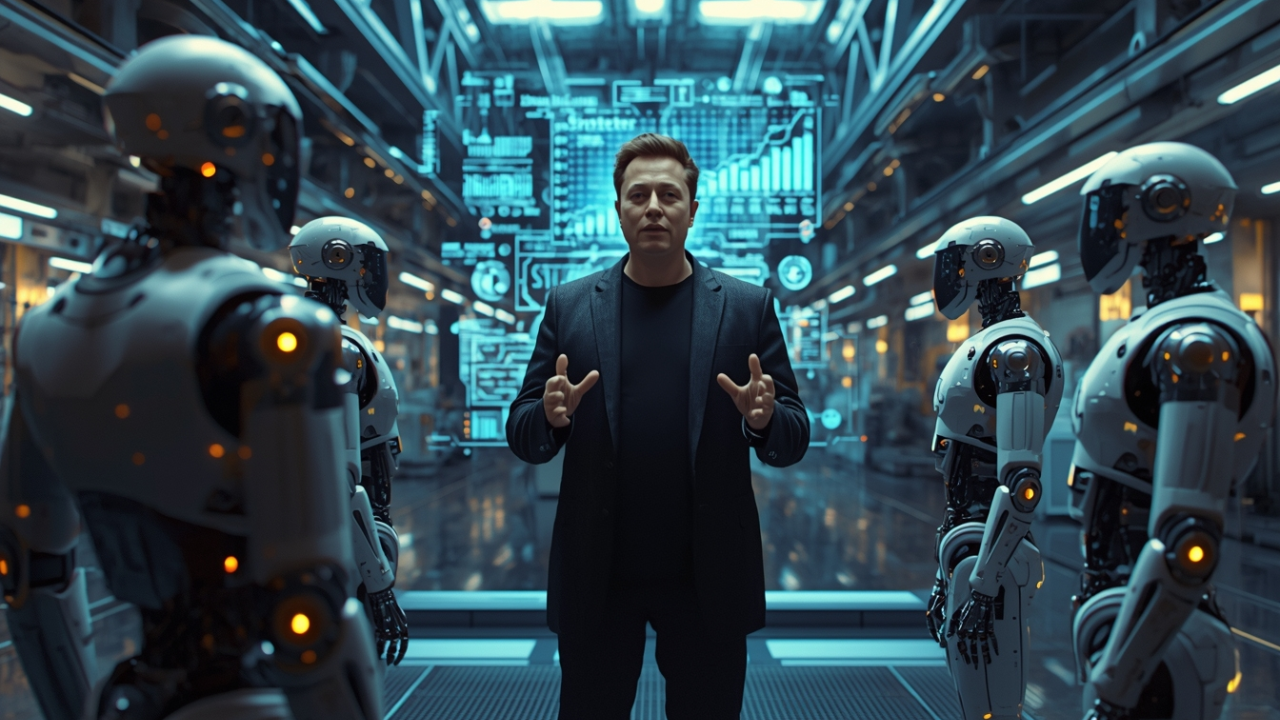
Robots performing most jobs, artificial intelligence surpassing human intelligence and financial worries disappearing from everyday life — this is the future envisioned by Elon Musk in a recent discussion about artificial intelligence and economic transformation.
The billionaire entrepreneur, known for leading companies such as Tesla, SpaceX, and xAI, suggested that traditional saving habits, including retirement planning, could soon become outdated. According to Musk, rapid advances in artificial intelligence and robotics may create a world where scarcity no longer exists.
But while the prediction sounds revolutionary, it also raises serious economic, technological and social questions about the future of money, work and financial security.
Musk’s Bold Prediction: Retirement Savings Could Become Irrelevant
During an interview on a technology-focused podcast, Musk outlined a dramatic timeline for artificial intelligence development. He suggested that within the next decade, AI systems could surpass the combined intelligence of humanity, while robots could outnumber humans in performing daily tasks.
If such a transformation occurs, Musk believes that conventional career paths and employment structures could collapse. He argued that many physical and cognitive tasks currently handled by humans may soon be performed by machines.
According to his projection, the need to save money for retirement may disappear entirely. In his view, a highly automated society could provide individuals with access to essential goods and services without relying on traditional employment income.
From Universal Basic Income to “Infinite” Universal Income
The idea of universal basic income (UBI) has existed for decades. Under this model, governments provide citizens with a fixed income regardless of employment status. However, Musk’s vision goes far beyond this concept.
He imagines a system where automation becomes so productive that society can provide near-limitless access to necessities such as:
- Food
- Housing
- Transportation
- Healthcare
- Digital services
In this scenario, advanced robotics and AI drastically reduce production costs, making essential goods widely accessible. Musk refers to this possibility as something close to “infinite universal income,” where financial scarcity disappears.
If realized, traditional economic ideas such as salaries, pensions and long-term savings could become less relevant because daily needs would already be guaranteed by automated systems.
Why Musk’s Vision Sparks Debate
Despite its futuristic appeal, Musk’s prediction has received mixed reactions from economists, financial planners and policy experts.
Many critics argue that current economic conditions present a stark contrast to his optimism. In several countries, households are struggling with inflation, rising healthcare costs and housing shortages. Retirement savings gaps continue to widen, and many people rely heavily on credit for daily expenses.
In this context, the idea of abandoning savings strategies appears unrealistic to many experts.
The Major Challenges Behind “Infinite Income”
Turning Musk’s prediction into reality would require overcoming enormous economic and social barriers.
1. Massive Productivity Growth
AI and robotics would need to produce goods and services far more efficiently than today. This means automation must dramatically reduce production costs across industries.
2. Fair Distribution of Wealth
Automation profits are currently concentrated among large technology companies. For universal income to succeed, societies would need systems that distribute automation-generated wealth widely.
3. New Social and Economic Policies
Governments would need to redesign welfare systems to provide guaranteed access to housing, healthcare and basic needs independent of employment.
Some economic models propose taxing automated systems or creating public investment funds that hold shares in AI-driven industries. These funds could distribute profits to citizens as social income.
The Ownership Question
One of the biggest concerns surrounding Musk’s prediction involves ownership of automation technologies. If a small group of corporations controls AI infrastructure, economic inequality could increase rather than decrease.
Ironically, companies associated with Musk, including Tesla and xAI, are positioned to benefit significantly from advanced automation. Critics question whether corporations developing AI would support systems that distribute wealth globally or whether automation could widen economic divides.
How Artificial Intelligence Is Already Changing Work
While Musk’s timeline is debated, AI is already transforming multiple industries. Automation tools currently assist in:
- Customer service operations
- Financial fraud detection
- Software development
- Investment management
- Data processing and analysis
Certain job categories, such as routine administration and data entry, are increasingly automated. At the same time, new roles are emerging in areas like:
- AI system supervision
- Robotics maintenance
- Data governance
- Human-AI collaboration
The employment landscape is evolving rather than disappearing entirely.
Why Financial Experts Still Recommend Saving
Most financial planners believe Musk’s prediction remains highly speculative. They emphasize the importance of financial resilience during technological transitions.
Saving money continues to provide protection against:
- Job disruption caused by automation
- Economic recessions
- Healthcare emergencies
- Market volatility
While AI could increase economic productivity over time, transitions between technological eras often create instability before long-term benefits appear.
Possible Futures for Today’s Younger Generations
To better understand Musk’s claim, consider three potential long-term scenarios.
Tech Utopia Scenario
Automation makes essential goods extremely cheap. Governments introduce universal income funded by AI-generated wealth. Savings become less critical, though still useful for luxury spending.
Mixed Outcome Scenario
Automation boosts productivity, but wealth remains unevenly distributed. Some countries adopt partial universal income systems, while individuals still rely on savings and retirement plans.
Fragmented Progress Scenario
Technological development slows due to regulatory or geopolitical challenges. Traditional employment declines gradually, but without strong social protection systems. Savings remain essential for retirement security.
Only the first scenario fully supports Musk’s prediction.
Key Concepts Behind Musk’s Forecast
Several economic and technological theories form the foundation of Musk’s vision.
Technological Unemployment
The idea that machines permanently replace human labour faster than new jobs can emerge.
Universal Basic Income
A guaranteed financial payment to citizens regardless of employment status.
Post-Scarcity Economy
A theoretical system where goods and services become extremely cheap due to automation.
Technological Singularity
A hypothetical moment when artificial intelligence surpasses human intelligence and begins improving itself rapidly.
Musk combines these ideas into a single long-term forecast, though each concept remains uncertain.
Opportunities Created by AI Automation
Artificial intelligence offers genuine potential benefits, including:
- Reducing dangerous manual labour
- Improving healthcare through faster diagnosis
- Expanding access to education using personalised learning systems
- Increasing global productivity
If managed carefully, automation could support stronger social safety nets and improve overall living standards.
Risks of Rapid Automation
However, rapid technological advancement also introduces serious risks.
- Large-scale job displacement
- Increased economic inequality
- Weakening pension systems
- Social instability during transition periods
Without strong public policy, automation could create economic divides between technology owners and workers displaced by AI.
A Practical Approach for Individuals Today
While Musk’s predictions may represent a long-term possibility, most financial experts recommend balancing optimism with practical preparation.
Individuals can prepare by:
- Maintaining emergency savings
- Investing in diversified assets
- Developing skills that complement AI
- Focusing on careers involving creativity, empathy and complex decision-making
Even if universal income systems eventually emerge, the transition period could span decades.
The Future of Money in an AI World
Musk’s vision of “infinite universal income” challenges traditional economic thinking. If automation reaches unprecedented productivity levels, society may redefine concepts such as employment, wealth and retirement.
However, achieving such a transformation would require not only technological breakthroughs but also major political and social reforms.
Until these systems exist, financial planning and savings remain essential tools for managing uncertainty.
The possibility of a post-scarcity future is fascinating — but for now, the balance between innovation and financial responsibility continues to shape how individuals prepare for tomorrow.


