
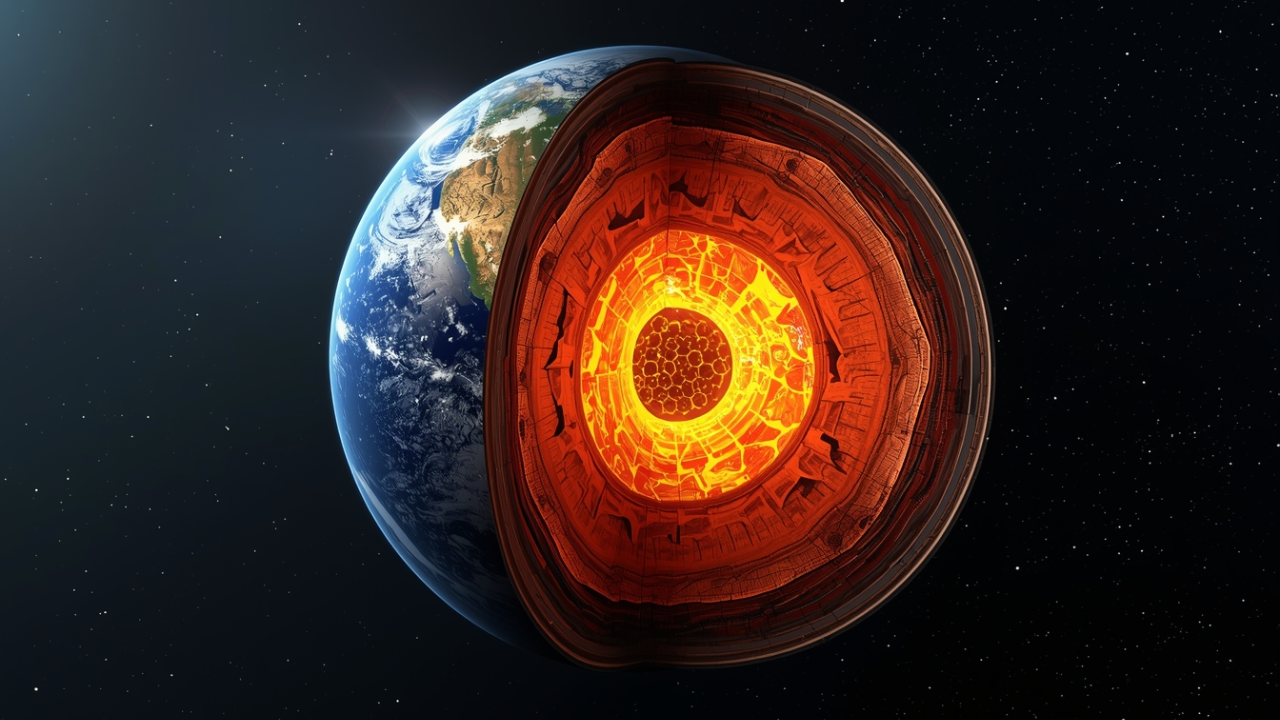
What if a massive portion of Earth’s water was not on the surface, in oceans or glaciers, but hidden deep inside the planet? Recent scientific experiments suggest that Earth’s core may contain significant amounts of hydrogen — enough to potentially create up to 45 oceans worth of water. This groundbreaking discovery is changing how scientists understand the formation of Earth and the origin of water on our planet.
For decades, researchers believed most of Earth’s water arrived through comet impacts or asteroid collisions after the planet formed. However, new research suggests that Earth may have trapped hydrogen during its earliest formation stages, allowing water components to exist much deeper within the planet than previously imagined.
Understanding Earth’s Inner Structure
Our understanding of Earth’s internal structure began developing significantly in the early 20th century through advancements in seismology. Scientists discovered that Earth is made up of several layers, each with unique characteristics. These include the crust, mantle, outer core, and inner core.
In 1936, Danish seismologist Inge Lehmann made a major breakthrough when she identified that Earth’s core is divided into two parts. The inner core is solid, while the outer core surrounding it is liquid. This discovery reshaped geological science and allowed researchers to better understand how Earth’s interior behaves.
Scientists rely heavily on seismic waves generated by earthquakes to study the deep interior of Earth. These waves travel at different speeds depending on the material they pass through. By analyzing wave patterns, researchers determined that the core is primarily made of iron and nickel. However, density measurements later revealed that these metals alone could not fully explain the core’s composition.
This led scientists to suspect that lighter elements must also be present inside the core, though identifying them proved extremely challenging.
More Than Just Iron and Nickel
Over time, improved analytical techniques revealed that Earth’s core contains additional elements beyond iron and nickel. Scientists began to identify lighter elements such as sulfur, silicon, oxygen, carbon, and hydrogen within the core.
Among these elements, hydrogen is particularly difficult to detect because it is the smallest and lightest chemical element. Its presence can be easily overlooked, especially when studying extreme environments deep inside the planet. Yet, even tiny amounts of hydrogen can have enormous implications for Earth’s water cycle and geological history.
Understanding hydrogen levels in the core has been a major challenge because direct sampling of Earth’s interior is impossible. Instead, scientists depend on laboratory simulations and indirect measurements to estimate the composition of these deep layers.
Simulating Earth’s Core in the Laboratory
To better understand the core’s composition, researchers recently conducted experiments replicating the extreme pressure and temperature conditions found deep within Earth. They used a specialized scientific device called a diamond anvil cell, which can recreate the intense pressure experienced in the planet’s core.
In these experiments, scientists placed iron samples mixed with hydrated silicate glass — a material representing early Earth’s molten magma ocean — between two diamond tips. The sample was then heated using powerful lasers to reach temperatures of approximately 4,800 degrees Celsius and pressures exceeding 111 gigapascals, similar to conditions near the Earth’s core.
Once the samples were exposed to these extreme conditions, scientists analyzed their structure using advanced nanoscale imaging technology known as atomic probe tomography. This method allowed researchers to create a detailed three-dimensional map showing how elements were distributed within the material.
The results revealed measurable amounts of silicon, oxygen, and hydrogen trapped within the iron structure. According to the findings, hydrogen makes up approximately 0.07% to 0.36% of the core’s total mass.
Although these percentages may appear extremely small, they represent an enormous quantity of hydrogen when considering the massive size of Earth’s core.
Hydrogen Equal to Dozens of Oceans
Scientists estimate that the amount of hydrogen stored in Earth’s core could equal the hydrogen contained in approximately 9 to 45 oceans. Since hydrogen combines with oxygen to form water, this discovery suggests that vast quantities of water components may exist deep inside the planet.
This finding challenges long-standing theories about how Earth obtained its water. One widely accepted theory suggested that water arrived mainly through late bombardment by comets and asteroids carrying ice and water molecules. However, if hydrogen is already present in the core, it implies that water may have formed during Earth’s earliest developmental stages.
According to researchers, this supports the theory that Earth captured water-forming elements while the planet was still forming from molten materials in the early solar system. If true, this could reshape our understanding of planetary formation not only for Earth but also for other rocky planets.
Why This Discovery Matters
The presence of hydrogen inside Earth’s core has significant implications for several scientific fields. First, it provides new insights into the origin of Earth’s water, one of the key factors that made life possible on our planet.
Second, hydrogen inside the core may influence Earth’s magnetic field. The movement of liquid metal in the outer core generates the magnetic field that protects Earth from harmful solar radiation. Even small changes in core composition can affect how this protective shield operates.
Additionally, understanding hydrogen distribution helps scientists develop more accurate models of Earth’s internal structure and thermal evolution. This knowledge is essential for predicting geological processes such as volcanic activity, tectonic plate movement, and long-term climate changes.
The Need for Further Research
Although these findings are groundbreaking, scientists emphasize that more studies are required to confirm the results. Laboratory experiments attempting to replicate Earth’s core conditions are incredibly complex, and small experimental biases can influence results.
Future research will likely involve additional experiments using different simulation techniques and more advanced imaging technologies. By comparing results from multiple studies, scientists hope to refine their understanding of Earth’s deep interior and confirm the role hydrogen plays in the planet’s formation.
A New Perspective on Earth’s Hidden Water
The discovery that Earth’s core may contain hydrogen equivalent to dozens of oceans opens an exciting new chapter in planetary science. It suggests that Earth’s water history is far more complex than previously believed, with hidden reservoirs potentially existing deep beneath the surface.
As scientific technology continues to advance, researchers are uncovering new secrets about the planet we call home. These discoveries remind us that Earth still holds many mysteries, even beneath our feet. Understanding these hidden processes not only deepens our knowledge of our planet but also helps scientists study the formation of other worlds across the universe.


