
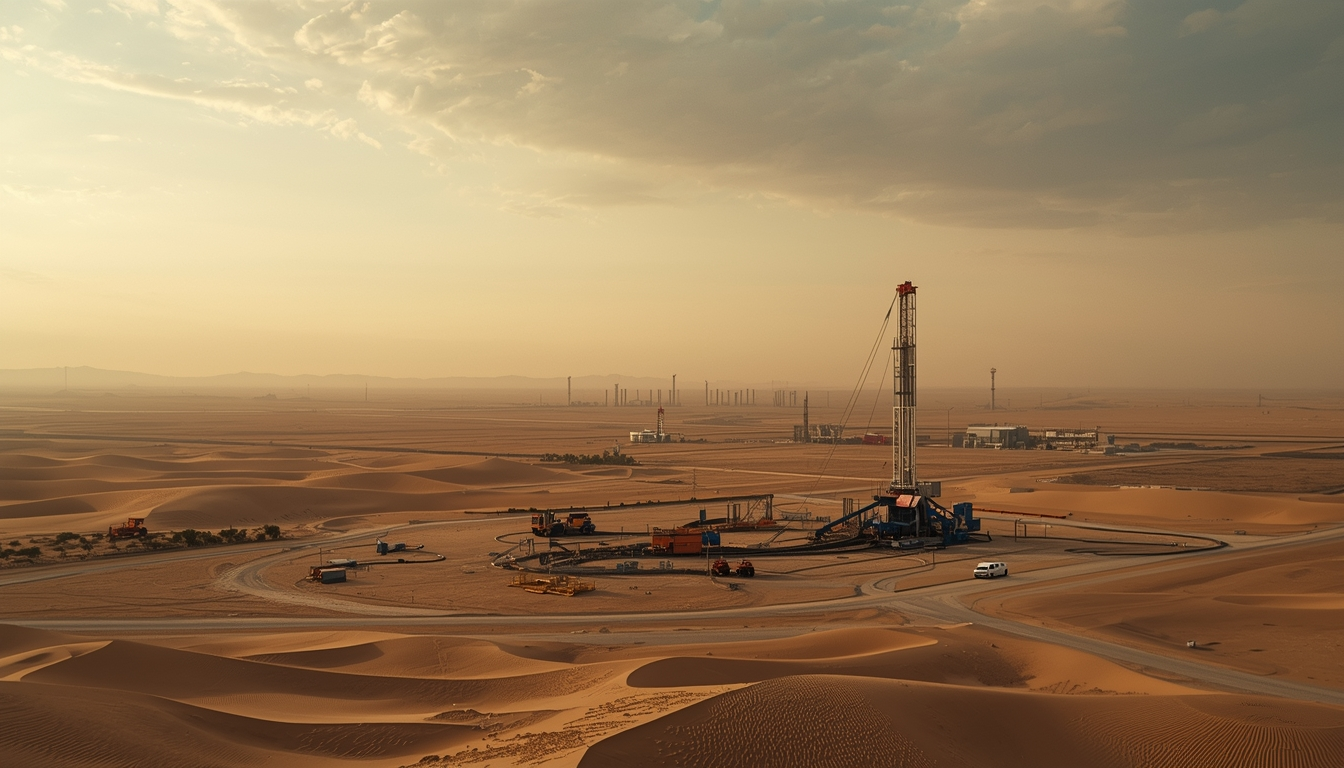
China has officially entered a new phase in its energy strategy. In July 2025, the country produced its first domestically extracted uranium from the Ordos Desert — a milestone achieved just one year after construction began on what is now known as the National Uranium No. 1 project.
For decades, China relied heavily on imported uranium to power its growing nuclear fleet. This breakthrough signals a decisive move toward fuel independence at a time when nuclear expansion is accelerating nationwide.
From Discovery to Production in Record Time
Construction of the National Uranium No. 1 project began on July 12, 2024, in Inner Mongolia’s Jingchuan region. By July 2025, the site had produced its first barrel of uranium using in-situ leaching — a method that injects a solution into underground rock formations to dissolve uranium, which is then pumped back to the surface.
The deposit lies within the Ordos Basin, where the China Geological Survey estimated reserves of up to 30 million tons in early 2025. If confirmed, that figure would place the basin among the largest uranium reserves in the world.
Unlike traditional open-pit mining, this project extracts uranium from aeolian sandstone formations — wind-deposited sand layers previously considered unsuitable for commercial recovery. Chinese researchers developed customized extraction techniques specifically adapted to this geology.
The rapid transition from groundbreaking to production reflects not only technical capability but also national urgency.
A Strategic Shift in the Global Uranium Market
Until now, China sourced most of its uranium from countries such as Kazakhstan, Canada, Australia, and Niger. This dependency exposed the country to price volatility, geopolitical tensions, and trade constraints.
For comparison:
- Kazakhstan, the world’s leading producer, mined approximately 24,000 tons in 2023.
- Australia holds about 1.7 million tons of recoverable uranium reserves.
China’s 30-million-ton estimate remains preliminary. Detailed geological assessments are still ongoing, and recoverable quantities will depend on economic viability and technological efficiency. Even so, exploiting a fraction of this reserve could significantly reduce import dependence.
A second major discovery announced in July 2025 further strengthens China’s position. In the Tarim Basin, geologists identified a sandstone-type uranium deposit at a depth of 1,820 meters — the deepest of its kind recorded domestically.
Environmental and Regulatory Challenges
While in-situ leaching avoids the large-scale land disruption of open-pit mining, it carries its own risks. Potential concerns include:
- Groundwater contamination
- Residual underground radioactivity
- High water consumption in arid regions
The Ordos Desert ecosystem is particularly fragile. Water resources are limited, and nearby communities depend on underground aquifers. Monitoring and safeguarding these water systems will be critical as operations scale.
Worker safety protocols and radioactive waste management will also face increased scrutiny as production expands. Rapid industrial growth in uranium extraction may test both regulatory frameworks and public confidence.
Nuclear Expansion Driving Demand
China currently operates 56 nuclear reactors with a combined capacity of roughly 57 gigawatts. Another 11 reactors are under construction, with long-term plans to triple nuclear capacity by 2035 as part of carbon neutrality targets.
At present, nuclear energy accounts for approximately 5% of China’s electricity generation. Expanding domestic uranium supply removes a key constraint in achieving those ambitious goals.
Securing its own fuel also strengthens China’s influence in global uranium markets, potentially reshaping supply dynamics over the next decade.
What Comes Next?
The first barrel extracted in Ordos is symbolic. The larger question is whether production can scale efficiently and sustainably.
Deeper discoveries such as the Tarim Basin deposit will require advanced extraction technology. Environmental oversight must keep pace with expansion. And economic feasibility will determine how much of the estimated 30 million tons can ultimately be recovered.
What is clear, however, is that China has demonstrated the technical ability to extract uranium from geological formations once considered commercially impractical. If production scales successfully, the country could transition from major uranium importer to near self-sufficiency within a decade.


