
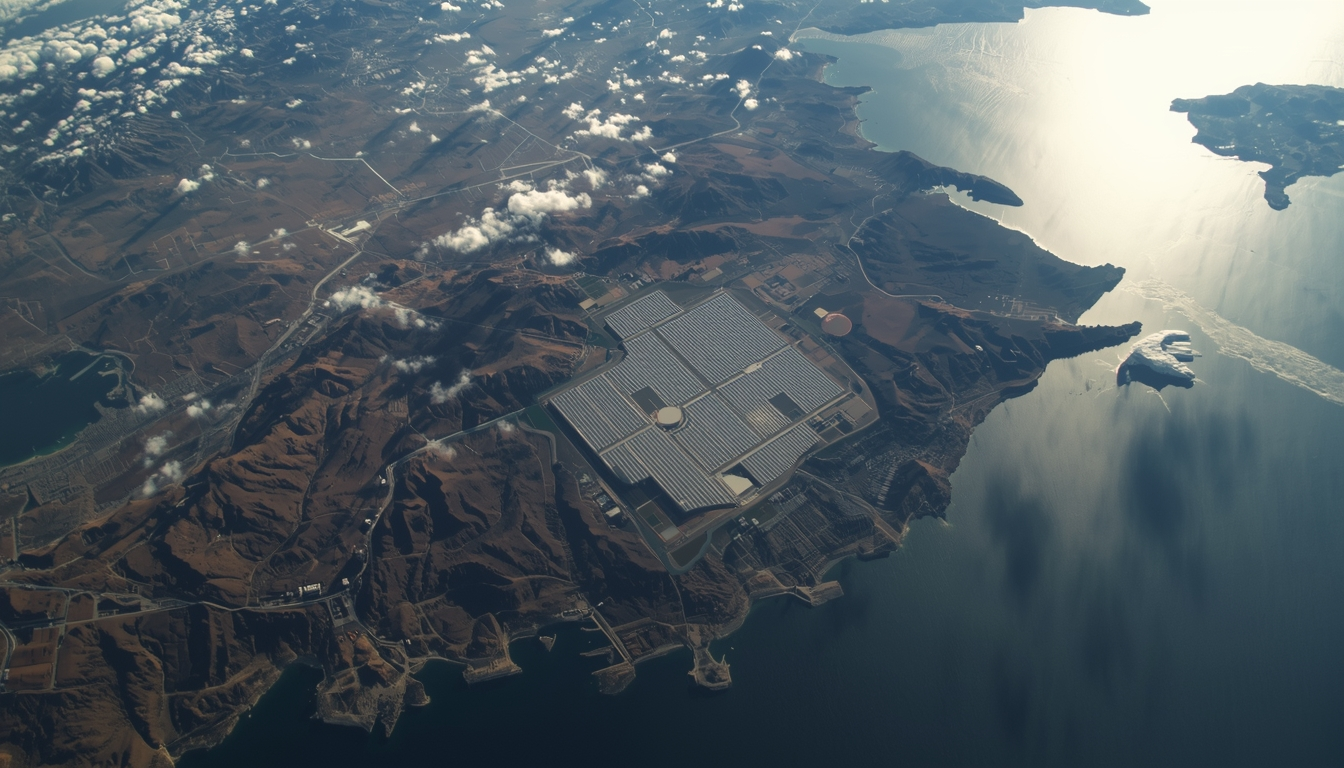
For generations, a popular claim has suggested that the Great Wall of China is visible from the Moon. It is an enduring myth — and one that astronauts have repeatedly debunked.
While the Wall blends into its mountainous surroundings, another human-made feature stands out far more clearly from orbit: a vast expanse of white greenhouses in southern Spain.
The Great Wall Myth
The belief that the Great Wall of China can be seen from the Moon predates the space age. The claim appears to have originated in 18th-century speculation, long before spaceflight made verification possible.
Astronauts from the Apollo program — including Neil Armstrong — confirmed that from the lunar surface, Earth’s continents and cloud systems are visible, but no individual human-built structure can be distinguished with the naked eye.
Even from low Earth orbit, the Wall is difficult to pick out. Constructed largely from local stone and soil, it mirrors the color and texture of the surrounding terrain. Unless sunlight strikes it at a low angle that casts long shadows, it remains almost indistinguishable from natural ridgelines.
Spain’s “Sea of Plastic”
In contrast, the greenhouse complex known as Los Invernaderos de Almería is frequently visible from orbit.
Located in the province of Almería in southern Spain, this agricultural region contains tens of thousands of hectares of white polyethylene-covered greenhouses. From space, the area appears as a bright, reflective patch along the Mediterranean coast.
Spanish astronaut Pedro Duque has described the site as unmistakable from orbit, noting how the white roofs sharply contrast with the darker hills and coastline.
Why It Stands Out
Visibility from space depends on three primary factors:
1. Reflectivity
The white plastic roofing has a high albedo, meaning it reflects a significant portion of incoming sunlight back toward space. This creates a luminous effect under clear skies.
2. Contrast
Unlike the earth-toned Great Wall, the greenhouse complex forms a sharp geometric contrast against the surrounding landscape.
3. Scale
Covering roughly 30,000 to over 40,000 hectares, the area represents one of the largest concentrations of greenhouses in the world. Its sheer size makes it easier to detect from orbit.
A Visible Footprint — and Its Costs
The Almería greenhouse region plays a major role in supplying fruits and vegetables across Europe. However, its intensity also raises environmental concerns.
Heavy water use strains local aquifers, while plastic waste management remains a persistent challenge. Interestingly, some studies suggest that the high reflectivity of the greenhouses has produced a localized cooling effect — a rare microclimatic contrast to the broader warming trend across southern Spain.
What Astronauts Really See
From low Earth orbit — such as aboard the International Space Station — the most visible human features are typically those that maximize brightness and contrast.
Here’s how various landmarks compare:
- Cities at night: Clearly visible due to artificial lighting.
- Great Wall of China: Rarely visible due to low contrast.
- Almería greenhouses: Often visible thanks to reflectivity and scale.
- Large open-pit mines: Frequently visible because of exposed rock and size.
- Major airport runways: Sometimes visible due to long, straight lines.
The reality of orbital visibility is less romantic than the myth suggests. The structures most easily seen from space are not always ancient wonders, but modern, high-contrast imprints on Earth’s surface.


