
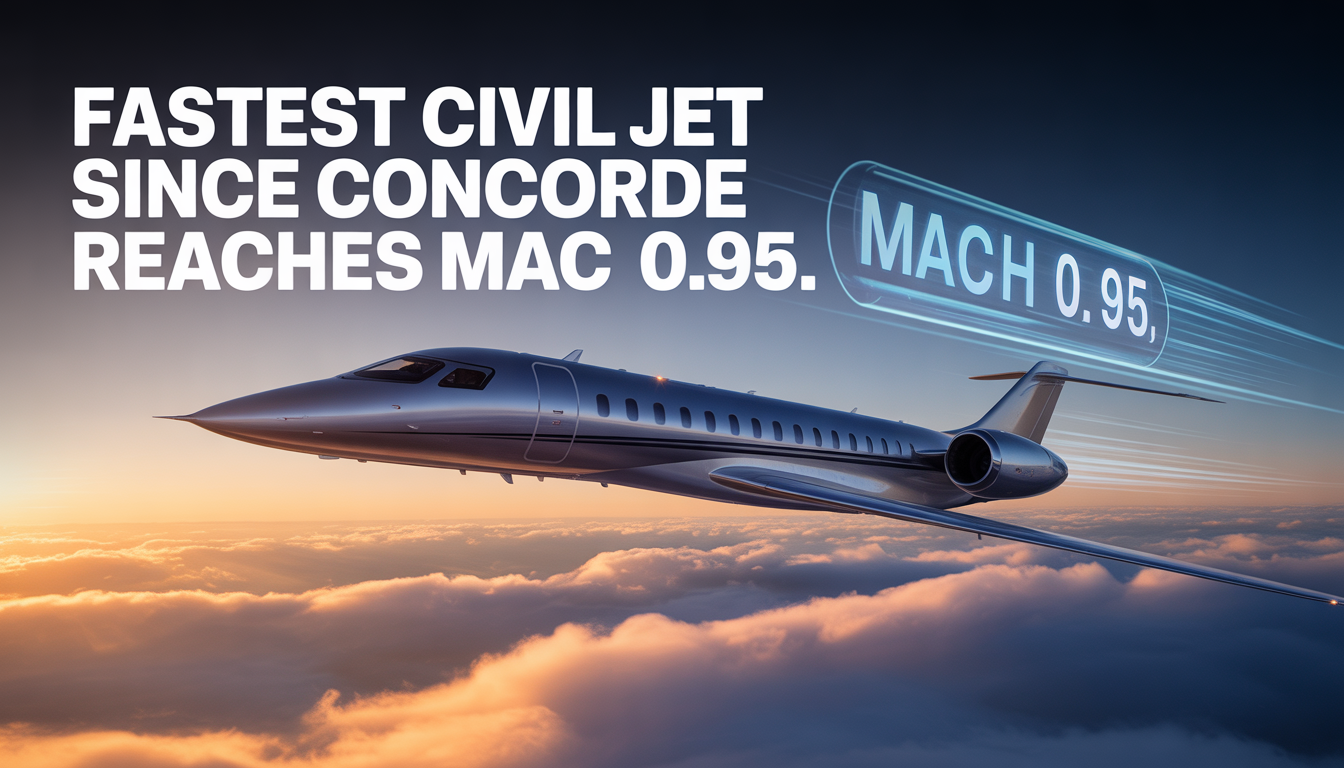
The aviation world is celebrating a milestone that many believed would take decades to achieve. For the first time since the retirement of the iconic Concorde, a civil aircraft has reached a top speed of Mach 0.95, making it the fastest civilian jet developed in the post-Concorde era. This accomplishment does not just represent a technical record — it symbolizes the return of speed as a serious priority in commercial aviation.
For over twenty years, aircraft manufacturers have focused primarily on fuel efficiency, cost reduction, and environmental performance. Speed, once the ultimate symbol of aviation progress, had taken a back seat. Now, with Mach 0.95 achieved in a civilian platform, the industry is once again looking toward faster skies.
Why Mach 0.95 Matters So Much
Mach 0.95 means the aircraft is flying at 95 percent of the speed of sound. At cruising altitude, that translates to approximately 1,150 to 1,200 kilometers per hour depending on atmospheric conditions. While it does not cross into supersonic territory, it pushes the limits of subsonic performance to the edge of the sound barrier.
Most modern commercial aircraft cruise between Mach 0.75 and Mach 0.85. Moving to Mach 0.95 may appear incremental, but in aviation engineering terms, this is a dramatic leap. As aircraft approach Mach 1, they enter what engineers call the transonic region — a zone where airflow behavior becomes highly complex and unpredictable.
In this region, portions of airflow over the wings can briefly exceed the speed of sound even if the aircraft itself remains subsonic. This causes shock waves, increased drag, and structural stress. Successfully operating at Mach 0.95 requires extraordinary aerodynamic precision and advanced materials capable of handling these forces safely.
The Long Shadow of Concorde
When Concorde retired in 2003, it ended the era of supersonic passenger travel. Cruising at Mach 2.04, it could cut transatlantic flight times in half. However, high fuel consumption, maintenance costs, limited routes, and strict noise regulations ultimately made it economically unsustainable.
After Concorde’s departure, manufacturers shifted focus. Airlines prioritized twin-engine efficiency, long-range capability, and reduced operating expenses. Passengers grew accustomed to steady but slower travel times, typically cruising at Mach 0.8.
For decades, no civil aircraft came close to pushing speed limits again. That is why Mach 0.95 represents more than a number — it represents a renewed ambition. While it does not replicate Concorde’s supersonic capability, it marks the fastest civilian jet performance since that legendary aircraft left the skies.
Engineering Innovation Behind the Record
Reaching Mach 0.95 required breakthroughs across multiple disciplines. Modern composite materials played a crucial role. Lightweight carbon-fiber structures and reinforced alloys allow aircraft to withstand high-speed aerodynamic loads without compromising safety or increasing weight excessively.
Aerodynamic shaping is another essential factor. Designers refined wing sweep angles, fuselage contours, and air intake geometry to reduce drag in the transonic zone. Advanced computational fluid dynamics simulations enabled engineers to test thousands of design variations digitally before building physical prototypes.
Propulsion systems also underwent significant refinement. High-efficiency turbofan engines were optimized to deliver sustained thrust at near-sound speeds while maintaining fuel economy. Improved turbine blade materials, digital engine controls, and better thermal management systems made high-speed cruise viable without exceeding regulatory emissions standards.
Commercial Potential and Market Impact
High-speed subsonic travel offers compelling advantages, particularly for business aviation and premium long-haul routes. Even a 15 percent reduction in travel time can significantly enhance productivity for corporate travelers and international executives.
For example, a ten-hour intercontinental flight could potentially be reduced by over an hour. In high-value business corridors, that time saving has measurable economic benefits. Airlines may consider deploying such aircraft for exclusive premium services where speed commands higher ticket prices.
However, commercial success will depend on operating economics. The Concorde experience demonstrated that technological brilliance alone does not guarantee profitability. Airlines must balance fuel costs, maintenance demands, and market demand before embracing a faster subsonic fleet.
Safety and Regulatory Oversight
Operating near Mach 1 demands rigorous oversight. Regulatory bodies such as the Federal Aviation Administration and the European Union Aviation Safety Agency impose strict certification standards for aircraft operating at the limits of aerodynamic performance.
Structural testing, fatigue analysis, and full-envelope flight trials are required to ensure safe operations. Pilots must receive specialized training to manage aircraft behavior in the transonic regime, where small changes in speed or altitude can produce significant aerodynamic effects.
Although Mach 0.95 remains subsonic and avoids sonic booms, noise control remains a priority. Engineers must comply with international airport noise standards while maintaining high-speed efficiency.
Environmental Considerations
One of the biggest challenges facing faster aviation is sustainability. Higher cruise speeds generally require increased fuel consumption. In an era where carbon reduction is a global priority, speed improvements must align with environmental goals.
Fortunately, advances in engine efficiency and the adoption of Sustainable Aviation Fuel (SAF) are helping reduce emissions. Improved aerodynamics also play a role in minimizing drag-related fuel burn. While Mach 0.95 may consume more fuel than Mach 0.8 cruising, smarter route planning and reduced total flight time could partially offset environmental impact.
Balancing performance with sustainability will be crucial in determining whether high-speed subsonic aircraft become mainstream.
A Bridge to the Future of Supersonic Travel
This Mach 0.95 milestone may serve as a stepping stone toward a broader revival of supersonic flight. Several aerospace innovators are currently working on next-generation supersonic aircraft that aim to solve the economic and environmental challenges that plagued Concorde.
Pushing subsonic aircraft to the edge of the sound barrier provides valuable data. Engineers gain insights into airflow behavior, material stress tolerances, and engine performance near Mach 1. These lessons will inform future supersonic programs and potentially shorten development timelines.
Rather than leaping directly back to Mach 2, the aviation industry appears to be taking a gradual path. Mastering extreme subsonic speeds could create a smoother transition into practical and commercially viable supersonic travel.
Frequently Asked Questions
How much faster is Mach 0.95 compared to today’s jets?
It is approximately 15 to 20 percent faster than the typical Mach 0.8 cruise speed of most commercial airliners.
Is Mach 0.95 supersonic?
No. Supersonic flight begins at Mach 1. Mach 0.95 remains subsonic but operates very close to the sound barrier.
Will this aircraft produce sonic booms?
No. Because it does not exceed Mach 1, it avoids the sonic boom phenomenon associated with supersonic aircraft.
Could this lead to faster commercial flights soon?
Potentially, but widespread adoption will depend on economic viability, regulatory approval, and environmental considerations.
Conclusion
The achievement of Mach 0.95 in a civil aircraft marks one of the most important speed milestones since Concorde’s retirement. It demonstrates that innovation in aviation remains strong and that the pursuit of faster air travel is far from over.
While challenges remain — from operating costs to environmental impact — this breakthrough proves that high-speed civilian flight is once again within reach. Mach 0.95 does not break the sound barrier, but it breaks a decades-long stagnation in civil aviation speed.
The sky may not yet echo with supersonic passenger jets, but this achievement suggests that the future of faster, smarter, and more efficient air travel has officially begun.


