
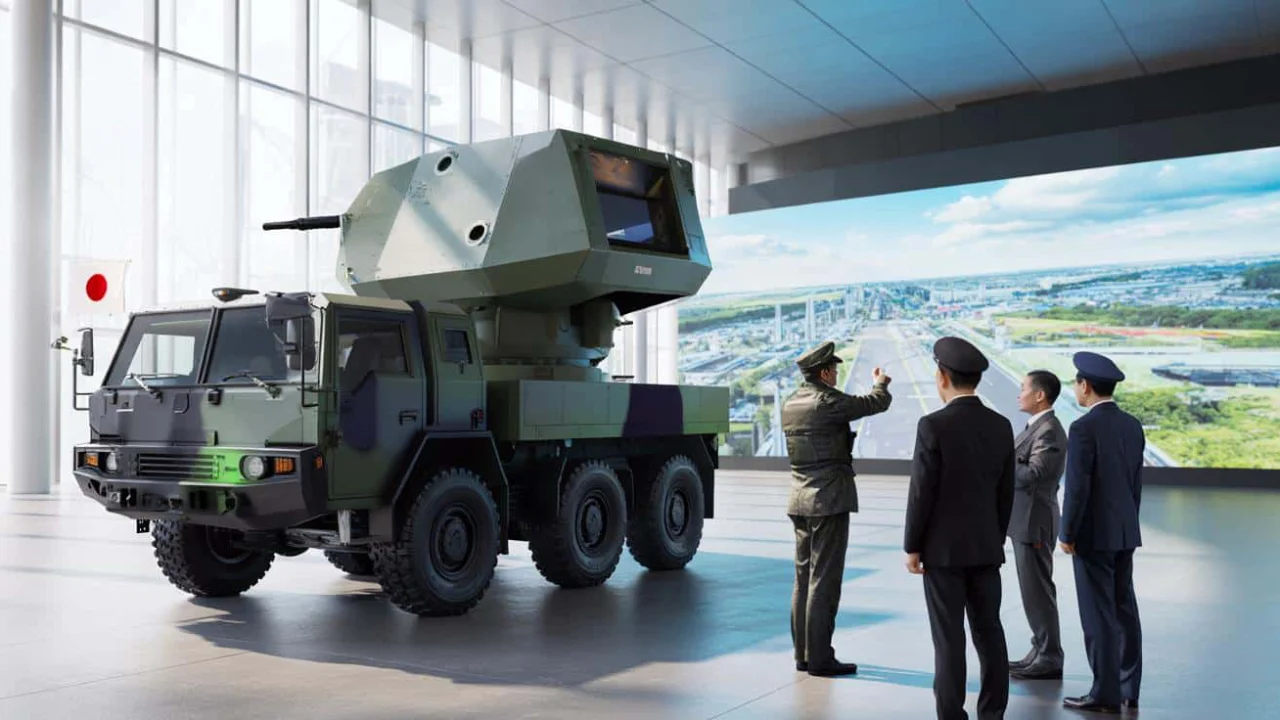
The defense contractor’s booth at DSEI Japan 2025 was packed with curious onlookers, but one elderly Japanese man stood transfixed by the massive truck parked in the center. His grandson tugged at his sleeve, asking why grandpa was staring so intently at what looked like an ordinary military vehicle.
“This changes everything,” the old man whispered, remembering stories his own grandfather told about kamikaze attacks during World War II. “No more pilots. No more suicide missions. Just light.”
That truck represents Japan’s bold answer to a growing global threat that keeps military planners awake at night. It’s not just any vehicle – it’s a truck-mounted laser cannon designed to make drone swarms think twice before darkening Japan’s skies.
When Science Fiction Becomes Military Reality
Japan just unveiled something that sounds straight out of a movie, but it’s very real and very serious. At DSEI Japan 2025, the country’s defense establishment revealed their truck-mounted laser cannon aimed at making massed drone attacks too costly, too slow, and ultimately too pointless for any rival to attempt.
The centerpiece wasn’t your typical military hardware. Instead of showcasing a new missile system or traditional artillery, Japan presented an 8×8 armored truck carrying a compact 10-kilowatt laser system. The Acquisition, Technology & Logistics Agency (ATLA), which reports directly to Japan’s Ministry of Defense, developed this game-changing demonstrator.
From the outside, you might mistake it for a large armored carrier. There’s no conventional gun barrel jutting out, no missile canisters mounted on top. Instead, a squat turret houses sophisticated optics, sensors, and the laser emitter itself.
“The message from Tokyo is blunt: future air defense will be written in light, not smoke, shrapnel and blast,” explains Dr. Kenji Nakamura, a defense technology analyst who witnessed the demonstration.
This system fires an invisible beam of concentrated energy at incoming aerial threats, burning through key components or sensors until the drone or loitering munition simply falls from the sky. The shot is completely silent, and there are no fragments raining down afterward – making it particularly attractive for defending urban areas and military bases.
The Growing Threat That Keeps Generals Awake
Japan’s truck-mounted laser cannon addresses a problem that’s been growing bigger every day. Military planners worldwide are grappling with small, slow, and low-flying threats that conventional air defenses struggle to handle effectively. These targets fall under the military acronym LSS: low, slow, small.
The threats Japan is preparing for include:
- Quadcopter drones used for artillery spotting
- Improvised kamikaze drones carrying explosives
- Commercial platforms converted for long-range surveillance
- Loitering munitions designed to circle for hours before striking
- Swarm attacks using dozens of coordinated drones
These systems have become highly visible in Ukraine, throughout the Middle East, and around Asia’s potential flashpoints. Swarms of cheap drones can overwhelm expensive interceptor missiles and saturate radar coverage, creating gaps that traditional air defense systems can’t fill.
“We’re seeing a fundamental shift in how warfare is conducted,” notes Colonel Hiroshi Tanaka, a retired Japan Self-Defense Forces officer. “A $500 drone can potentially take out a million-dollar tank. That math doesn’t work for defenders.”
| Threat Type | Cost to Deploy | Traditional Intercept Cost | Laser Intercept Cost |
|---|---|---|---|
| Commercial Drone | $500-2,000 | $50,000-100,000 | $1-10 |
| Military UAV | $10,000-50,000 | $100,000-500,000 | $1-10 |
| Loitering Munition | $20,000-80,000 | $200,000-1,000,000 | $1-10 |
How Japan’s Laser Solution Changes the Game
Japan’s answer is a mobile, truck-mounted laser cannon that can be driven alongside ground units, power up quickly, and engage incoming drones at short notice. This system forms another crucial layer in what strategists call “layered air defense” – overlapping systems ranging from long-range missiles down to point-defense weapons protecting specific bases and vehicles.
The beauty of this truck-mounted laser cannon lies in its economics. While a single interceptor missile can cost tens of thousands of dollars, each laser shot costs roughly the price of a cup of coffee. When facing swarms of cheap drones, that cost difference becomes a decisive advantage.
“This levels the playing field in a way we haven’t seen since radar was invented,” explains Maria Santos, a defense industry consultant who attended the Tokyo demonstration.
The system offers several key advantages over traditional air defense:
- Silent operation that doesn’t reveal defensive positions
- No ammunition to run out or reload
- Minimal collateral damage in populated areas
- Extremely low cost per engagement
- Ability to engage multiple targets rapidly
What This Means for Regional Security
Japan’s truck-mounted laser cannon sends a clear message to potential adversaries, particularly China, which has been rapidly developing its own drone capabilities. The system demonstrates that Japan is serious about defending its territory against modern asymmetric threats.
For civilian populations, this technology could mean safer skies over cities and towns. Unlike traditional air defense systems that rely on explosive interceptors, laser systems eliminate threats without creating dangerous debris falling from above.
Military bases and critical infrastructure also benefit significantly. The truck-mounted design means these laser cannons can be repositioned quickly as threats evolve, providing flexible protection where it’s needed most.
“This isn’t just about military applications,” points out Dr. Yuki Sato, a technology policy researcher. “We’re looking at a future where this technology could protect airports, power plants, and even large public events from drone threats.”
The international implications extend beyond Japan’s borders. As this truck-mounted laser cannon technology matures and potentially becomes available for export, it could reshape how nations approach air defense procurement and strategy.
Other countries watching Japan’s development closely include South Korea, Australia, and several European nations facing similar drone threats. The success of Japan’s system could trigger a wave of similar developments worldwide, fundamentally changing how militaries think about protecting their assets and populations.
FAQs
How powerful is Japan’s truck-mounted laser cannon?
The system operates at 10 kilowatts, enough to disable or destroy small drones and loitering munitions but not powerful enough for larger aircraft or missiles.
How much does each laser shot cost?
Each engagement costs between $1-10, making it dramatically cheaper than traditional missile interceptors that can cost tens of thousands of dollars.
Can the laser work in bad weather?
Weather conditions like heavy rain, fog, or dust can reduce laser effectiveness, which is why it’s designed as part of a layered defense system with other weapons.
Is this technology available for export?
Japan hasn’t announced export plans yet, but the technology demonstration suggests they may consider sharing it with close allies in the future.
How fast can the laser engage multiple targets?
The system can rapidly switch between targets, potentially engaging multiple drones within seconds, though exact specifications haven’t been publicly released.
Will this make drone attacks obsolete?
While highly effective against current drone threats, this technology will likely spark an arms race as drone developers work to counter laser defenses with new tactics and technologies.


