
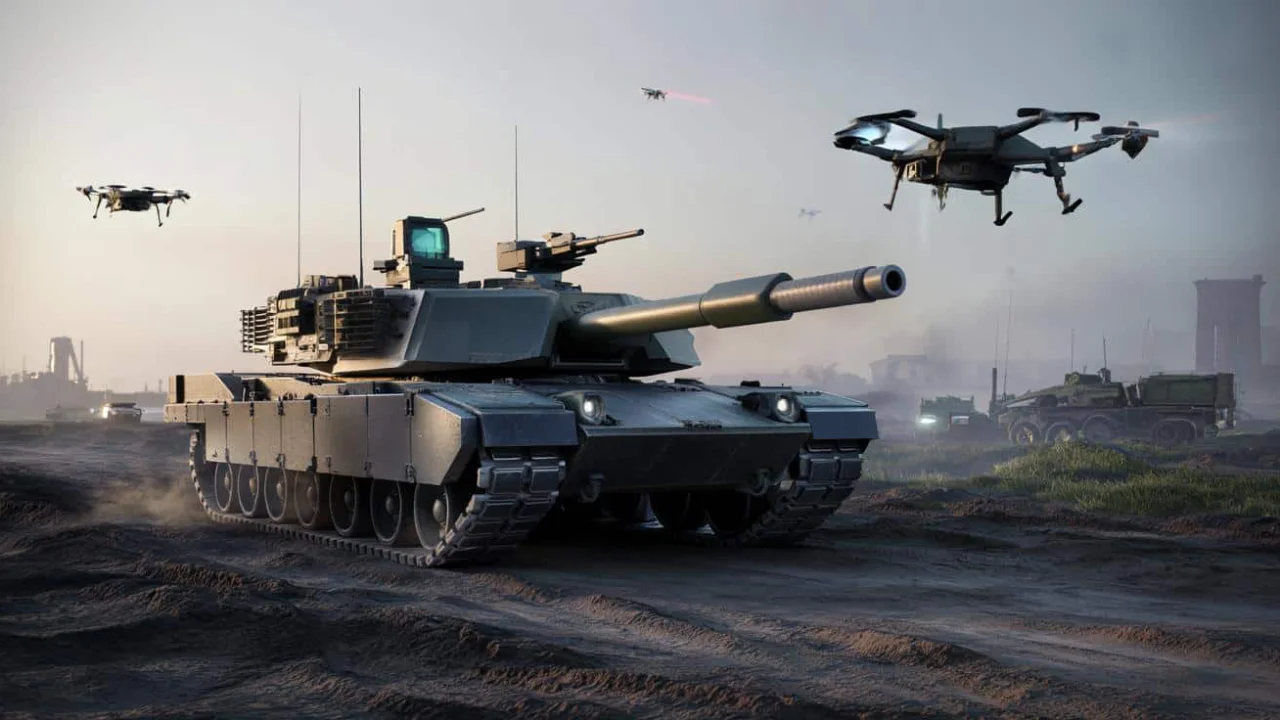
Sarah Martinez was fixing her morning coffee when her phone buzzed with a news alert from her son deployed overseas. “Mom, you should see what they’re building here,” his message read, followed by a blurry photo of something that looked like it came straight out of a science fiction movie. The massive steel hull gleamed under floodlights, but this wasn’t your grandfather’s tank.
That photo showed the AbramsX tank, and Sarah’s son was witnessing history in the making. This isn’t just another military upgrade—it’s America’s answer to a world where warfare has completely changed, and Russia is paying very close attention.
The stakes couldn’t be higher. While families like Sarah’s worry about their loved ones in uniform, military planners are racing to build weapons that can survive in tomorrow’s brutal battlefields.
Why This Tank Has Russia Losing Sleep
The AbramsX tank represents everything Moscow fears about American military innovation. Unlike the traditional M1 Abrams that has dominated battlefields for decades, this new machine was designed specifically to counter the lessons learned from Ukraine’s devastating drone warfare.
“This isn’t your Cold War tank anymore,” explains defense analyst Michael Chen. “The AbramsX was built knowing that every vehicle will be spotted, tracked, and targeted within minutes of entering a combat zone.”
General Dynamics Land Systems didn’t just update an old design—they reimagined what a main battle tank needs to be. The AbramsX combines artificial intelligence, hybrid propulsion, and modular armor into a platform that can think, adapt, and survive in ways that would have seemed impossible just five years ago.
Russian military observers have openly expressed concern about the AbramsX’s capabilities. Their own tank programs, still relying heavily on Soviet-era design philosophies, suddenly look outdated by comparison.
Breaking Down the AbramsX Tank’s Game-Changing Features
The technical specifications of the AbramsX tank read like a wish list of everything military engineers have wanted for decades. Here’s what makes this machine so revolutionary:
| Feature | AbramsX Capability | Why It Matters |
|---|---|---|
| Weight | 20% lighter than M1A2 | Better mobility, easier deployment |
| Crew Size | 3 personnel (down from 4) | Reduced human risk, AI assistance |
| Power System | Hybrid diesel-electric | Silent watch capability, fuel efficiency |
| Armor | Modular reactive system | Adaptable protection, easier repairs |
| AI Integration | Autonomous threat detection | Faster response times, crew safety |
The armor system deserves special attention. Instead of just piling on more steel, the AbramsX uses smart materials that can actually react to incoming threats. Explosive reactive armor blocks detonate outward to deflect projectiles, while modular sections can be quickly replaced in the field.
- Advanced composite materials that are lighter but stronger than traditional steel
- Compartmentalized ammunition storage that prevents catastrophic explosions
- Improved fire suppression systems that activate in milliseconds
- Reduced thermal and radar signatures to avoid detection
- Modular design allowing rapid battlefield repairs and upgrades
“The beauty of the AbramsX is that it doesn’t try to be invincible,” notes former tank commander Colonel James Wright. “Instead, it makes every enemy shot harder to land and survivable if it connects.”
The hybrid propulsion system might be the most game-changing feature. The AbramsX tank can operate in near-silent mode using only electric motors, making it nearly impossible to detect acoustically. This “stealth mode” allows crews to set up ambush positions without giving away their location.
What This Means for Global Military Balance
The implications of the AbramsX tank extend far beyond American military capabilities. This machine represents a fundamental shift in how ground warfare will be conducted, and other nations are scrambling to keep up.
NATO allies are closely studying the AbramsX’s design principles for their own next-generation armor programs. Countries like Germany, France, and the United Kingdom are already incorporating similar technologies into their future tank concepts.
For Russia, the AbramsX presents a serious strategic problem. Their newest T-14 Armata tank, which has faced production delays and technical issues, suddenly looks less impressive when compared to American capabilities. Chinese military planners are also reassessing their own armor programs in light of the AbramsX’s advanced features.
“This tank doesn’t just change the game—it rewrites the entire playbook,” says international security expert Dr. Lisa Park. “Any nation hoping to compete in future ground conflicts will need to match these capabilities or find completely different approaches.”
The psychological impact cannot be understated. The AbramsX tank sends a clear message that America intends to maintain its edge in ground warfare technology. For potential adversaries, knowing that American forces could deploy such advanced systems creates a powerful deterrent effect.
Production timelines remain classified, but industry sources suggest that limited AbramsX units could enter service within the next five years. The Army is taking a measured approach, using the current version as a technology demonstrator while planning full-scale production based on real-world testing results.
The Human Side of High-Tech Warfare
Behind all the technical specifications and strategic implications are real people like Sarah’s son—soldiers who will actually operate these machines. The AbramsX tank was designed with crew survival as a top priority, something that gives families hope in an increasingly dangerous world.
The reduced crew size from four to three personnel might seem like a small change, but it represents a fundamental shift toward human-machine cooperation. The AI systems don’t replace human judgment—they enhance it, giving crews better information faster while handling routine tasks automatically.
Training programs for AbramsX crews will be unlike anything the military has done before. Soldiers will need to understand not just mechanical systems but also how to work effectively with artificial intelligence partners. This represents a new era of warfare where success depends as much on digital literacy as traditional combat skills.
Maintenance teams face similar challenges. The AbramsX tank’s modular design makes field repairs easier in some ways, but the advanced electronics and AI systems require specialized knowledge that current mechanics are just beginning to learn.
FAQs
How much does the AbramsX tank cost compared to current models?
While exact costs remain classified, estimates suggest the AbramsX will be significantly more expensive initially but cheaper to operate long-term due to better fuel efficiency and reduced crew requirements.
When will the AbramsX tank enter active service?
The Army plans to begin limited deployments within five years, with full production depending on testing results and budget approval from Congress.
Can the AbramsX really operate silently?
Yes, the hybrid electric system allows for nearly silent operation at low speeds, making it much harder for enemies to detect using sound-based sensors.
How does the AbramsX compare to Russian and Chinese tanks?
Current assessments suggest the AbramsX represents a generational leap ahead of existing Russian T-14 and Chinese Type 99 variants, particularly in AI integration and survivability.
Will the AbramsX replace all existing M1 Abrams tanks?
No, the military plans to maintain mixed fleets for cost reasons, with AbramsX units deployed to the most critical missions while upgraded M1 variants handle other roles.
What happens if the AI systems fail during combat?
The AbramsX tank is designed to operate normally even if AI systems go offline, with all critical functions remaining under direct human control as backup.


