
Commander Sarah Mitchell still remembers the sleepless nights during her deployment near the Kashmir border. Every radar blip, every unknown aircraft crossing into their airspace meant scrambling jets, risking lives, and hoping their pilots would make it home safely. “We’d send our best pilots deep into enemy territory,” she recalls, “knowing that some missions were essentially suicide runs.”
Those days might be ending. India’s latest hypersonic missile technology promises to change everything about how air forces think about striking distant targets. Instead of sending pilots into harm’s way, this new weapon can travel at over 6,000 km/h while the aircraft launching it never leaves safe airspace.
The human cost of traditional air warfare has always been its biggest weakness. Families wait anxiously as their loved ones fly dangerous missions, often crossing enemy lines where sophisticated air defense systems wait to shoot them down. This new hypersonic missile could finally break that deadly cycle.
The Rudram-4: India’s Game-Changing Hypersonic Missile
The weapon making headlines is the Rudram-4, developed by India’s Defence Research and Development Organisation (DRDO). This isn’t just another missile – it’s a complete rethinking of how modern air forces can project power across vast distances.
Defense analyst Dr. Rajesh Kumar explains, “What makes the Rudram-4 revolutionary is its combination of extreme speed and standoff range. Pilots can fire this hypersonic missile from inside Indian airspace and hit targets over 550 kilometers away.”
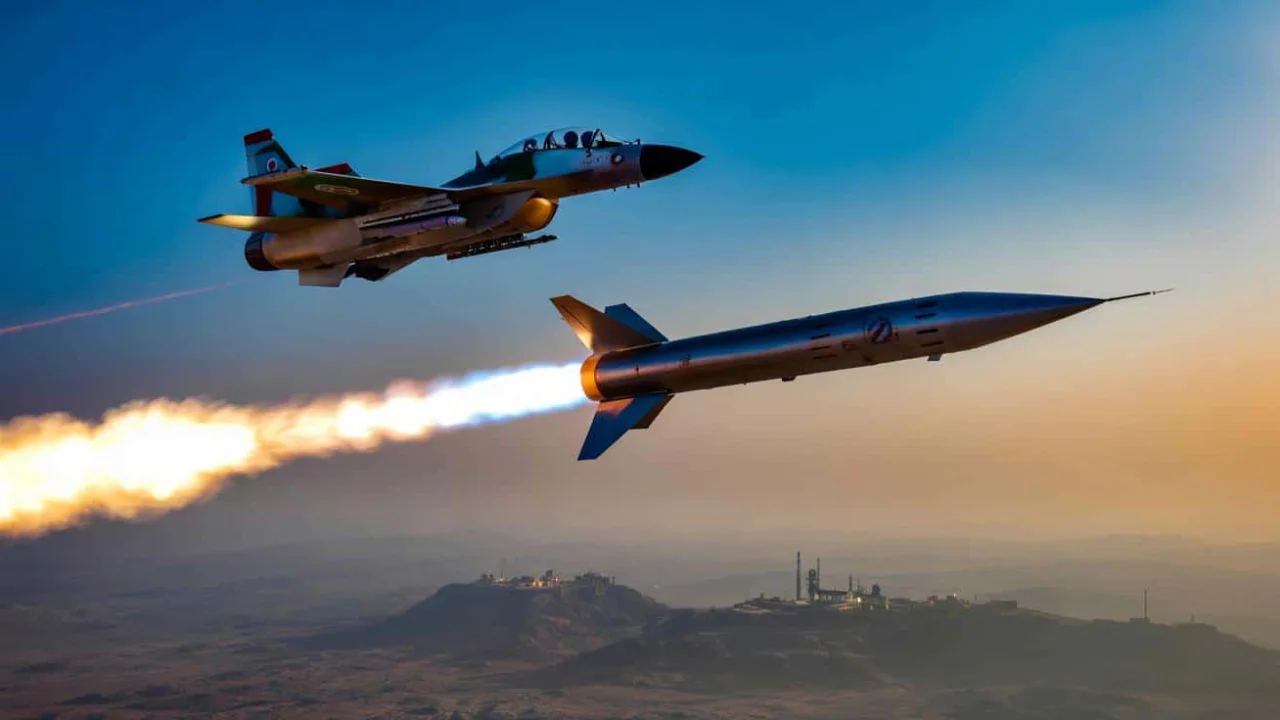
The missile launches from proven fighter aircraft like the Su-30MKI, with future integration planned for India’s new Rafale jets. Once released, it accelerates beyond Mach 5 – that’s more than five times the speed of sound, or roughly 6,174 km/h at sea level.
At these incredible velocities, the hypersonic missile can cross hundreds of kilometers in just minutes. Enemy radar operators might detect the launch, but by the time they process the threat and coordinate a response, the Rudram-4 has already reached its target.
Technical Specifications That Matter in Real Combat
Understanding the Rudram-4’s capabilities requires looking at what makes it different from conventional weapons. Here’s how this hypersonic missile stacks up against traditional options:
| Feature | Rudram-4 | Traditional Cruise Missile |
|---|---|---|
| Maximum Speed | Mach 5+ (6,000+ km/h) | Mach 0.8 (980 km/h) |
| Range | 550+ km | 300-400 km typical |
| Flight Pattern | Quasi-ballistic with maneuvers | Low-altitude, straight path |
| Detection Window | Minutes | 10-15 minutes |
| Interception Difficulty | Extremely High | Moderate to High |
The missile’s “quasi-ballistic” trajectory sets it apart from both traditional cruise missiles and ballistic weapons. Military technology expert Colonel (Ret.) Anil Sharma notes, “Unlike a ballistic missile that follows a predictable arc, the Rudram-4 can change course mid-flight, making interception nearly impossible.”
Key technical advantages include:
- Hypersonic speed that compresses enemy reaction time to mere minutes
- Maneuvering capability that defeats most air defense systems
- High-altitude flight path that avoids traditional low-level defenses
- Advanced guidance systems that can adjust targeting in real-time
- Hardened warhead designed to penetrate reinforced structures
The Rudram-4’s primary targets include air defense radar installations, command bunkers, communication hubs, and hardened aircraft shelters. These are exactly the types of high-value targets that previously required dangerous deep-strike missions.
Why Speed Changes Everything in Modern Warfare
The mathematics of hypersonic warfare are brutally simple. When a missile travels at Mach 5, it covers one kilometer every 1.8 seconds. That leaves almost no time for human decision-making in the target area.
Strategic affairs analyst Dr. Priya Menon explains, “Even the most advanced air defense systems like the S-400 or Patriot need several minutes to detect, track, and engage incoming threats. The Rudram-4’s speed essentially eliminates that window.”
Consider what happens when this hypersonic missile launches from 400 kilometers away:
- 0-30 seconds: Missile accelerates to hypersonic speed
- 30 seconds-4 minutes: Crosses enemy airspace at Mach 5+
- 4-5 minutes: Final approach and target engagement
Traditional air defense doctrine assumes much longer engagement timelines. Radar operators expect 10-15 minutes to coordinate responses against subsonic cruise missiles. The Rudram-4 compresses that entire cycle into under five minutes.
The psychological impact on enemy forces is equally important. Knowing that high-value targets can be struck with virtually no warning creates constant tension and forces defenders to spread their resources thin across multiple potential targets.
Real-World Impact on Regional Security
This hypersonic missile technology doesn’t exist in a vacuum. It’s reshaping how military planners think about deterrence, escalation, and regional power balance.
For India’s neighbors, the Rudram-4 represents a fundamental shift in the strategic equation. Air defense systems that cost billions of dollars become significantly less effective when facing hypersonic threats that can maneuver unpredictably.
Former Air Marshal Vikram Singh observes, “The beauty of standoff weapons like the Rudram-4 is that they reduce the risk of escalation. When your pilots don’t cross enemy borders, you’re less likely to trigger wider conflicts.”
The ripple effects extend beyond military circles:
- Defense contractors worldwide are rushing to develop similar hypersonic capabilities
- Traditional air defense systems face potential obsolescence
- Military budgets are shifting toward hypersonic research and countermeasures
- Regional powers are reassessing their strategic doctrines
The missile also represents India’s growing technological sophistication. Developing hypersonic weapons requires mastery of advanced materials science, precision guidance systems, and complex aerodynamics. Successfully fielding the Rudram-4 places India in an exclusive club alongside the United States, Russia, and China.
For Indian taxpayers, this represents a significant return on defense investment. Rather than purchasing expensive foreign weapons systems, India is developing indigenous capabilities that can be customized for specific regional threats.
The Future of Standoff Strike Warfare
The Rudram-4 is likely just the beginning. Military experts predict that hypersonic weapons will become standard equipment for major air forces within the next decade.
The implications for pilot training are already emerging. Instead of preparing for dangerous penetration missions, aircrew can focus on standoff tactics, launch procedures, and target coordination from safe distances.
This shift also affects aircraft design priorities. Future fighters may prioritize missile-carrying capacity and advanced sensors over traditional dogfighting capabilities, since the actual strike mission will be handled by hypersonic weapons.
The success of India’s hypersonic missile program could accelerate similar developments across South Asia and beyond. Pakistan, Bangladesh, and other regional powers are likely watching these developments closely and considering their own responses.
FAQs
How fast does the Rudram-4 hypersonic missile actually travel?
The Rudram-4 flies at speeds above Mach 5, which translates to more than 6,000 kilometers per hour, allowing it to cover vast distances in just minutes.
Can existing air defense systems stop hypersonic missiles?
Most current air defense systems struggle against hypersonic threats due to the extremely short reaction time and unpredictable flight paths these weapons can take.
Why is the standoff capability so important for pilot safety?
Standoff weapons allow aircraft to launch attacks while remaining in friendly airspace, eliminating the need for pilots to fly dangerous missions deep into enemy territory.
What types of targets can the Rudram-4 attack effectively?
The missile is designed to strike high-value targets like radar installations, command bunkers, communication centers, and hardened aircraft shelters.
How does hypersonic speed affect the target’s ability to respond?
At Mach 5+, the missile compresses enemy reaction time to just a few minutes, making coordinated defensive responses nearly impossible.
Is this technology available to other countries?
Currently, only a few nations possess operational hypersonic weapons, making this technology a significant strategic advantage for countries like India that successfully develop it.


