
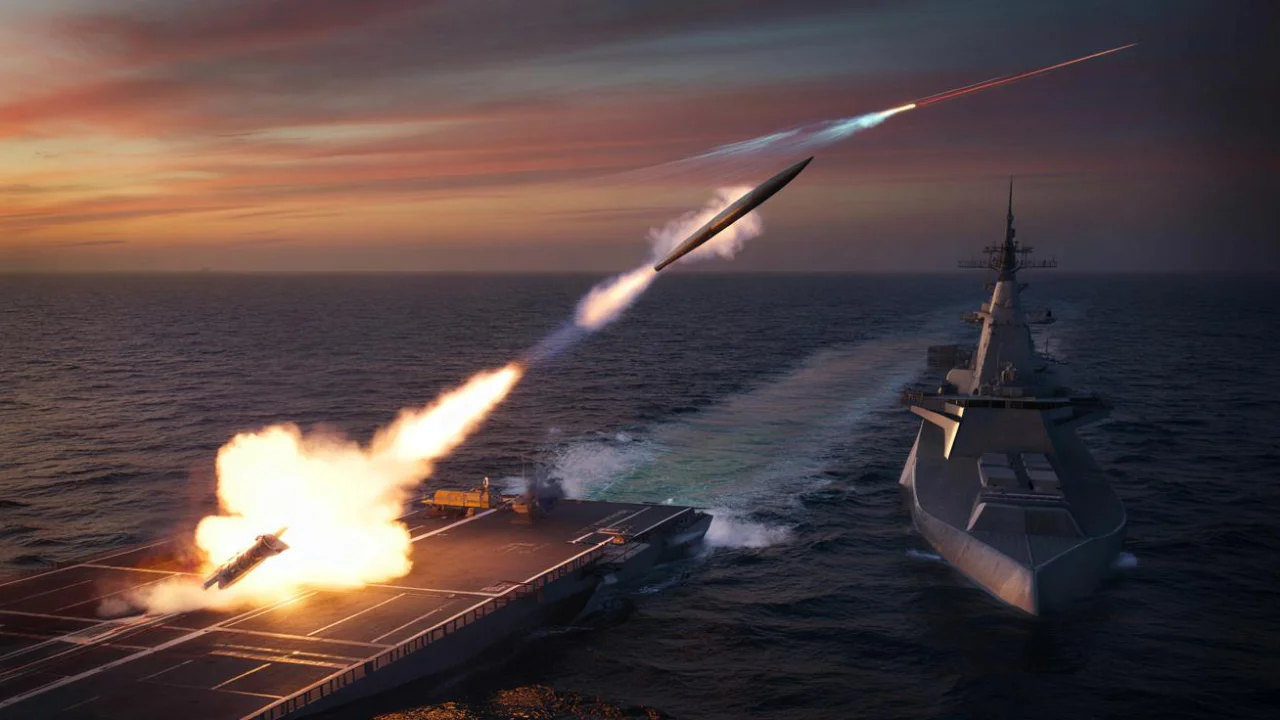
Captain Sarah Chen stared at the radar screen aboard the USS Zumwalt, watching a blip move faster than anything she’d ever tracked. “Mach 5.2 and climbing,” her weapons officer reported, voice tight with concentration. What they were witnessing wasn’t science fiction—it was the future of warfare, arriving at hypersonic speed.
This scene isn’t happening yet, but it could be reality within a few short years. The Pentagon has just committed nearly one billion euros to make hypersonic weapons a cornerstone of American naval power, fundamentally changing how future conflicts might unfold.
The investment represents more than just another defense contract. It’s a bet that the next generation of warfare will be decided not by who has the most nuclear weapons, but by who can strike anywhere on Earth within minutes using conventional firepower alone.
What Makes Conventional Prompt Strike So Revolutionary
The Conventional Prompt Strike program isn’t your typical missile system. Think of it as the military equivalent of a precision surgeon’s scalpel, but one that can reach across oceans in the time it takes you to brew a cup of coffee.
“We’re talking about hitting a target 6,000 kilometers away in under 30 minutes, without anyone knowing it’s coming until the last few seconds,” explains Dr. Michael Harrison, a defense analyst who has tracked hypersonic development for over a decade. “That changes everything about how countries think about deterrence.”
The billion-euro investment covers far more than just building missiles. Lockheed Martin, the primary contractor, will integrate these weapons onto two crucial naval platforms: the stealth Zumwalt-class destroyers and Virginia-class attack submarines.
What makes conventional prompt strike particularly appealing to military planners is its non-nuclear nature. Unlike intercontinental ballistic missiles, these weapons won’t trigger nuclear warning systems or force enemies into “use it or lose it” scenarios that could escalate conflicts beyond control.
Inside the Hypersonic Technology That’s Changing War
The technical specifications of the conventional prompt strike system read like something from a Tom Clancy novel, but they’re very real and surprisingly elegant in their simplicity.
| Component | Manufacturer | Purpose | Key Capability |
|---|---|---|---|
| Two-stage booster | Northrop Grumman | Initial acceleration | Reaches Mach 5+ speeds |
| Hypersonic glide vehicle | Dynetics | Final approach and strike | Maneuvers at hypersonic speeds |
| Launch systems | Lockheed Martin | Platform integration | Sea-based deployment |
| Guidance systems | Multiple contractors | Precision targeting | Pinpoint accuracy |
The physics behind these weapons is both beautiful and terrifying. Instead of carrying explosive warheads, conventional prompt strike missiles rely entirely on kinetic energy—the devastating power of mass multiplied by velocity squared.
“When something weighing several hundred kilograms hits a target at over 6,000 kilometers per hour, the impact alone creates destruction equivalent to a truck-sized bomb,” notes Jennifer Walsh, a former Pentagon weapons specialist. “The difference is precision—you can take out a single building without touching the one next door.”
Here are the key technical advantages that make this system so formidable:
- Speed exceeding Mach 5 makes interception nearly impossible with current defense systems
- Maneuverability during flight path confuses tracking radars
- Non-nuclear warhead reduces political barriers to deployment
- Sea-based launch platforms provide global reach and mobility
- Kinetic impact eliminates radioactive fallout concerns
How This Billion-Euro Investment Changes Global Power
The real significance of conventional prompt strike goes far beyond its technical capabilities. This investment signals a fundamental shift in American military strategy that could reshape international relations for decades.
Countries like China and Russia have been developing their own hypersonic weapons, creating what defense experts call a “hypersonic arms race.” The Pentagon’s billion-euro commitment demonstrates that America isn’t willing to fall behind in this crucial technology.
“What we’re seeing is the emergence of a new class of weapons that sits between conventional missiles and nuclear weapons,” explains retired Admiral James McKenzie. “It’s fast enough and powerful enough to take out critical targets, but doesn’t cross the nuclear threshold.”
The implications for future conflicts are staggering. Imagine a scenario where hostile forces are massing for an invasion. Instead of deploying thousands of troops or risking nuclear escalation, a single submarine could launch conventional prompt strike missiles that eliminate key command centers, radar installations, and supply depots within minutes.
This capability fundamentally changes how adversaries must think about their own defense strategies:
- High-value targets must be constantly mobile or deeply buried
- Command and control systems need multiple redundant layers
- Traditional air defense systems become largely obsolete
- The element of surprise becomes even more crucial in military planning
What This Means for You and Global Stability
You might wonder why a billion-euro weapons program matters to ordinary people going about their daily lives. The answer lies in how these technologies influence global stability and the likelihood of major conflicts.
Conventional prompt strike weapons could actually make large-scale wars less likely. When potential aggressors know that critical military assets can be eliminated within minutes of any hostile action, the incentive to start conflicts diminishes significantly.
“The goal isn’t to fight wars with these weapons—it’s to prevent wars by making aggression too costly to contemplate,” argues Dr. Lisa Rodriguez, a strategic studies professor who advises government agencies on weapons policy.
However, the technology also introduces new risks. The speed of hypersonic weapons compresses decision-making time for world leaders. When you only have minutes to respond to an incoming strike, the margin for error shrinks dramatically.
The economic implications are equally significant. This billion-euro investment represents thousands of high-tech jobs across multiple states, from engineers designing guidance systems to technicians manufacturing precision components. The ripple effects will benefit universities conducting related research and suppliers providing specialized materials.
For international travelers and global businesses, conventional prompt strike capabilities could contribute to a more stable security environment. When major powers possess credible deterrent capabilities, they’re less likely to engage in proxy conflicts or regional interventions that disrupt commerce and travel.
FAQs
How fast do conventional prompt strike missiles actually travel?
These missiles exceed Mach 5, which translates to over 6,000 kilometers per hour, allowing them to cross continents in less than 30 minutes.
Why doesn’t the Pentagon just use nuclear weapons instead?
Nuclear weapons carry massive political and strategic risks, including potential escalation to full-scale nuclear war. Conventional prompt strike provides similar deterrent effects without crossing the nuclear threshold.
Can these missiles be intercepted by current defense systems?
Current missile defense systems have extremely limited capability against hypersonic weapons due to their speed, maneuverability, and unpredictable flight paths.
Which ships will carry these new weapons?
Initially, the Zumwalt-class stealth destroyers will be equipped, followed by Virginia-class attack submarines, giving the U.S. Navy global strike capability.
How much damage can a non-explosive hypersonic missile actually cause?
The kinetic energy from impact at hypersonic speeds creates destruction equivalent to a large conventional bomb, capable of destroying buildings or heavily armored targets.
When will these weapons be operational?
While specific timelines remain classified, military analysts expect initial operational capability within the next few years, with full deployment following shortly after.


