
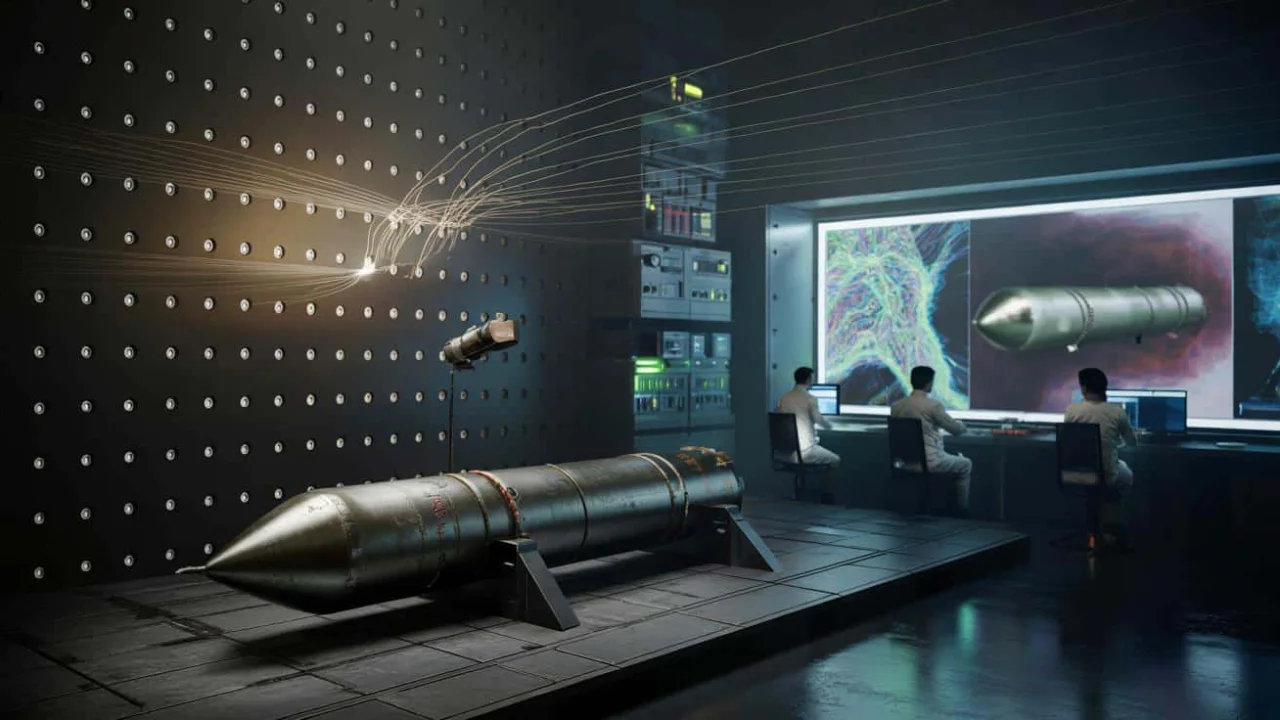
Picture this: It’s 3 AM in a sterile inspection facility somewhere in Eastern Europe. Two teams of nuclear inspectors are staring at what looks like an ordinary metal cylinder. One team insists it contains a real warhead that needs to be counted under treaty limits. The other team suspects it’s just a cleverly designed dummy meant to fool them.
For decades, this exact scenario has played out in tense rooms around the world. The stakes couldn’t be higher – get it wrong, and entire arms control agreements could crumble. Trust between nuclear powers hangs by threads thin enough that a single miscalculation could spark international incidents.
Now, China claims it has the answer to this age-old problem. Their new artificial intelligence system promises to tell real nuclear warheads from fakes with unprecedented accuracy, all while keeping military secrets locked away.
The Nuclear Shell Game That’s Haunted Diplomats for Generations
Ever since nuclear weapons entered the world stage, countries have played an elaborate game of show-and-tell. Treaties demand transparency, but national security requires secrecy. It’s like being asked to prove you own a diamond while keeping it locked in an impenetrable safe.
Traditional verification methods have been frustratingly crude. Inspectors would measure radiation levels, check weights, and use primitive scanning techniques. But sophisticated decoys could fool most of these systems. Countries learned to build fake warheads that looked, weighed, and even radiated like the real thing.
“The verification paradox has strangled arms control negotiations for decades,” explains Dr. James Morrison, a former nuclear inspector. “We needed to see inside without actually seeing inside. It’s been an impossible puzzle.”
China’s AI nuclear warhead detection system claims to solve this puzzle using neutron physics and machine learning. Instead of trying to peek inside weapons, it watches how neutrons behave when they encounter different materials.
How China’s Nuclear Detective Actually Works
The technology behind China AI nuclear warheads verification reads like science fiction, but the physics is surprisingly straightforward. When neutrons hit different materials, they bounce around in predictable patterns. Think of it like throwing marbles at various objects in a dark room – each material creates its own unique sound signature.
Here’s what makes each material special to neutron detectors:
- Enriched Uranium: Creates distinct absorption patterns that are nearly impossible to fake
- Plutonium: Generates specific neutron multiplication signatures
- Lead shielding: Produces heavy-element scattering that shows up clearly
- Steel casings: Create medium-density reflections with characteristic timing
- Composite materials: Generate complex multi-layer interaction patterns
Chinese researchers trained their AI system on millions of computer simulations. These digital tests included every conceivable type of real warhead, sophisticated decoy, simple dummy, and cleverly disguised fake they could imagine.
The breakthrough comes from combining massive computing power with advanced neutron physics. Where human inspectors might miss subtle differences, the AI can spot patterns across thousands of data points simultaneously.
| Detection Method | Accuracy Rate | Information Revealed | Security Risk |
|---|---|---|---|
| Traditional X-ray | 60-70% | Basic structure | Medium |
| Gamma ray scanning | 75-80% | Material composition | High |
| Neutron activation | 80-85% | Nuclear materials | Very High |
| China’s AI system | 95%+ (claimed) | Authentication only | Low |
“What’s revolutionary is that this system claims to give yes-or-no answers without revealing the how or why,” notes Dr. Sarah Chen, a nuclear security analyst. “If it works as advertised, inspectors could verify warheads without learning enough to build their own.”
Why This Changes Everything About Nuclear Diplomacy
The implications stretch far beyond technical capabilities. China AI nuclear warheads detection could reshape how countries approach arms control, military transparency, and strategic balance.
For arms control negotiators, this technology offers a potential breakthrough. Treaties that have stalled for years over verification disputes could suddenly become feasible. Countries might finally agree to deeper cuts in nuclear arsenals if they trust the inspection process.
But the technology also raises uncomfortable questions about nuclear balance. If China perfects this system first, they gain a significant advantage in future negotiations. Other nuclear powers might feel pressured to develop competing technologies or resist inspections entirely.
The verification revolution could affect these key areas:
- START treaties: US-Russia agreements could expand with better verification
- NATO nuclear sharing: Alliance weapons could face new scrutiny
- Non-proliferation efforts: Detecting undeclared weapons becomes more feasible
- Disarmament verification: Confirming weapon destruction gets more reliable
- Regional tensions: Neighbors could demand mutual inspections
Military strategists are watching closely too. If every nuclear power eventually adopts similar AI systems, the era of nuclear hide-and-seek could end. Weapons would become harder to conceal, potentially altering deterrence calculations that have kept the peace for decades.
“This isn’t just about counting warheads anymore,” warns former Pentagon official Michael Rodriguez. “It’s about whether nuclear secrecy as we know it can survive the age of artificial intelligence.”
The Trust Problem That Still Needs Solving
Even if China’s AI system works perfectly, it faces a fundamental challenge: getting other countries to trust it. Nuclear verification has always been as much about politics as technology. Nations don’t just want accurate results – they want to understand and control how those results are obtained.
International adoption would require extensive testing, peer review, and probably joint development programs. The AI algorithms would need to be transparent enough to build confidence without revealing sensitive details about how they work.
There’s also the question of what happens when this technology spreads. Today’s breakthrough could become tomorrow’s standard equipment, available to any country willing to pay for it. That democratization of nuclear verification capability could destabilize regions where nuclear ambiguity currently maintains peace.
The timeline for deployment remains unclear. China has published research papers about the technology but hasn’t demonstrated it publicly or offered it for international testing. Converting laboratory success into diplomatic reality typically takes years or even decades.
FAQs
How accurate is China’s AI nuclear warhead detection system?
China claims over 95% accuracy, but this hasn’t been independently verified by international observers or competing nuclear powers.
Could other countries develop similar AI verification systems?
Yes, the underlying physics and AI techniques are well-established. The main challenge is accessing enough training data and computing resources.
Would this technology make nuclear weapons obsolete?
No, it only helps with verification and detection. Nuclear weapons would remain potent military tools even if they become harder to hide.
How soon could this AI system be used in actual arms control inspections?
International deployment would likely take 5-10 years minimum, requiring extensive testing, diplomatic negotiations, and trust-building measures.
What prevents countries from simply refusing AI-based inspections?
Nothing, legally. Arms control remains voluntary, and nations can withdraw from treaties if verification requirements become unacceptable to them.
Could this technology be used to find hidden nuclear weapons programs?
Potentially, but it would require access to suspected sites. The AI system needs to physically scan objects to determine if they’re real warheads.


