
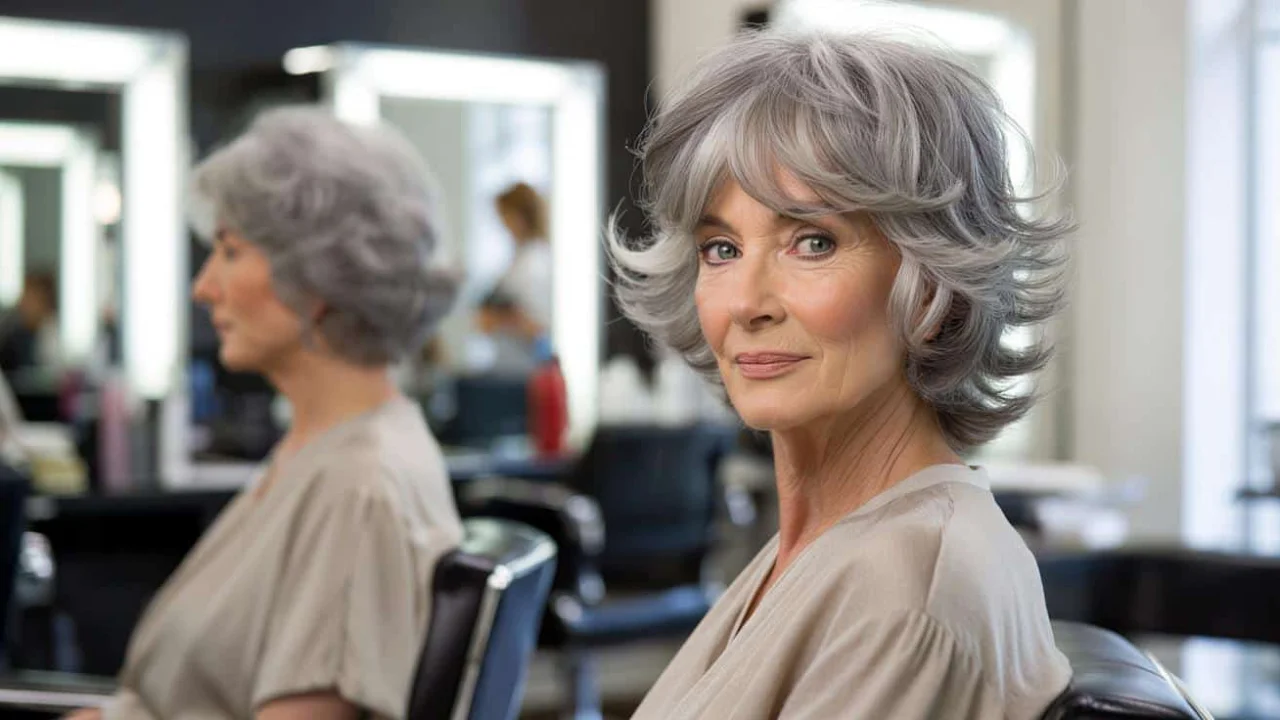
Margaret stared at her reflection in the salon mirror, her fingers nervously smoothing down her silver hair. At 65, she’d been getting the same “sensible” bob for fifteen years – neat, curved under at the chin, never a strand out of place. But today, she clutched a magazine photo of Helen Mirren sporting a tousled, layered cut with wispy bangs that looked effortlessly chic.
“I brought this,” she whispered to her stylist, sliding the photo across like contraband. “But maybe it’s too young for me?”
Her stylist, Maria, had seen this dance a thousand times. Women over 60 walking in with inspiration photos, then backing down at the last second, choosing safety over style. What Margaret didn’t know was that she was about to become part of a quiet revolution happening in salons across the country.
The Truth Behind Conservative Cuts After 60
Professional stylists are speaking out about a phenomenon they see daily: women over 60 requesting hairstyles driven by insecurity rather than personal preference. The “age-appropriate” cuts many women default to often have nothing to do with elegance and everything to do with fear.
“I have clients who bring me photos of stunning, modern cuts, then immediately apologize and ask for something ‘more suitable,'” says celebrity stylist Roberto Martinez. “They’re not choosing conservative styles because they love them – they’re choosing them because they think they have to.”
The most requested hairstyles after 60 tell a revealing story. Tight perms, helmet-like bobs, and ultra-short crops dominate salon appointment books. These aren’t necessarily bad cuts, but they’re often chosen for the wrong reasons – to hide, minimize, or conform rather than to express personality or enhance natural beauty.
What’s particularly striking is how many women arrive with inspiration photos they never show their stylists. They’ve done the research, found cuts they love, but lack the confidence to ask for what they actually want.
Breaking Down the Most Popular Styles and Their Real Impact
Understanding which hairstyles after 60 actually work – and why – requires looking beyond the surface of “appropriate” versus “inappropriate.” Here’s what professional stylists see making the biggest difference:
| Hair Type | Conservative Choice | Bold Alternative | Real Impact |
|---|---|---|---|
| Fine, thinning hair | Short, tight perm | Textured bob with layers | Creates volume without appearing artificial |
| Thick, gray hair | Blunt bob at jawline | Long layers with side-swept bangs | Showcases natural silver while adding movement |
| Wavy, coarse hair | Ultra-short crop | Shoulder-length shag | Works with natural texture instead of fighting it |
The key differences aren’t about length or color – they’re about working with natural hair characteristics rather than against them. The most successful hairstyles after 60 embrace texture, movement, and individual face shapes.
“When clients stop trying to hide their hair and start celebrating it, that’s when the magic happens,” explains master stylist Jennifer Chen. “A 70-year-old with a modern shag can look more vibrant than a 40-year-old with a boring bob.”
The bold style that’s proving this point? The textured shag with long, piece-y bangs. It’s becoming the go-to choice for women ready to break free from conservative constraints.
Why the Modern Shag Is Changing Everything
The textured shag represents everything traditional “age-appropriate” styling rejects. It’s messy instead of neat. It moves instead of staying put. It draws attention instead of disappearing into the background.
Yet this supposedly “inappropriate” cut is delivering results that safe styles can’t match:
- Creates the illusion of fuller hair through strategic layering
- Softens facial features with face-framing pieces
- Requires minimal styling for maximum impact
- Works with natural hair movement rather than fighting it
- Looks intentionally tousled, not accidentally messy
The long, sweeping bangs that define this cut serve multiple purposes. They hide forehead lines without looking obvious, create vertical lines that elongate the face, and add a youthful element without appearing costume-like.
“I’ve had 65-year-old clients tell me they feel like themselves again after getting this cut,” says stylist Amanda Torres. “Not a younger version of themselves – just themselves, without apology.”
The maintenance factor is another surprise advantage. While traditional “neat” cuts require frequent touch-ups to maintain their precise lines, the textured shag looks better as it grows out. The deliberately imperfect nature means slight variations enhance rather than detract from the overall look.
The Ripple Effects of Bold Hair Choices
What happens when women over 60 embrace adventurous hairstyles extends far beyond the salon chair. Stylists report that clients who make bold hair choices often experience broader lifestyle changes.
They start experimenting with makeup they’d avoided for years. They update their wardrobes with pieces that complement their new confidence. They stop apologizing for taking up space or expressing opinions.
“Hair is often the first step,” observes color specialist David Kim. “When someone feels good about how their hair looks, it affects everything else. Posture changes. Energy shifts. They start saying yes to things they’d been avoiding.”
The social response is equally telling. While many women fear judgment for “age-inappropriate” choices, the opposite typically occurs. Compliments increase. Conversations become more engaging. People respond to confidence, regardless of the hairstyle that creates it.
The economic impact shouldn’t be overlooked either. Women who feel confident about their appearance are more likely to pursue career opportunities, social activities, and personal goals they might have previously dismissed as “not for someone my age.”
This shift challenges fundamental assumptions about aging and appearance. Instead of viewing 60+ as a time to become invisible, it positions it as an opportunity for authentic self-expression without the constraints of earlier decades.
FAQs
Will a modern cut like a textured shag work with thinning hair?
Yes, strategic layering can actually make thinning hair appear fuller by creating movement and texture that adds visual volume.
How do I know if a bold hairstyle will suit my face shape?
The best approach is consulting with a professional stylist who can adapt any cut to your specific features and hair characteristics.
Are there any hairstyles after 60 that are genuinely inappropriate?
The only inappropriate hairstyle is one that makes you feel uncomfortable or inauthentic – age has nothing to do with it.
How much maintenance do textured cuts require compared to traditional styles?
Surprisingly less – textured cuts are designed to look good slightly messy, while precise cuts show every imperfection as they grow out.
What if I try a bold cut and hate it?
Hair grows, and most dramatic cuts can be modified gradually if needed. The bigger risk is spending years in a style that doesn’t make you happy.
Should I consider my lifestyle when choosing hairstyles after 60?
Absolutely, but don’t assume that means choosing the most conservative option – many modern cuts are actually lower maintenance than traditional “safe” styles.


