
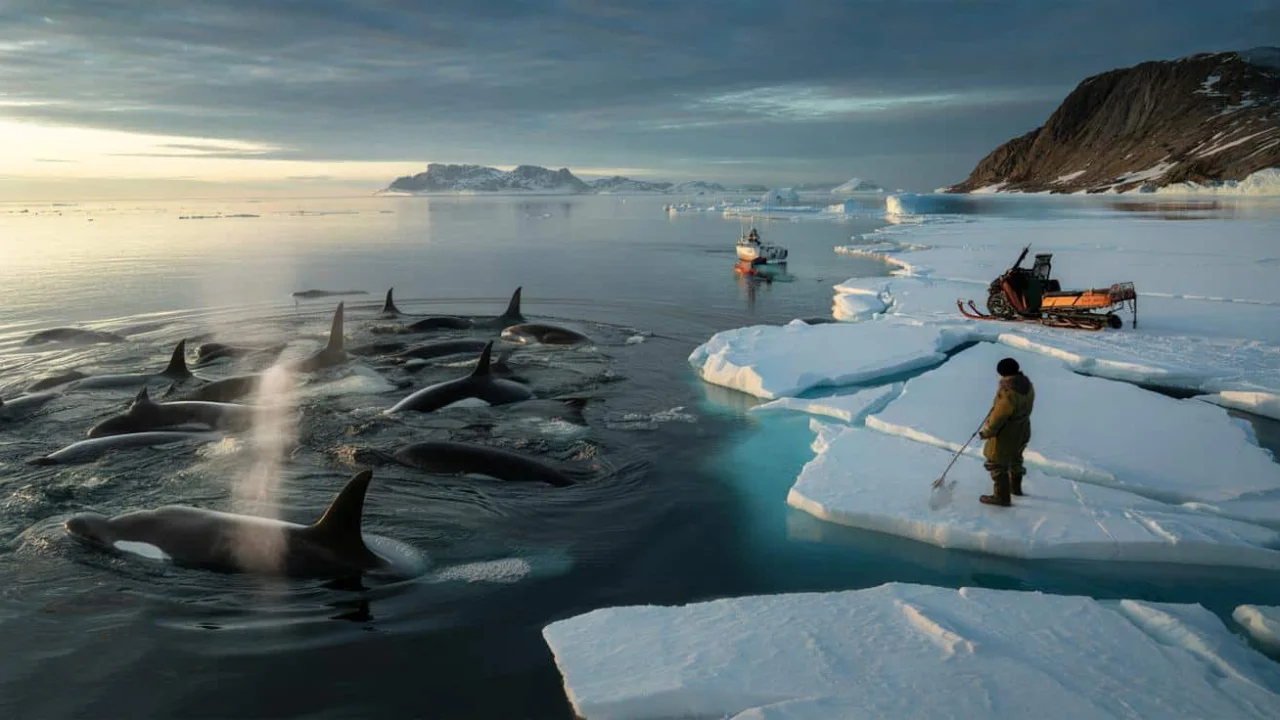
Maria Kristensen was putting her youngest son to bed when the emergency siren cut through the quiet February evening in Nuuk. Her first thought was fire, maybe at the harbor. But when she stepped outside, neighbors were already gathering on the street, pointing toward the fjord with a mix of excitement and worry she’d never seen before.
There, moving like dark shadows against the ice, were orcas. Not one or two, but an entire pod, their fins cutting through water that should have been frozen solid. Maria’s neighbor, an elder who’d lived through decades of Arctic winters, shook his head slowly. “The ice isn’t right,” he said. “And now they’re here.”
Within an hour, Greenland’s emergency services had issued their unprecedented warning: orcas spotted dangerously close to rapidly melting ice, immediate evacuation of ice-dependent activities required.
When Arctic Waters Break All the Rules
The orcas Greenland ice situation isn’t just about whales showing up in unexpected places. It’s about an entire ecosystem shifting faster than anyone anticipated. These apex predators, normally confined to the open ocean edges, are now swimming deep into fjords that were once protected by thick, multi-year sea ice.
Local hunters who’ve spent their lives reading ice conditions describe the current situation as “surreal.” The ice formations that typically last through spring are breaking apart in February, creating dangerous conditions for both humans and marine life.
“We’ve been hunting these waters for generations, but this is completely new territory,” explains Jakob Nielsen, a veteran hunter from Qaanaaq. “The orcas are following pathways that didn’t exist before. The ice is talking, but it’s speaking a language we’re still learning.”
Scientists tracking the phenomenon through satellite data confirm what local communities are witnessing firsthand. Warmer Atlantic water is pushing northward, undermining ice stability from below while rising air temperatures attack from above.
The Numbers Behind the Crisis
Understanding the scale of this emergency requires looking at the hard data. The interaction between orcas Greenland ice patterns reveals alarming trends that extend far beyond this single incident.
| Location | Normal Ice Thickness (February) | Current Ice Thickness | Orca Sightings (Past Month) |
|---|---|---|---|
| Nuuk Fjord | 80-120 cm | 20-40 cm | 15 pods |
| Ilulissat | 100-150 cm | 30-60 cm | 8 pods |
| Kullorsuaq | 120-180 cm | 40-80 cm | 12 pods |
| Qaanaaq | 150-200 cm | 60-100 cm | 6 pods |
The emergency response measures put in place include:
- Immediate suspension of all ice-based hunting and fishing activities
- Establishment of 500-meter safety zones around orca sightings
- Daily ice condition monitoring and public safety bulletins
- Emergency rescue teams positioned at high-risk locations
- Coordination with marine biologists to track orca movement patterns
Dr. Sarah Mitchell from the Arctic Research Institute explains the broader implications: “These orcas are essentially following new ocean highways created by climate change. What we’re seeing in Greenland is a real-time preview of how rapidly Arctic ecosystems can shift.”
Living on the Front Lines of Change
For Greenland’s coastal communities, the orcas represent more than just an interesting wildlife encounter. They’re a symbol of how quickly their traditional way of life is being challenged by forces beyond their control.
Fishing boat captain Lars Møller had to turn back from his planned route when orcas appeared near unstable ice formations. “It’s not just about the whales being dangerous,” he says. “It’s that everything we know about reading the water and ice is changing faster than we can adapt.”
The economic impact extends beyond individual fishing trips. Tourism operators who rely on stable ice conditions for their winter programs have had to cancel bookings. Traditional hunting routes used for centuries are no longer safe or predictable.
Children in affected communities are experiencing this transformation as part of their normal childhood, but elders worry about the loss of traditional knowledge. When the ice behaves differently every year, how do you pass down survival skills that took generations to develop?
Emergency services coordinator Anne Lynge notes that response protocols developed for Arctic conditions may need complete revision. “We’re dealing with scenarios that weren’t in any of our planning documents,” she explains. “The orcas Greenland ice emergency is showing us gaps in our preparedness we didn’t know existed.”
What Happens Next
The immediate crisis may pass as orcas move on to other hunting grounds, but the underlying conditions that brought them so far into Greenlandic waters aren’t going anywhere. Scientists predict that similar incidents will become more frequent as ice conditions continue to deteriorate.
Local authorities are already developing new safety protocols that account for unpredictable ice conditions and increased marine mammal activity in previously frozen areas. These changes will likely become permanent features of Arctic life.
For the orcas themselves, accessing new feeding grounds might seem like a positive development. But marine biologists warn that rapid ecosystem changes often create instability that affects all species, including the apex predators taking advantage of new opportunities.
The Greenlandic government has announced plans for expanded monitoring programs and updated emergency response capabilities specifically designed for climate-related wildlife encounters. This emergency may be the first of many as Arctic conditions continue to shift.
FAQs
Why are orcas appearing near Greenland’s ice now?
Warmer ocean temperatures and rapidly melting ice are creating new pathways for orcas to access areas that were previously blocked by thick sea ice.
Are these orcas dangerous to humans?
Orcas rarely attack humans, but the unstable ice conditions they’re associated with create significant safety risks for people on or near the ice.
How long will this emergency situation last?
The immediate orca presence may be temporary, but the underlying ice conditions that allowed their access are expected to persist and worsen.
Is this happening in other Arctic regions?
Similar patterns are being observed across the Arctic, with orcas expanding their range into previously ice-covered waters in Alaska, northern Canada, and Norway.
What can local communities do to stay safe?
Following emergency guidelines, avoiding unstable ice areas, maintaining communication with authorities, and updating traditional safety practices for changing conditions.
Will this affect Greenland’s marine ecosystem long-term?
Yes, the arrival of apex predators like orcas in new areas typically causes significant changes to local food chains and marine biodiversity patterns.


