
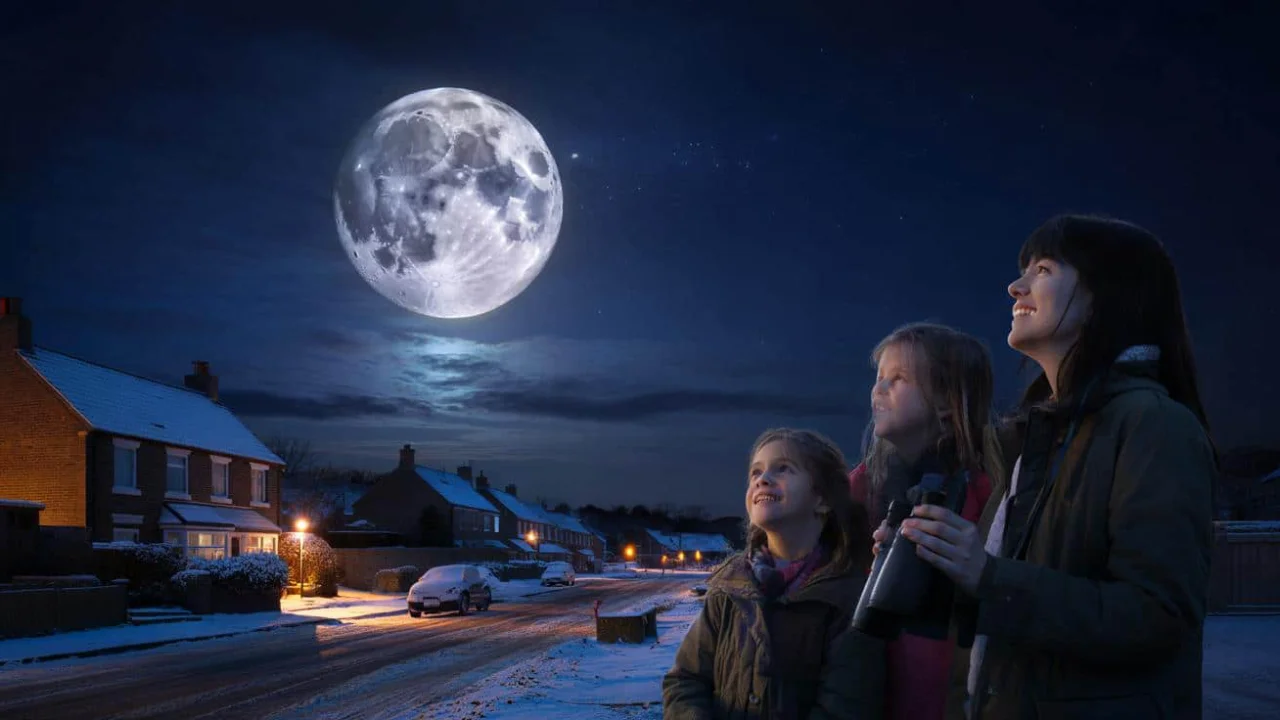
Sarah rushed her kids to the car after their evening football practice, glancing up at the bright orb hanging in the February sky. “Mom, why is the moon so big tonight?” her seven-year-old asked from the backseat. She paused, realizing she’d been so caught up in daily routines that she’d barely noticed the spectacular snow moon illuminating their small town.
Millions of people like Sarah missed the exact moment when February’s snow moon reached its peak brightness on Sunday night at 10:09 PM UK time. But here’s the thing that makes this celestial event special – you haven’t actually missed it at all.
The snow moon might have officially peaked, but your window to witness this stunning lunar display is still wide open. For the next few nights, you can step outside and see what appears to be a perfectly full moon lighting up the winter sky.
Why You Still Have Time to Catch the Snow Moon
The human eye simply can’t detect the subtle changes that happen immediately after a full moon peaks. What astronomers call the “full” phase actually extends over several nights for casual observers like us.
“The difference between 99% and 100% illumination is virtually impossible to spot without specialized equipment,” explains Dr. Emily Rodriguez, a lunar researcher at the National Observatory. “Most people will see what looks like a completely full moon for at least two to three days after the official peak.”
As we move through this week, the snow moon will gradually transition into what’s called a waning gibbous phase. The illuminated portion will start shrinking from the right-hand side if you’re viewing from the Northern Hemisphere, but it’ll still appear remarkably bright and nearly complete.
This means families across the UK and beyond can still enjoy spontaneous moon-gazing sessions without any special planning or equipment. Just step outside after dark, look up, and there it is – February’s headline celestial event still putting on quite a show.
The Fascinating Story Behind the Snow Moon’s Name
February’s full moon carries the name “snow moon” for deeply practical reasons rooted in survival and tradition. Indigenous communities in what is now the northeastern United States coined this term because February typically brought their heaviest snowfalls and harshest winter conditions.
Different tribal groups sometimes used alternative names, but they all reflected the same brutal reality of late winter survival. Some called it the “Hunger Moon,” marking the period when food stores ran dangerously low and hunting became nearly impossible through deep snow.
Others referred to it as the “Storm Moon,” acknowledging the fierce winter weather that could trap families in their shelters for days. These names weren’t just poetic – they served as vital reminders of what to expect during this challenging time of year.
“These traditional moon names represent a completely different relationship with the night sky,” notes cultural historian Dr. Michael Thompson. “The moon wasn’t just beautiful – it was a crucial calendar and clock that guided survival decisions.”
European settlers gradually adopted these Indigenous names, and they’ve filtered into modern culture through observatories, almanacs, and now social media feeds. Today’s snow moon represents the same celestial event, but our relationship with it has fundamentally changed.
Key Details About February’s Snow Moon
Understanding the snow moon becomes easier when you break down the essential facts and timing. Here’s what sky-watchers need to know about this month’s lunar spectacle:
| Detail | Information |
|---|---|
| Peak Time | Sunday, 10:09 PM UK time |
| Visibility Duration | Appears full for 2-3 nights after peak |
| Best Viewing Time | Just after sunset through midnight |
| Next Phase | Waning gibbous (shrinking from right side) |
| Position in Year | Second full moon of the year |
| Alternative Names | Hunger Moon, Storm Moon, Bone Moon |
The snow moon follows a predictable pattern that makes it accessible to casual observers. Unlike some astronomical events that require specific timing or locations, this lunar display accommodates busy schedules and unpredictable weather.
Key viewing tips include:
- No special equipment needed – your naked eye captures the full beauty
- City lights don’t significantly diminish the viewing experience
- Any clear patch of sky works, even between buildings
- The moon rises earlier each night, making it visible during family-friendly hours
- Cloudy weather just means trying again the next night
“The beauty of full moon viewing is its flexibility,” says amateur astronomy guide Janet Liu. “Unlike meteor showers or eclipses, you don’t need perfect conditions or precise timing to enjoy the show.”
What This Means for Stargazers and Families
The snow moon’s extended visibility creates opportunities that busy families often miss with other astronomical events. Parents juggling work schedules, school activities, and household responsibilities can still share this natural wonder with their children without elaborate planning.
Photography enthusiasts will find the next few nights ideal for capturing lunar images. The nearly full moon provides excellent lighting for landscape photography, while the slightly waning phase can actually create more interesting shadows and dimensional effects than a perfectly round moon.
For those interested in lunar observation, this period offers a perfect introduction to moon watching. The bright illumination makes it easy to spot major lunar features like craters and maria (the dark patches that early astronomers thought were seas).
“This is exactly how I got my kids interested in astronomy,” shares parent and amateur astronomer Mark Stevens. “We started with easy wins like full moons, and gradually worked up to more complex observations.”
The snow moon also represents a seasonal marker that connects us to natural cycles often forgotten in our indoor, artificially-lit world. February’s harsh weather historically made this full moon a beacon of hope – a bright light promising that spring would eventually return.
Schools and youth groups can use this extended viewing window to organize simple outdoor activities or science lessons. The combination of accessibility and cultural significance makes the snow moon an ideal introduction to both astronomy and cultural history.
Weather permitting, the next few nights offer a rare chance to disconnect from screens, step outside, and experience the same celestial event that has captivated humans for thousands of years. The snow moon reminds us that some of the most spectacular shows in the universe require nothing more than looking up.
FAQs
How long will the snow moon appear full to the naked eye?
Most people will see what looks like a completely full moon for 2-3 nights after the official peak, with noticeable dimming becoming apparent after about a week.
Do I need any special equipment to see the snow moon properly?
No special equipment is needed. The snow moon is bright enough to enjoy with just your naked eye, though binoculars can reveal interesting surface details if you’re curious.
Why is February’s full moon called the snow moon instead of other names?
While it has several traditional names like Hunger Moon and Storm Moon, “Snow Moon” became the most popular because February historically brought the heaviest snowfall to many regions.
What time is best for viewing the snow moon this week?
The moon is most spectacular just after sunset and remains visible throughout the night, but you can see it clearly any time after dark when the sky is relatively clear.
Will city lights prevent me from seeing the snow moon clearly?
City lights won’t significantly impact your ability to see and enjoy the snow moon, as it’s bright enough to shine through most urban light pollution.
When is the next full moon after the snow moon?
March’s full moon, traditionally called the Worm Moon, will occur about a month after February’s snow moon, continuing the monthly cycle of lunar phases.


