
Maria Santos had been hunting shipwrecks for twenty years when she first heard the fisherman’s story. He was an old-timer from Geraldton, hands weathered like driftwood, telling anyone who’d listen about “something big” his nets kept catching on. Most people nodded politely and changed the subject. Maria bought him another beer and pulled out her notebook.
That conversation three years ago led to one of the most extraordinary discoveries in maritime archaeology. The fisherman’s “something big” turned out to be the find of a lifetime—an explorer’s ship found perfectly preserved after disappearing 250 years ago, sitting on the ocean floor like it was waiting for its crew to return.
Sometimes the greatest discoveries start with the simplest conversations. And sometimes, they change how we understand our past forever.
When History Refuses to Stay Buried
The moment sonar revealed that pristine ship outline on the seafloor off Western Australia, everyone in the research vessel knew they were looking at something impossible. Ships from the 1700s don’t survive this well. They’re supposed to be scattered timber and rusted metal, picked clean by centuries of ocean currents and marine life.
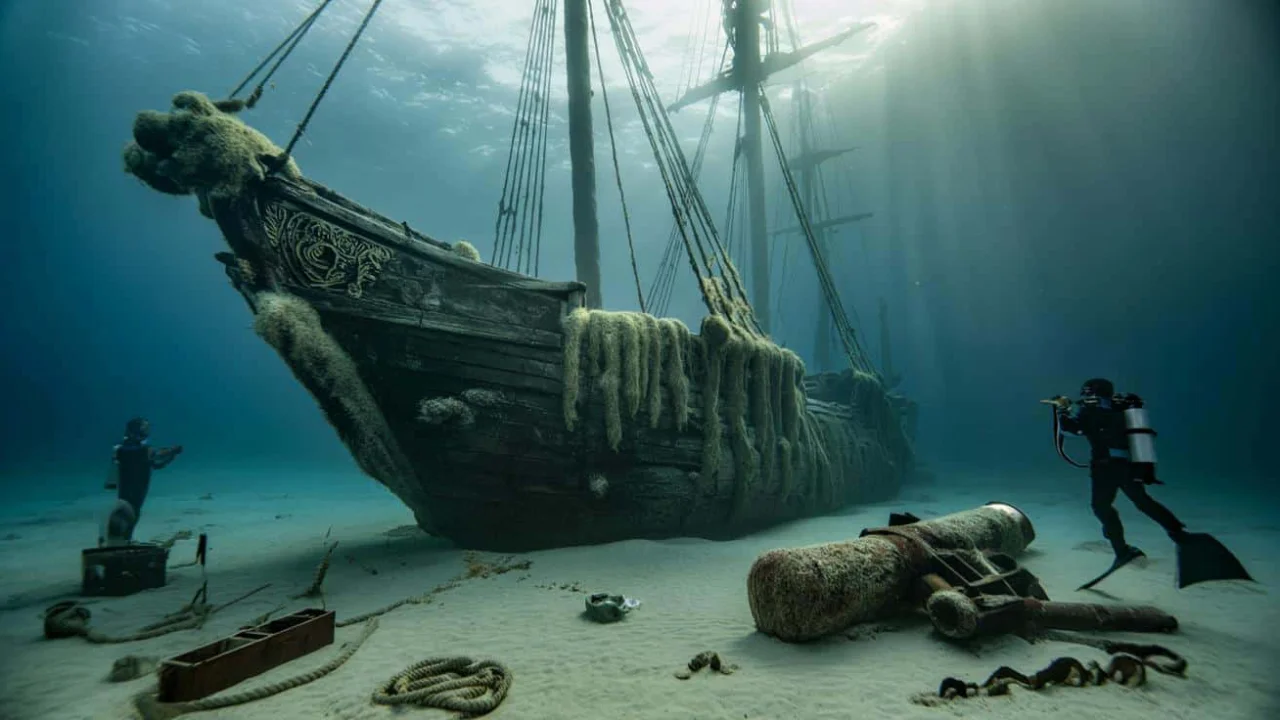
Yet there it was—an 18th-century tall ship sitting upright on the seabed, its hull lines so sharp and clean that crew members joked it looked “parked rather than wrecked.” The explorers ship found beneath 40 meters of water has become a time capsule that’s rewriting what scientists thought they knew about underwater preservation.
This isn’t just any vessel. Historical records suggest this ship belonged to the Age of Discovery, when European explorers pushed into uncharted waters with nothing but primitive navigation tools and unshakeable determination. These sailors mapped coastlines, collected specimens, and documented cultures that had never seen Europeans before.
“Finding a ship this intact from that era is like discovering a perfectly preserved house from colonial times,” explains Dr. James Mitchell, a maritime archaeologist who wasn’t involved in the discovery. “Every rope, every tool, every personal belonging tells us something new about how these people lived and worked.”
What Makes This Discovery So Remarkable
The preservation level of this explorers ship found off Australia’s coast defies normal expectations. Most wooden vessels from the 1700s disintegrate within decades, but this one survived due to a perfect storm of environmental factors.
Here’s what researchers discovered during their initial surveys:
- Original timber planking still curved in elegant ship lines
- Decorative stern carvings visible under coral growth
- Cannon positioned exactly where the crew left them
- Coils of rope and rigging hardware intact
- Navigation instruments potentially still in the captain’s quarters
- Personal belongings scattered throughout crew areas
The ship’s remarkable condition comes down to three key factors working together:
| Factor | How It Helped Preservation |
|---|---|
| Water Temperature | Cold, stable temperatures slowed decay |
| Oxygen Levels | Low oxygen prevented most bacterial growth |
| Sea Floor Type | Soft sediment cushioned the ship’s landing |
| Location | Remote area avoided shipping traffic damage |
| Depth | 40 meters kept it below most destructive currents |
Dr. Sarah Chen, an oceanographer studying the site conditions, notes that “this combination of preservation factors is incredibly rare. It’s like the ocean created a natural museum just for this vessel.”
The discovery team used advanced sonar mapping and underwater drones to document the wreck before any human divers approached it. Their footage shows a ship that looks more like a movie set than a 250-year-old wreck.
What This Means for Our Understanding of History
This explorers ship found intact is giving historians unprecedented insights into 18th-century maritime life. Unlike museum pieces or artistic representations, this vessel shows exactly how sailors lived, worked, and explored during the Age of Discovery.
Preliminary investigations suggest the ship carried scientific equipment, specimen collection tools, and detailed charts of uncharted waters. These weren’t just merchants or military vessels—they were floating laboratories pushing the boundaries of human knowledge.
“We’re seeing personal items, work tools, and navigation equipment exactly as they were used,” explains Professor Robert Hayes, a colonial history expert. “It’s like stepping into a crew member’s daily routine from 1773.”
The impact extends beyond academic circles. This discovery could reshape museum exhibits, educational programs, and our understanding of early Australian exploration. The ship represents a direct connection to the people who first mapped Australia’s dangerous western coastline.
Researchers are particularly excited about potential astronomical instruments and charts that might still be preserved in the ship’s sealed compartments. Navigation techniques from that era relied heavily on star positions and detailed logbooks that rarely survived other shipwrecks.
The preservation is so complete that archaeologists hope to recover intact examples of ship construction techniques, rope-making methods, and tool designs that have been lost to history. Some experts believe this could be the most complete 18th-century vessel ever studied.
The Long Road to Recovery
Finding the ship was just the beginning. Now comes the delicate work of documenting, preserving, and possibly raising artifacts without destroying them. The team faces challenges that didn’t exist when this explorers ship found its final resting place centuries ago.
Every item brought to the surface must be immediately treated to prevent rapid deterioration. Wood that’s been underwater for 250 years can crumble in hours when exposed to air and different temperatures.
Current plans include creating a detailed 3D map of the entire wreck site before disturbing anything. Underwater archaeologists will spend months documenting the position of every rope, tool, and cannon before any recovery attempts begin.
The Australian government is working with international maritime archaeology experts to ensure this discovery receives the scientific attention it deserves. They’re also consulting with indigenous groups whose ancestors may have witnessed the original shipwreck.
“This isn’t just about preserving artifacts,” says Maria Santos, the archaeologist who started this hunt with a fisherman’s story. “We’re preserving a moment in time when everything changed—when the world became connected for the first time.”
FAQs
How was the ship preserved so well after 250 years underwater?
The combination of cold water, low oxygen levels, soft seabed, and remote location created perfect preservation conditions that prevented normal decay.
What kind of ship is this exactly?
Based on initial surveys, it appears to be an 18th-century exploration vessel used for mapping and scientific research during the Age of Discovery.
Will they raise the entire ship to the surface?
That decision hasn’t been made yet. Researchers are focusing on detailed documentation and careful artifact recovery first.
How do they know it’s 250 years old?
The ship’s design, construction methods, and historical records of missing vessels from that period all point to the 1770s era.
Can the public see the wreck?
The site is currently restricted to research teams, but plans for public education programs and museum displays are being developed.
What’s the most exciting thing they hope to find?
Researchers are particularly interested in navigation instruments, charts, scientific equipment, and personal belongings that could provide new insights into 18th-century exploration.


