
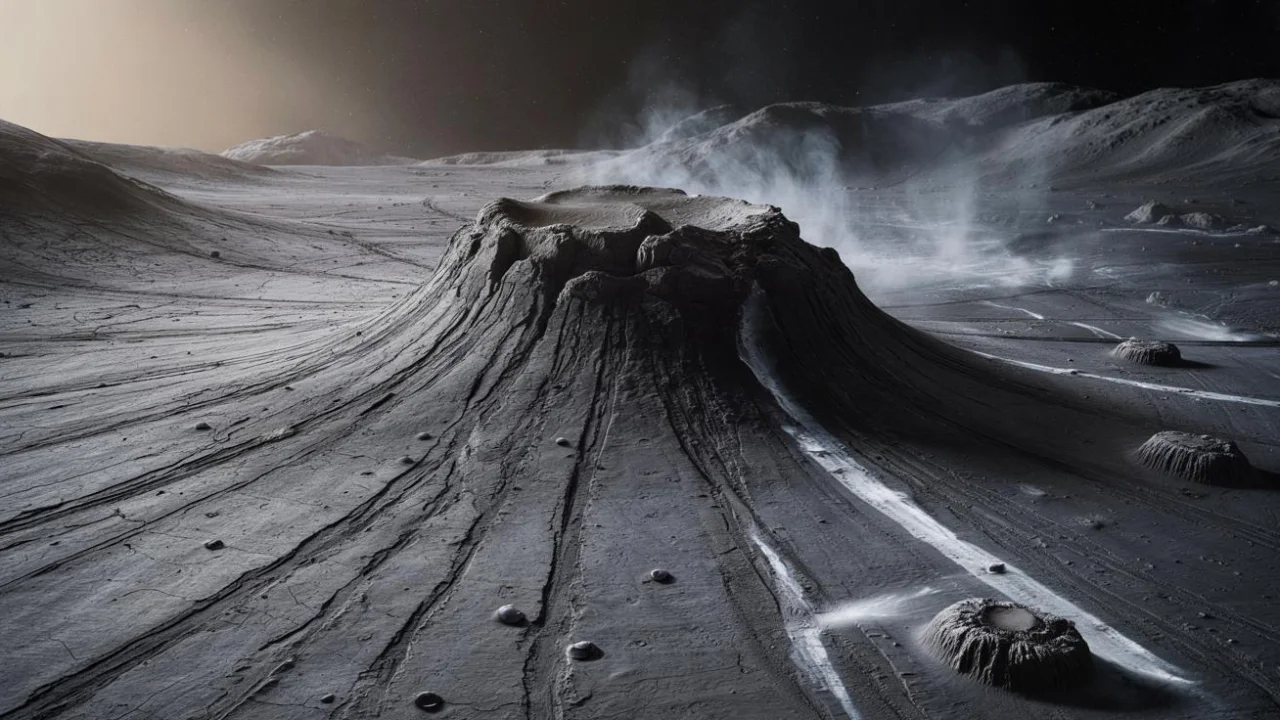
Sarah Chen was scrolling through her astronomy forum at 2 AM when she stopped dead. The image filling her screen looked like nothing she’d ever seen from space—geometric ridges, perfectly parallel grooves, and what appeared to be metallic studs arranged in neat rows across a charcoal-black surface.
“This can’t be real,” she whispered to her sleeping cat. But it was. The European Space Agency had just released the sharpest images ever taken of interstellar comet ATLAS, and they were breaking the internet.
Within hours, Sarah’s quiet corner of the web exploded. Comments poured in from around the globe. Some called it the smoking gun for alien intelligence. Others dismissed it as wishful thinking. But everyone agreed on one thing: this comet looked nothing like what they expected.
When Space Rocks Start Looking Like Spacecraft
The interstellar comet ATLAS—officially designated 3I/ATLAS—arrived in our solar system like an uninvited guest carrying mysterious baggage. Unlike our familiar comets that orbit the sun in predictable patterns, this visitor came from deep space, somewhere beyond the influence of our star.
For months, ATLAS remained just another faint dot tracked by telescopes. That changed when an ESA probe managed an unprecedented close flyby, capturing images that would spark one of the most heated debates in modern astronomy.
The photos revealed a world that defied expectations. Instead of the dirty snowball scientists anticipated, ATLAS appeared as a jagged, coal-black object covered in structures that looked unnervingly artificial.
“The first time I saw those images, my jaw literally dropped,” says Dr. Michael Torres, a planetary scientist at the University of Arizona. “The level of geometric precision we’re seeing is extraordinary, even for natural processes.”
Breaking Down the Bizarre Features
The controversy centers around specific features that appear almost manufactured. Analysis of the high-resolution images has revealed several striking characteristics that have both scientists and conspiracy theorists buzzing:
- Parallel Ridge Systems: Straight lines running across the surface with mathematical precision
- Hexagonal Pits: Six-sided depressions arranged in patterns reminiscent of honeycomb structures
- Raised Nodes: Button-like protrusions spaced at regular intervals
- Right-Angle Fractures: Cracks forming perfect 90-degree angles
- Linear Seams: Bright lines that appear to separate distinct surface sections
| Feature Type | Size Range | Distribution | Scientific Explanation |
|---|---|---|---|
| Parallel Ridges | 10-50 meters wide | Concentrated on north pole | Thermal stress fractures |
| Hexagonal Pits | 5-15 meters across | Scattered globally | Gas venting from subsurface |
| Raised Nodes | 1-3 meters diameter | Linear arrangements | Differential erosion patterns |
| Linear Seams | 100+ meters long | Equatorial regions | Structural boundaries |
The most controversial image shows what appears to be a section of the comet’s surface covered in parallel tracks with regularly spaced “bolts” between them. Under magnification, the resemblance to manufactured components becomes eerily convincing.
“When you zoom in on certain sections, your brain immediately goes to artificial explanations,” admits Dr. Lisa Nakamura from the Jet Propulsion Laboratory. “The patterns are that regular, that geometric.”
The Scientific Reality Check
While the images are undeniably striking, mainstream scientists are urging caution. The same processes that create natural wonders on Earth can produce seemingly artificial patterns in space, especially under the extreme conditions of interstellar travel.
Planetary geologists point to several well-understood mechanisms that could explain the interstellar comet ATLAS’s unusual appearance:
- Thermal cycling causing regular fracture patterns
- Differential sublimation creating geometric voids
- Impact cratering on low-gravity bodies
- Radiation weathering over millions of years
- Outgassing creating linear channel systems
Dr. Amanda Foster, who studies comet geology, explains the phenomenon: “When ice sublimates in regular patterns, it can create structures that look manufactured. Add millions of years of cosmic radiation and gravitational stresses, and you get formations that seem impossible but are entirely natural.”
The scientific community has seen similar controversies before. The famous “Face on Mars” turned out to be a trick of light and shadow. The mysterious radio signals from space often have mundane explanations. Pattern recognition is hardwired into human psychology—we find meaning even in random data.
Why This Matters Beyond the Headlines
Regardless of whether the structures on interstellar comet ATLAS are natural or artificial, their discovery is reshaping our understanding of what’s possible in deep space. The images represent the most detailed look we’ve ever had at an object from outside our solar system.
The controversy highlights the challenges facing modern space science. Social media amplifies speculation faster than peer review can provide answers. By the time scientists publish their analysis, public opinion has often crystallized around more sensational explanations.
“We’re dealing with unprecedented detail from an unprecedented visitor,” notes Dr. James Rodriguez, who studies interstellar objects. “The fact that it looks strange doesn’t make it alien—it makes it interesting.”
The debate over ATLAS also reflects broader questions about life in the universe. With thousands of exoplanets discovered and growing evidence of habitable conditions throughout the galaxy, the possibility of encountering artificial objects from other civilizations seems less far-fetched than it once did.
Whether the features on interstellar comet ATLAS prove to be natural or something more extraordinary, they’re forcing scientists to expand their toolkit for analyzing cosmic visitors. Future missions will carry more sophisticated instruments, and analysis techniques will become more rigorous.
The ongoing study of ATLAS is also pushing the boundaries of image processing and pattern recognition. Advanced AI systems are being trained to distinguish between natural geological processes and potentially artificial structures—skills that could prove valuable as we encounter more interstellar visitors.
FAQs
What makes interstellar comet ATLAS different from regular comets?
ATLAS originated outside our solar system and shows unusual geometric surface features that appear almost manufactured, unlike the typical irregular shapes of local comets.
How close did the probe get to ATLAS?
The ESA probe achieved a flyby distance of approximately 500 kilometers, capturing the highest resolution images ever taken of an interstellar object.
Are the “artificial” features really that geometric?
Yes, some features show parallel lines, right angles, and regular spacing that are unusually precise for natural formations, though scientists believe natural processes can explain them.
How fast is ATLAS traveling?
The interstellar comet ATLAS is moving at roughly 40 kilometers per second relative to the sun, typical for objects arriving from deep space.
Will we get more images of ATLAS?
Unfortunately, ATLAS is already moving away from the inner solar system, making additional close observations extremely difficult with current technology.
What happens if scientists prove the structures are artificial?
Such a discovery would revolutionize our understanding of the universe and likely trigger the largest scientific investigation in human history, though current evidence points to natural explanations.


