
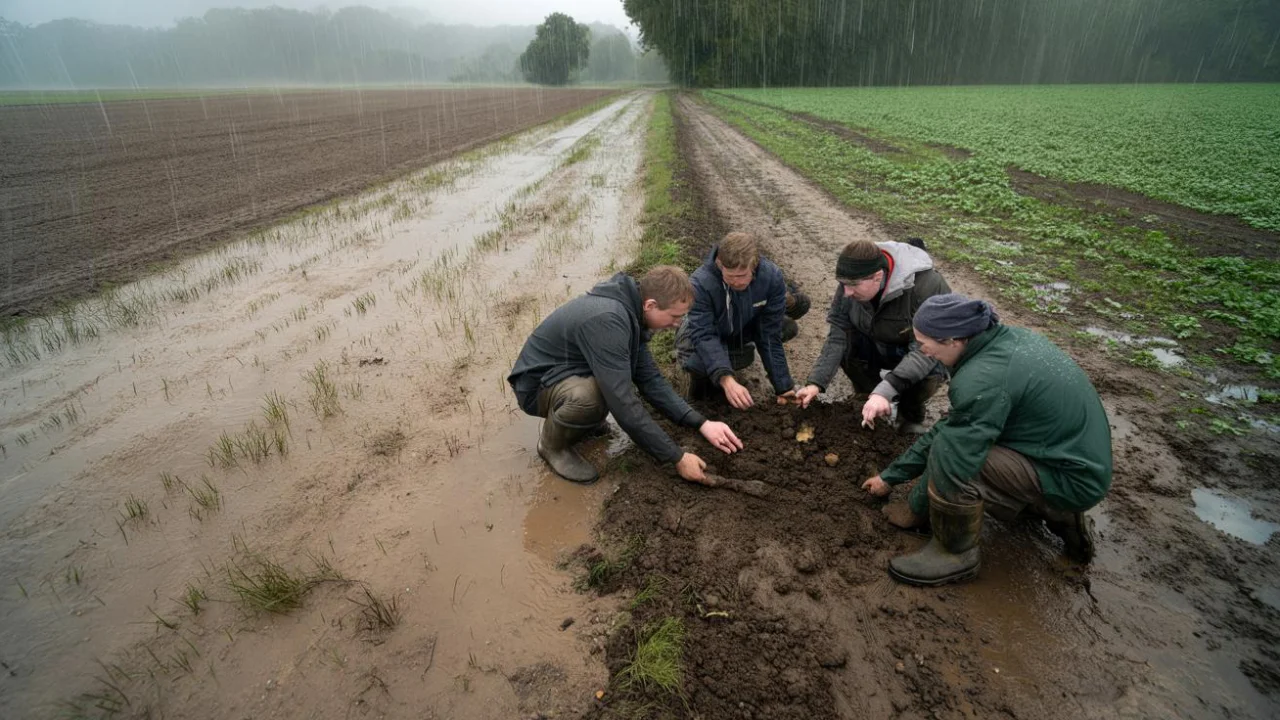
Sarah Martinez still remembers the morning she watched her neighbor’s cornfield turn into a lake while hers stayed perfectly dry. Both farms had received the same four-inch downpour overnight in rural Iowa last August. Yet across the fence line, the difference was startling.
Her neighbor’s field, worked hard with heavy machinery for decades, couldn’t absorb the sudden deluge. Water pooled everywhere, drowning young corn plants and washing precious topsoil into the creek. Meanwhile, Sarah’s soil—built up over five years with cover crops and careful management—drank every drop like a thirsty sponge.
“That’s when it hit me,” Sarah says. “All this talk about climate change and extreme weather—maybe the solution isn’t just in the sky. Maybe it’s right under our feet.”
The Hidden Connection Between Dirt and Climate Survival
Scientists are discovering that soil health climate resilience represents one of our most powerful tools against increasingly unpredictable weather patterns. What looks like ordinary brown dirt actually functions as nature’s insurance policy against floods, droughts, and extreme temperatures.
Dr. James Chen, a soil scientist at the University of California Davis, explains it simply: “Healthy soil is like a giant underground storage system. It can hold 20 times its weight in water, slowly releasing it during dry spells and preventing floods during heavy rains.”
The difference lies in soil structure. Living, healthy soil contains billions of microorganisms, fungi networks, and organic matter that create tiny spaces and tunnels. These microscopic pathways allow water to infiltrate quickly and stay put when needed. Degraded soil, by contrast, becomes compacted and sealed—turning farmland into something resembling a parking lot.
Recent research from agricultural universities across Europe and North America confirms this connection. Fields with just 1-2% higher organic matter showed dramatically better performance during extreme weather events, with some farms reducing flood damage by up to 80%.
The Science Behind Soil’s Climate Superpowers
Understanding how soil health climate resilience works requires looking at what happens beneath the surface. Healthy soil operates as a complex ecosystem with several key characteristics that make it climate-resistant:
- Water infiltration: Living soil can absorb up to 6 inches of rain per hour, while degraded soil manages less than 0.5 inches
- Water storage: Each 1% increase in organic matter allows soil to hold an additional 16,500 gallons per acre
- Temperature regulation: Rich soil stays 10-15°F cooler than bare or compacted ground during heat waves
- Carbon sequestration: Healthy soil stores 2-3 times more carbon than degraded soil, removing CO2 from the atmosphere
- Biological diversity: A teaspoon of healthy soil contains more microorganisms than there are people on Earth
Dr. Maria Santos, lead researcher at the International Soil Health Institute, puts it in perspective: “We’re talking about a living system that’s been perfected over millions of years. When we damage it, we lose all these natural climate protections.”
| Soil Condition | Water Absorption Rate | Flood Risk | Drought Resilience | Carbon Storage |
|---|---|---|---|---|
| Healthy Living Soil | 4-6 inches/hour | Very Low | High | High |
| Average Farm Soil | 1-2 inches/hour | Moderate | Moderate | Moderate |
| Degraded/Compacted Soil | 0.1-0.5 inches/hour | Very High | Very Low | Very Low |
The mechanism works through something scientists call “aggregate stability.” When soil organisms break down organic matter, they produce sticky substances that glue soil particles together into small clumps or “aggregates.” These structures create the pore spaces that allow water and air to move freely through the soil.
Real-World Impact: From Farms to Cities
The connection between soil health climate resilience extends far beyond agriculture. Urban areas implementing soil restoration projects report significant improvements in flood management and heat reduction.
Milwaukee, Wisconsin, invested $2.3 million in improving soil health across city parks and green spaces. During the record-breaking storms of 2022, neighborhoods with restored soil experienced 40% less flooding compared to areas with conventional landscaping.
Farmers are seeing even more dramatic results. Tom Richardson, who manages 1,200 acres in Nebraska, switched to regenerative practices five years ago. His soil now contains 4.2% organic matter compared to the regional average of 1.8%.
“Last year we had a month without rain, then got hit with three inches in two hours,” Richardson recalls. “My neighbor lost half his crop to drought stress and then flooding. My corn never missed a beat.”
The economic implications are staggering. The USDA estimates that improved soil health could prevent $2.8 billion in annual flood damage while reducing crop losses from drought by 35%. For individual farmers, the benefits include:
- Reduced need for irrigation during dry spells
- Lower fertilizer costs due to improved nutrient cycling
- Decreased erosion and topsoil loss
- Higher crop yields during extreme weather events
- Improved long-term land values
Building Tomorrow’s Climate Defense System
The path to better soil health climate resilience doesn’t require revolutionary technology—just returning to practices that work with nature instead of against it. Cover crops, reduced tillage, diverse crop rotations, and strategic grazing all help rebuild soil structure and biology.
Dr. Chen emphasizes the timeline: “People think soil improvement takes decades, but we’re seeing measurable changes in water infiltration within 12-18 months. The biology responds quickly when you give it what it needs.”
Policy makers are taking notice. The European Union’s Green Deal includes €1.8 billion specifically for soil health initiatives. The U.S. Farm Bill now offers significant payments to farmers who adopt soil-building practices.
For homeowners, the principles apply on any scale. Adding compost to garden beds, avoiding soil compaction, and keeping living roots in the ground year-round all contribute to local climate resilience.
As extreme weather becomes the new normal, the solution might literally be beneath our feet. Every handful of healthy soil represents millions of years of evolution creating the perfect climate adaptation system—one that’s been waiting for us to rediscover its power.
FAQs
How quickly can soil health improve climate resilience?
You can see measurable improvements in water absorption within 6-12 months of implementing soil-building practices, with major benefits typically visible within 2-3 years.
Does improving soil health require expensive equipment or chemicals?
No, most soil health improvements involve reducing inputs rather than adding them—like using cover crops, reducing tillage, and avoiding unnecessary chemical applications.
Can urban areas benefit from soil health improvements?
Absolutely. Cities implementing soil restoration in parks, street medians, and green spaces report significant reductions in flooding and urban heat island effects.
What’s the difference between healthy soil and regular dirt?
Healthy soil is alive with billions of microorganisms, has good structure with air pockets, and contains 3-6% organic matter, while degraded soil is compacted, lifeless, and contains less than 1% organic matter.
How does soil health help during both floods and droughts?
Healthy soil acts like a sponge—quickly absorbing excess water during storms to prevent flooding, then slowly releasing stored moisture to plants during dry periods.
Is there scientific proof that soil health affects climate outcomes?
Yes, numerous peer-reviewed studies show that increasing soil organic matter by just 1% can help soil hold an additional 16,500 gallons of water per acre and significantly reduce both flood and drought damage.


