
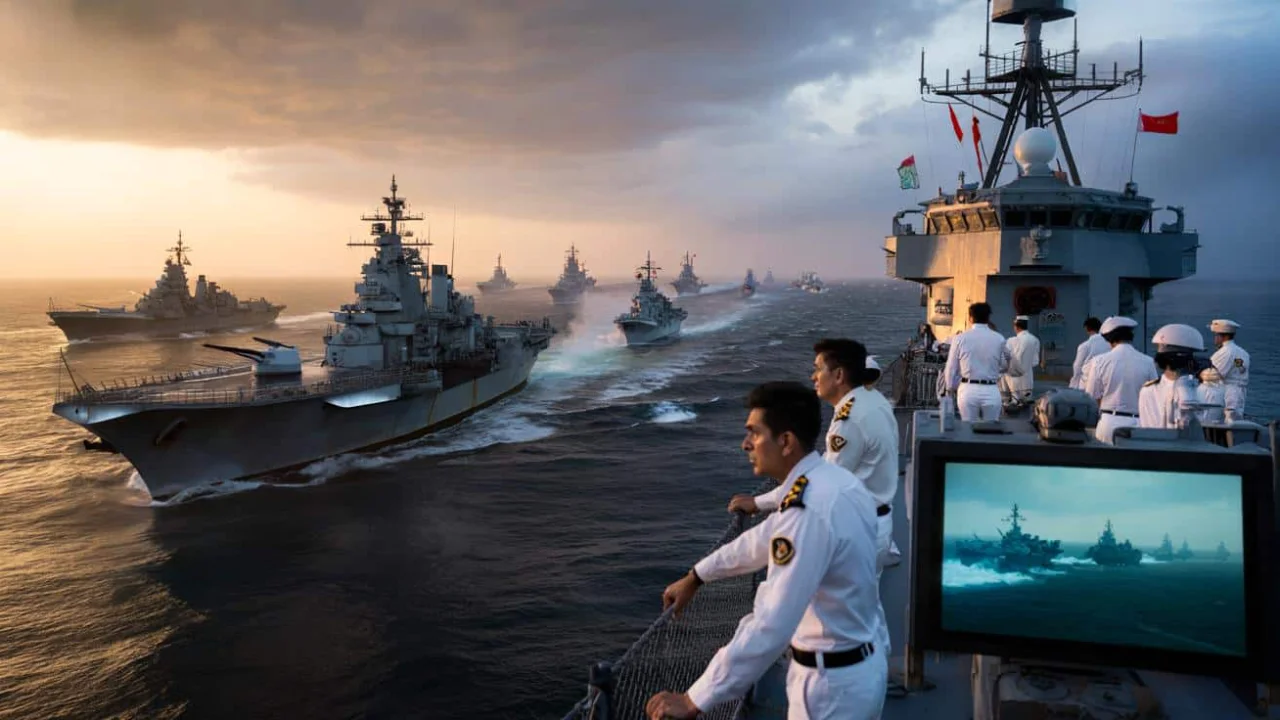
Captain Rajesh Sharma remembers the exact moment everything changed for him. Standing on the bridge of his destroyer in the Arabian Sea last spring, he watched through binoculars as a sleek Chinese frigate passed just outside India’s territorial waters. What struck him wasn’t the ship itself, but the casual confidence of its crew waving from the deck.
“Ten years ago, we barely saw Chinese warships this far west,” Sharma told his officers that evening. “Now they’re practically neighbors.” His radio crackled with reports of more Chinese vessels spotted near the Maldives, Sri Lanka, and Pakistan’s coast. The Indian Ocean, once India’s backyard, was getting crowded.
This scene plays out daily across India’s naval command centers, where officers track an unprecedented Chinese naval expansion that’s reshaping the balance of power in Asian waters.
When Your Neighbor Decides to Build the World’s Largest Navy
The numbers tell a stark story. China’s plan to acquire 50 new warships represents just the latest wave in a naval buildup that has defense analysts in New Delhi working overtime. Chinese naval expansion isn’t just about adding ships – it’s about fundamentally changing who controls the sea lanes that India depends on for survival.
For a country where 90% of trade moves by sea, this hits differently than distant military posturing. Every Chinese destroyer launched in Shanghai ripples through Indian strategic planning like a stone dropped in still water.
“We’re watching them build a navy that could challenge us in our own neighborhood,” explains retired Admiral Vikram Singh, who spent decades patrolling these same waters. “That’s not a scenario we ever thought we’d face twenty years ago.”
The Chinese naval expansion has accelerated dramatically since 2020. What once looked like gradual modernization now resembles an industrial sprint toward naval dominance. Chinese shipyards are launching major warships at a pace that leaves other navies struggling to keep up, let alone compete.
Breaking Down China’s Naval Shopping List
The scope of Chinese naval expansion becomes clearer when you look at what they’re actually building. It’s not just quantity – it’s the type of ships that has Indian strategists losing sleep.
| Ship Type | Current Chinese Fleet | Planned Additions | Strategic Impact |
|---|---|---|---|
| Aircraft Carriers | 3 | 2-3 more | Power projection far from home |
| Destroyers | 32+ | 15-20 | Air defense and strike capability |
| Frigates | 50+ | 20-25 | Anti-submarine warfare |
| Submarines | 60+ | 10-15 | Stealth operations |
The Chinese naval expansion includes several game-changing capabilities:
- Long-range anti-ship missiles that can reach 1,000+ kilometers
- Advanced radar and sonar systems for tracking enemy movements
- Nuclear-powered submarines capable of staying submerged for months
- Amphibious assault ships designed for power projection
- Support vessels that extend operational range far from Chinese ports
“They’re not just building ships, they’re building a complete naval ecosystem,” notes maritime security expert Dr. Priya Menon. “That’s what makes this expansion so concerning for India.”
What makes these numbers particularly worrying for India is the speed of construction. Chinese shipyards can complete a major warship in 18-24 months, while Indian naval projects often stretch across decades.
How This Changes Everything for India’s Ocean
The real impact of Chinese naval expansion isn’t felt in conference rooms or strategy papers. It’s visible in fishing villages along India’s coast, where local fishermen report more encounters with unfamiliar warships. It’s evident in shipping insurance rates that tick upward as maritime tensions rise.
Indian naval officers describe a subtle but significant shift in regional dynamics. Chinese submarines now regularly transit through the Indian Ocean, often surfacing near ports in Pakistan or Sri Lanka to make their presence known. Chinese survey ships map the ocean floor with unusual intensity, gathering data that could prove crucial in future conflicts.
The Malacca Strait, once considered firmly within India’s sphere of influence, now sees regular Chinese naval patrols. Trade routes that Indian strategists assumed they could control in a crisis are increasingly contested waters.
“Every month brings reports of Chinese naval vessels in places we used to consider our exclusive domain,” says Commander Sarah Joseph from the Indian Naval War College. “It’s psychological warfare as much as it is military positioning.”
For India’s neighbors, Chinese naval expansion creates difficult choices. Countries like Bangladesh, Myanmar, and the Maldives find themselves courted by both powers, often playing one against the other for better deals on ports, loans, and security guarantees.
The economic implications ripple through regional trade patterns. Shipping companies adjust routes based on naval presence. Port authorities weigh the benefits of Chinese investment against potential Indian displeasure. Insurance companies factor military tensions into their risk calculations.
India’s Response Strategy Takes Shape
Indian naval planners aren’t sitting idle while Chinese naval expansion reshapes their strategic environment. New Delhi has launched its own crash program to modernize and expand the Indian Navy, though at a pace that struggles to match China’s industrial capacity.
India’s counter-strategy involves several key elements:
- Accelerated indigenous shipbuilding programs
- Stronger naval partnerships with the US, Japan, and Australia
- Enhanced surveillance capabilities across the Indian Ocean
- Deeper military cooperation with friendly regional nations
- Development of advanced anti-ship missile systems
The challenge for India lies not just in matching Chinese numbers, but in developing the technological sophistication that modern naval warfare demands. Chinese naval expansion includes cutting-edge sensors, communications, and weapons systems that take years to develop and deploy.
“We’re playing catch-up in a race where the finish line keeps moving,” admits a senior Indian naval officer who requested anonymity. “But we’re not giving up our ocean without a fight.”
Regional allies are watching this naval competition with growing concern. Smaller nations worry about being caught between two rising powers, while major players like Japan and Australia see Chinese naval expansion as a direct threat to their own security interests.
FAQs
Why is China expanding its navy so rapidly?
China wants to protect its trade routes and project power beyond its immediate neighbors, transforming from a regional to a global naval power.
How many ships does China’s navy currently have?
China operates over 350 naval vessels, making it the world’s largest navy by number of ships, though not necessarily by total displacement or capability.
What can India do to counter Chinese naval expansion?
India is building more ships, strengthening alliances with other naval powers, and developing advanced missile systems to maintain strategic balance.
Are there any diplomatic solutions to this naval competition?
Both countries engage in regular dialogue, but fundamental strategic interests make compromise difficult as long as Chinese naval expansion continues.
How does this affect global shipping and trade?
Rising naval tensions increase shipping insurance costs and force companies to consider alternative routes, potentially affecting global supply chains.
Could this naval competition lead to actual conflict?
While both sides prefer to avoid direct confrontation, the risk of miscalculation increases as more warships operate in contested waters.


