
Sarah stares at her laptop screen, watching a chatbot draft the same type of marketing email she’s been writing for three years. The AI finishes in thirty seconds what usually takes her an hour. She feels a weird mix of relief and dread—like watching someone else do your laundry, but knowing they might never give it back.
Her phone buzzes with a news alert about another company replacing customer service reps with AI. Sarah closes her laptop and wonders: what happens when the robots get really good at everything?
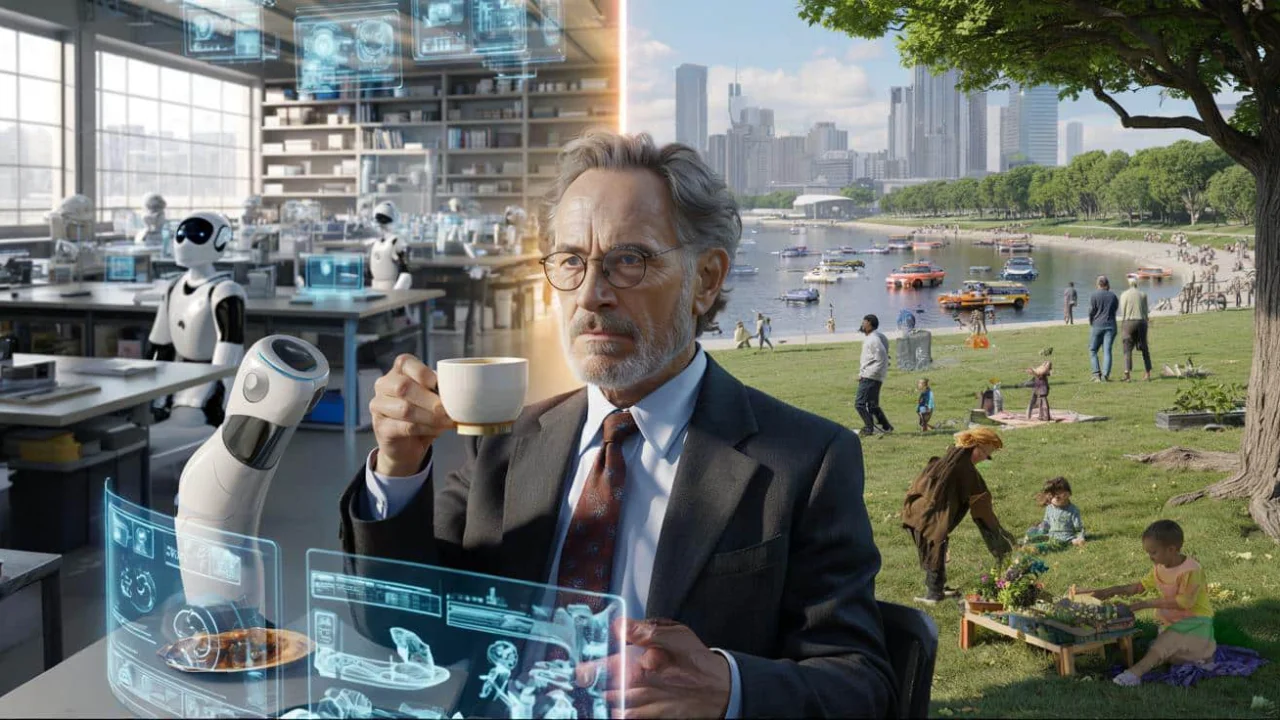
According to a Nobel Prize-winning physicist, that future isn’t coming—it’s already here. And surprisingly, he thinks Elon Musk and Bill Gates might be right about what comes next.
When Nobel Winners Start Talking Like Tech Billionaires
Giorgio Parisi, who won the Nobel Prize in Physics in 2021, recently made headlines by agreeing with something that sounds straight out of a Silicon Valley conference room. The future of work automation, he argues, will fundamentally reshape how humans spend their time.
Musk has long predicted a world where “work becomes optional” thanks to AI and robotics. Gates envisions people having “a lot more free time” as AI handles routine tasks. What makes Parisi’s endorsement striking is that he’s approaching this from pure physics and data analysis, not tech evangelism.
“We’re not just seeing incremental improvements,” Parisi explains in recent interviews. “This is a phase transition, like water becoming steam. The entire structure changes.”
The numbers back up his physics-based perspective. AI can now write code, analyze legal documents, create art, and even perform surgery with robotic assistance. Unlike previous automation waves that targeted manual labor, this one is coming for knowledge workers too.
The Jobs Most Likely to Vanish (And the Ones That Won’t)
Recent studies paint a clear picture of which careers face the biggest disruption from automation. The future of work automation isn’t hitting every job equally—there’s a distinct pattern emerging.
| High Risk Jobs | Low Risk Jobs | Timeline |
|---|---|---|
| Data entry clerks | Therapists and counselors | 2-5 years |
| Basic bookkeepers | Skilled tradespeople | 3-7 years |
| Customer service reps | Creative professionals | 2-6 years |
| Routine legal research | Teachers and trainers | 5-10 years |
| Basic financial analysis | Healthcare workers | 3-8 years |
The pattern is clear: jobs requiring human connection, creativity, or complex problem-solving in unpredictable environments remain safer. Meanwhile, routine cognitive tasks—even sophisticated ones—are increasingly vulnerable.
Here are the key factors determining job security in an automated world:
- Requires emotional intelligence and human empathy
- Involves complex decision-making in unpredictable situations
- Needs creative problem-solving or artistic expression
- Demands physical dexterity in unstructured environments
- Involves building trust and long-term relationships
“The irony is that the most ‘human’ jobs are becoming the most valuable,” notes labor economist Dr. Maria Rodriguez. “AI can beat us at chess, but it struggles to comfort a crying child or fix a broken pipe in a cramped basement.”
What “More Free Time” Actually Looks Like
The promise of increased free time sounds appealing until you dig into the details. Historical precedent offers both hope and concern about how this transition might unfold.
When the industrial revolution automated agricultural work, displaced farmers didn’t immediately enjoy leisure. They moved to cities and worked in factories—often under worse conditions. The benefits of increased productivity took decades to translate into shorter work weeks and better living standards.
Gates envisions AI assistants handling routine tasks, freeing people for more meaningful work. “Imagine if AI could read all your emails, summarize the important ones, and draft responses for your approval,” he suggests. “That alone could save hours every day.”
But Musk’s vision goes further. He predicts “universal high income” where productivity gains are shared broadly, allowing people to pursue passion projects, learning, or simply rest. The key question is whether society will distribute these benefits fairly.
Early signs are mixed. Some companies are using AI to reduce staff while maintaining output. Others are retraining workers for higher-value roles. The difference often comes down to leadership philosophy and policy frameworks.
“We’re at a crossroads,” explains technology historian Dr. James Chen. “We could end up with a leisure class and a struggling class, or we could figure out how to share the productivity gains. The technology doesn’t determine the outcome—our choices do.”
The Hidden Challenges Nobody’s Talking About
While the promise of more free time sounds appealing, psychologists warn about potential downsides that could reshape society in unexpected ways.
Work provides more than income—it offers purpose, social connection, and identity. Studies of people who retire early or win lotteries reveal that sudden freedom from work can lead to depression and a sense of purposelessness.
“Humans are wired to contribute and feel needed,” explains behavioral psychologist Dr. Sarah Kim. “If AI handles most productive tasks, we’ll need to completely reimagine how people find meaning and structure in their lives.”
The transition period poses additional challenges. As the future of work automation accelerates, millions of workers may face job displacement faster than new opportunities emerge. Unlike previous technological shifts that unfolded over generations, AI development happens in months or years.
Countries are already experimenting with solutions. Finland tested universal basic income. Singapore is retraining entire industries. South Korea is considering robot taxes to fund social programs. These pilot programs offer glimpses of possible futures.
The physicist Parisi remains optimistic but realistic: “The technology will deliver the productivity gains. Whether we use them wisely depends on our social and political choices. Physics can predict the capabilities of machines—it can’t predict the wisdom of humans.”
FAQs
Will AI really eliminate most jobs?
Not eliminate, but dramatically change. Most experts predict AI will automate specific tasks rather than entire jobs, forcing workers to adapt and learn new skills.
How long do we have before major job displacement happens?
It’s already happening gradually. Most economists expect significant acceleration over the next 5-10 years, with full impact emerging over 15-20 years.
What jobs are actually safe from automation?
Jobs requiring creativity, emotional intelligence, complex problem-solving in unpredictable environments, and skilled physical work in unstructured settings remain relatively safe.
Will everyone really have more free time, or just the wealthy?
That depends on policy choices. The technology could create leisure for everyone or concentrate benefits among capital owners—society will decide through regulations and social programs.
Should I be worried about my career?
Stay informed and adaptable. Focus on developing skills that complement rather than compete with AI—creativity, emotional intelligence, complex reasoning, and human connection.
What can governments do to help workers transition?
Options include retraining programs, universal basic income, shorter work weeks, robot taxes to fund social programs, and policies encouraging companies to share productivity gains with workers.


