
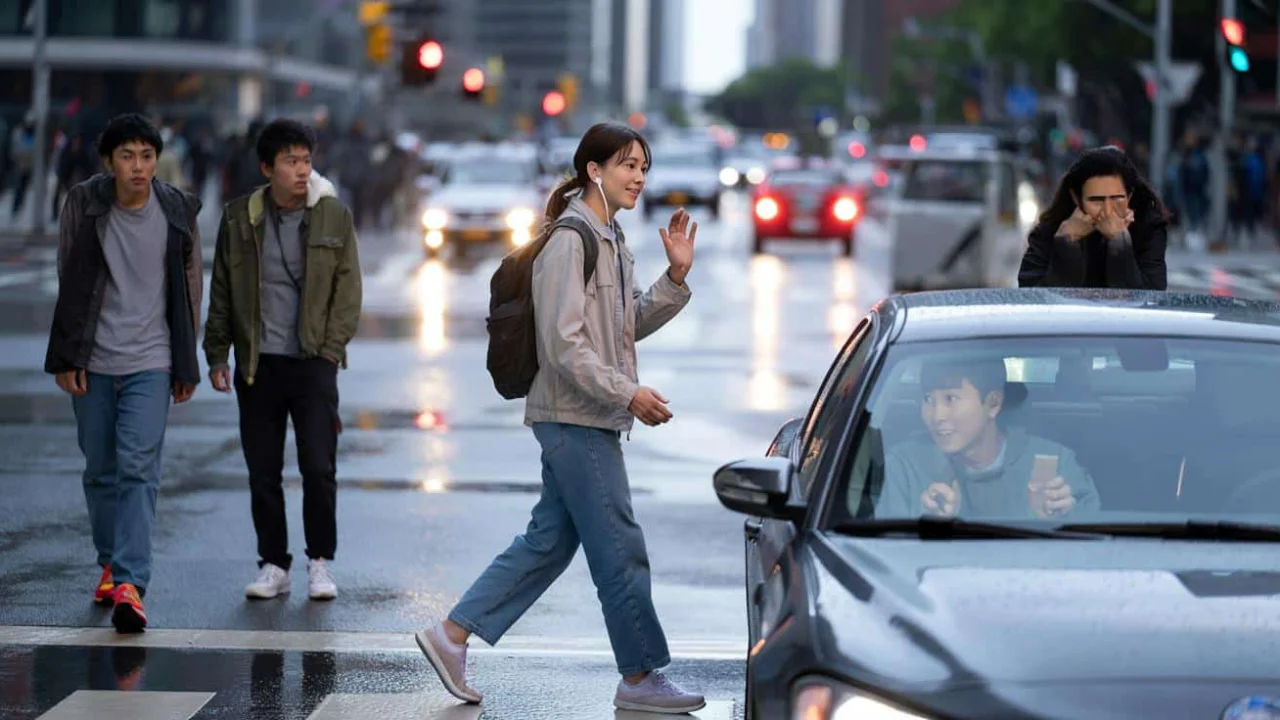
Sarah hurries across Fifth Avenue during the morning rush, rain droplets clinging to her jacket. A delivery truck stops just as the light changes, the driver catching her eye through the windshield. Without thinking, she raises her hand in a quick wave and mouths “thank you.” Her friend Jake, walking beside her, rolls his eyes. “Why do you always do that? They’re supposed to stop anyway.”
Sarah pauses on the sidewalk, suddenly aware of something she’s done thousands of times without question. “I don’t know,” she admits. “It just feels right.”
That simple gesture – thanking cars while crossing the street – happens millions of times daily in cities worldwide. Most people never think twice about it. But psychologists are discovering that this tiny moment reveals profound truths about who we are when no one’s watching.
The psychology behind street gratitude
Watch any busy intersection for ten minutes and you’ll witness a fascinating social experiment. Some pedestrians cross with eyes straight ahead, treating drivers like obstacles rather than people. Others make brief eye contact, offer a small wave, or nod acknowledgment even when they have the right of way.
“These micro-interactions are windows into personality,” explains Dr. Rachel Martinez, a behavioral psychologist at Columbia University. “People who thank drivers during routine crossings often demonstrate higher levels of empathy and social awareness in other areas of their lives.”
The act itself seems meaningless. Legally, drivers must yield to pedestrians at crosswalks. Yet some people feel compelled to acknowledge this basic courtesy, transforming a mechanical transaction into a human moment.
Research from the University of Michigan’s Institute for Social Research tracked pedestrian behavior at 50 urban intersections over six months. The findings revealed striking personality patterns among those who consistently thank drivers:
- Higher scores on agreeableness personality tests
- Greater tendency toward conflict resolution
- Stronger sense of community connection
- Lower rates of road rage when driving themselves
- More likely to help strangers in everyday situations
What your crosswalk behavior reveals about you
The simple act of thanking cars while crossing creates a personality profile that extends far beyond street corners. Psychologists have identified several key traits associated with this behavior:
| Personality Trait | Car-Thankers | Non-Thankers |
|---|---|---|
| Empathy Level | Above average | Average to below |
| Social Anxiety | Lower | Higher |
| Conflict Avoidance | Moderate | High |
| Community Engagement | Higher | Lower |
| Gratitude Expression | Frequent | Rare |
Dr. James Chen, who studies social psychology at Stanford, notes an interesting cultural dimension: “In societies where thanking drivers is common, we see lower rates of pedestrian-vehicle conflicts and generally more cooperative urban environments.”
The gesture serves as a tiny social lubricant, reducing tension in potentially stressful situations. When Maria, a nurse from Boston, started consciously thanking drivers during her daily commute, she noticed something unexpected: “Drivers began stopping more readily, even when I was still several steps from the crosswalk. It was like they anticipated a positive interaction.”
But there’s a flip side. Some people find the expectation of gratitude annoying, especially in cities where pedestrians have strong legal protections. “I shouldn’t have to thank someone for following traffic laws,” argues Tom, a software developer from Seattle. “It’s like thanking someone for not punching you.”
The deeper meaning of micro-gestures
Thanking cars while crossing represents something psychologists call “surplus empathy” – extending kindness beyond social requirements. People who exhibit this behavior often share several key characteristics:
- High emotional intelligence: They read social situations quickly and respond appropriately
- Optimistic worldview: They assume positive intent from strangers
- Strong reciprocity impulse: They feel compelled to “pay back” even minor courtesies
- Low entitlement mentality: They don’t take others’ compliance for granted
“This behavior correlates with success in relationships, workplace collaboration, and community leadership,” observes Dr. Lisa Park, a research psychologist at NYU. “People who acknowledge drivers tend to be the same individuals who remember their server’s name, hold doors without expecting recognition, and apologize when they accidentally bump into someone.”
The gesture also reveals cultural programming. Children who grow up watching parents thank drivers often adopt the habit unconsciously. It becomes part of their social DNA, influencing how they navigate countless future interactions.
Interestingly, people who thank cars while crossing often report feeling more connected to their neighborhoods. They see their daily routes as shared spaces populated by real people rather than anonymous obstacles. This perspective shift has measurable mental health benefits, reducing urban stress and increasing life satisfaction.
When street courtesy becomes problematic
Not everyone views crosswalk thanking positively. Some argue it reinforces problematic power dynamics, suggesting pedestrians should be grateful for basic safety. Others worry it creates social pressure to perform gratitude constantly.
Dr. Chen acknowledges these concerns: “There’s a difference between genuine appreciation and compulsive people-pleasing. Healthy gratitude feels natural and spontaneous, not anxious or obligatory.”
Cultural context matters enormously. In cities like New York, thanking drivers might seem unusual or even suspicious. In smaller towns, failing to acknowledge a driver’s courtesy could mark you as rude or antisocial.
The key lies in authenticity. People who thank cars while crossing because they genuinely appreciate the human connection show different neural patterns than those doing it from social anxiety or fear of judgment.
Recent neuroimaging studies reveal that genuine gratitude activates reward centers in the brain, while performative gratitude triggers stress responses. Your body knows the difference, even when your conscious mind doesn’t.
FAQs
Is thanking drivers while crossing the street necessary?
No, it’s not required, but research suggests it can improve social interactions and reduce urban stress for both pedestrians and drivers.
What does it mean if I never thank drivers?
It doesn’t make you a bad person. Some people express gratitude differently or prioritize efficiency over social pleasantries, which can be equally valid.
Can this behavior predict other personality traits?
Studies show correlations with empathy, agreeableness, and social awareness, but individual personalities are complex and can’t be determined by a single behavior.
Should I start thanking drivers if I don’t naturally do it?
Only if it feels genuine to you. Forced gratitude can create stress rather than positive connections.
Do drivers actually notice when pedestrians thank them?
Most drivers report noticing and appreciating acknowledgment from pedestrians, often leading to more cautious and courteous driving behavior.
Is this behavior more common in certain places?
Yes, smaller communities and areas with strong social cohesion tend to have higher rates of pedestrian-driver acknowledgment compared to large, anonymous urban centers.


