
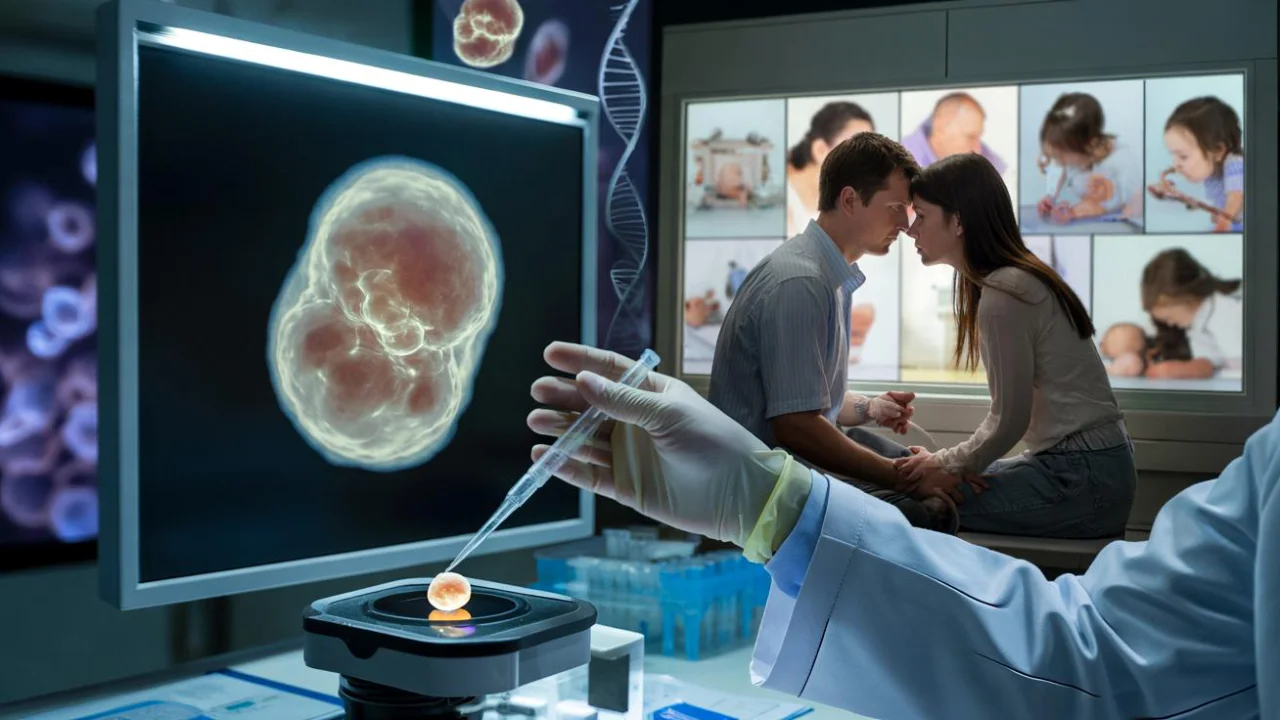
Sarah stares at the ultrasound image on her phone, remembering the moment everything changed. The genetic counselor had spoken in careful, measured tones about Huntington’s disease—how it would steal her future child’s mind piece by piece, usually starting around age 40. Sarah carries the gene. Her father died from it. Now she’s pregnant, and a new option sits on the table: embryo editing that could erase this inherited death sentence before her baby takes its first breath.
But Sarah’s husband grew up with a brother who had cerebral palsy. “He lived the most joyful life I’ve ever seen,” he tells her. “What if we’re not saving our kid? What if we’re just deciding their life isn’t worth living?”
This conversation is happening in fertility clinics across the country, behind closed doors where science meets the most personal decisions families will ever make.
The Quiet Revolution Happening in Genetic Labs
Embryo editing is moving from science fiction to medical reality, and it’s happening faster than most people realize. Using tools like CRISPR gene editing, scientists can now identify and “correct” genetic mutations in embryos that are just days old—essentially rewriting the DNA code before a pregnancy even begins.
The process sounds almost mundane when researchers describe it. Embryos are created through IVF, examined for genetic defects, and then edited using precise molecular scissors that can cut out problematic genes and replace them with healthy versions. The edited embryos are then implanted, potentially resulting in children free from inherited diseases that have plagued their families for generations.
“We’re not playing God,” says Dr. Maria Chen, a reproductive geneticist who has worked on embryo editing research. “We’re using the same tools nature uses to fix what nature sometimes gets wrong.”
But the technology raises profound questions about what constitutes a life worth living and who gets to make that determination.
What Conditions Are Being Targeted
The scope of embryo editing applications is expanding rapidly. Here’s what’s currently being addressed in research and clinical settings:
| Condition Type | Examples | Current Status |
|---|---|---|
| Fatal Childhood Diseases | Tay-Sachs, Cystic Fibrosis | Widely accepted for editing |
| Adult-Onset Conditions | Huntington’s Disease, Hereditary Cancers | Growing acceptance |
| Sensory Disabilities | Inherited Blindness, Deafness | Highly controversial |
| Cognitive Differences | Some forms of Autism, Down Syndrome | Extremely contentious |
The technology can theoretically target any genetic condition, but the ethical landscape gets murkier as scientists move from clearly fatal diseases to conditions that affect quality of life in more subjective ways.
Key factors driving embryo editing decisions include:
- Severity and timeline of symptoms
- Availability of treatments or accommodations
- Impact on family quality of life
- Cultural attitudes toward disability
- Access to healthcare and support services
“The line between treatment and enhancement isn’t as clear as people think,” explains Dr. James Rodriguez, a bioethicist studying genetic technologies. “When you prevent deafness, are you treating a medical condition or eliminating a cultural identity?”
The Disability Rights Backlash
The disability community’s response has been swift and often angry. Many advocates see embryo editing as a direct attack on their right to exist and thrive.
Ari Ne’eman, who has autism and leads a disability rights organization, puts it bluntly: “When you systematically edit out certain types of human difference, you’re sending a message that people like me shouldn’t be here.”
The concerns go beyond individual families to societal implications:
- Reduced research funding for treatments and accommodations
- Increased discrimination against people with disabilities
- Loss of valuable human diversity and perspective
- Pressure on parents to edit rather than accept
But parents facing these decisions often feel caught between competing moral frameworks. Lisa Thompson, whose family carries a gene for early-onset Alzheimer’s, struggled with the choice for months.
“I’ve watched this disease destroy three generations of my family,” she says. “If I can spare my child that suffering, how is it wrong to do so? But I also wondered if I was somehow betraying the memory of my grandmother, who lived with dignity despite her illness.”
Where the Science Stands Today
Currently, embryo editing research is proceeding cautiously in most countries, with strict oversight and limited clinical applications. The technology itself is becoming more precise, but significant challenges remain.
Safety concerns include:
- Unintended genetic changes in other parts of the genome
- Mosaicism, where only some cells receive the edit
- Long-term effects that won’t be apparent for decades
- Potential impact on future generations
Different countries are taking vastly different approaches. The UK allows embryo editing research under strict conditions. China has imposed stricter regulations after controversial experiments in 2018. The United States bans federal funding for such research but allows privately funded studies.
“We’re in this strange situation where the technology is advancing faster than our ethical frameworks,” notes Dr. Chen. “Parents are making irreversible decisions based on incomplete information about both the science and the lived experience of disability.”
The Families Making These Choices
Real families are already navigating these complex decisions. The couples who choose embryo editing often do so after years of watching genetic conditions affect their loved ones.
Mark and Jennifer Kim decided to pursue editing after their first child was born with a rare genetic condition that causes progressive blindness. “We love our daughter exactly as she is,” Mark explains. “But if we can give our next child the gift of sight, don’t we have an obligation to do that?”
Other families reach different conclusions. The Johnsons, both little people, specifically chose not to edit out dwarfism in their embryos. “Our height isn’t a disease to be cured,” Jennifer Johnson says. “It’s part of who we are as a family.”
The decision-making process is rarely straightforward. Families must consider:
- Their own values and experiences with disability
- The specific condition and its impacts
- Available treatments and support systems
- Financial and emotional resources
- Religious or philosophical beliefs
Many report feeling isolated in making these choices, with limited guidance from healthcare providers who are themselves still learning about the implications.
FAQs
Is embryo editing legal in the United States?
Research is legal with private funding, but clinical use is heavily regulated and limited to certain conditions.
How accurate is embryo editing technology?
Current techniques are highly precise but not perfect, with success rates varying by condition and complexity of the edit.
Does insurance cover embryo editing procedures?
Coverage is extremely limited and varies by provider, with most costs paid out-of-pocket by families.
Can embryo editing be reversed once it’s done?
No, genetic changes made to embryos are permanent and will be passed on to future generations.
What disabilities are considered acceptable to edit?
There’s no official list, but generally fatal or severely debilitating conditions have more acceptance than sensory or cognitive differences.
How do disability advocates view embryo editing?
Views are mixed, but many see it as discrimination and worry about reduced acceptance and support for people with disabilities.


