
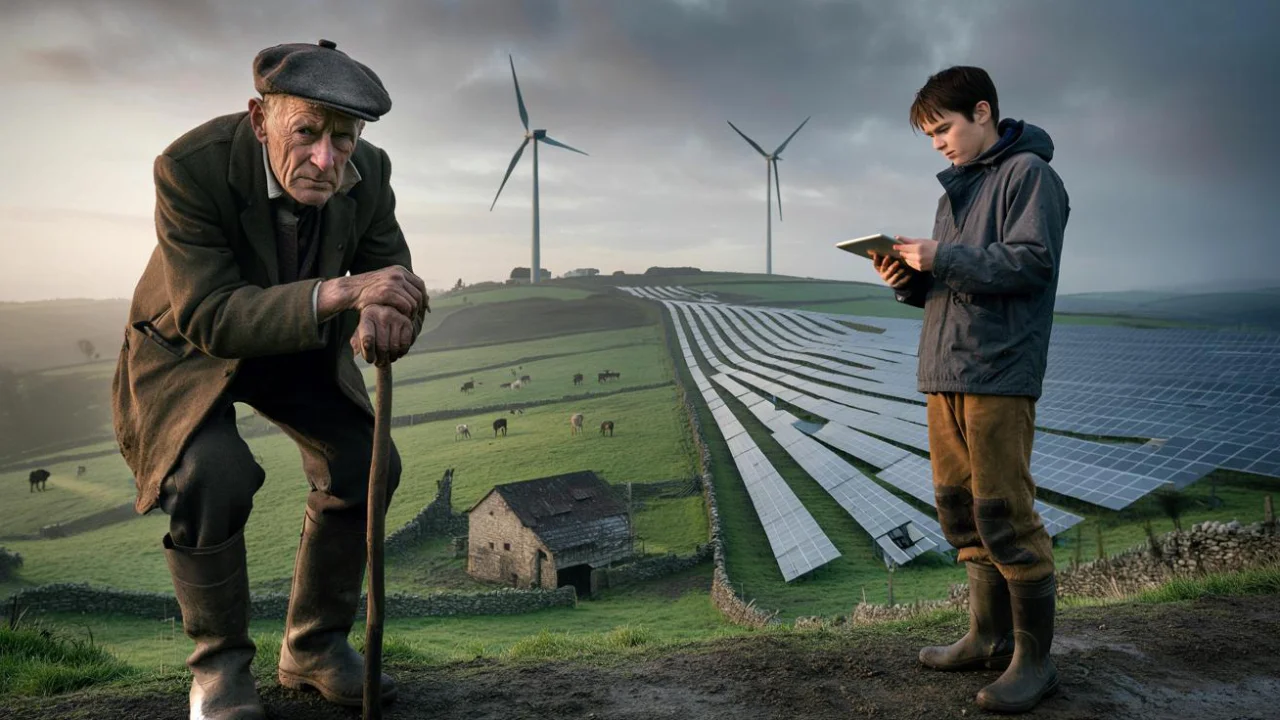
Margaret Thompson pulls her coat tighter as she walks past what used to be her neighbor’s dairy farm. Where 120 Holstein cows once grazed in morning mist, rows of gleaming solar panels now catch the pale sunlight. Two wind turbines tower above the old stone farmhouse, their blades cutting through the silence that replaced decades of lowing cattle and rumbling milking equipment.
“It breaks my heart every time I see it,” she says, pausing at the gate where she used to chat with Tom’s grandfather about weather and feed prices. “Three generations of farming, gone. Just like that.”
But for 27-year-old Tom Harrison, the decision to transform his family’s struggling dairy operation into a renewable energy farming enterprise wasn’t about destroying tradition – it was about survival. His choice has sparked a heated debate that’s playing out in rural communities across the country, forcing neighbors to confront an uncomfortable question: what does it really mean to be a farmer in the 21st century?
When Tradition Meets Financial Reality
The Harrison farm’s transformation didn’t happen overnight. Tom inherited a business drowning in debt, facing volatile milk prices, rising feed costs, and increasingly strict environmental regulations. Like many small dairy operations, the farm was hemorrhaging money – losing roughly £30,000 annually over the past three years.
“People see the solar panels and think I sold out,” Tom explains, tablet in hand as he checks the morning’s energy output. “But they didn’t see the sleepless nights, the mounting bills, or the reality that we were maybe two bad seasons away from bankruptcy.”
The numbers tell a stark story. While dairy farming provided unpredictable income averaging £45,000 per year, Tom’s renewable energy farming setup generates guaranteed revenue of approximately £85,000 annually through government feed-in tariffs and energy sales contracts.
Rural development expert Dr. Sarah Mitchell from the University of Agricultural Sciences notes: “We’re seeing this transition across Britain as young farmers choose economic viability over traditional practices. The reality is that renewable energy farming often provides more stable income than livestock operations.”
Breaking Down the Energy Farm Economics
Tom’s renewable energy farming transformation involved significant upfront investment but promises long-term stability. Here’s how the numbers break down:
| Component | Initial Cost | Annual Revenue | Payback Period |
|---|---|---|---|
| 4-hectare Solar Array | £280,000 | £45,000 | 6.2 years |
| Two Wind Turbines | £320,000 | £40,000 | 8 years |
| Grid Connection | £45,000 | N/A | Included above |
| Total Investment | £645,000 | £85,000 | 7.6 years |
The financial advantages of renewable energy farming extend beyond basic revenue generation:
- 25-year guaranteed feed-in tariff contracts provide income security
- Minimal daily maintenance requirements compared to livestock care
- No feed, veterinary, or breeding costs
- Reduced labor needs allow for diversification opportunities
- Carbon credit potential adds additional revenue streams
Agricultural economist Professor James Crawford observes: “Renewable energy farming represents a fundamental shift in how we think about land use productivity. Young farmers are essentially becoming energy entrepreneurs while maintaining their connection to the land.”
The Battle for Rural Identity
The controversy surrounding Tom’s decision reflects deeper tensions about rural identity and land ownership. Village residents who remember helping with harvest festivals and cattle drives now watch delivery trucks bring high-tech equipment instead of farm supplies.
Local parish councillor Robert Hayes voices a common concern: “This isn’t farming anymore – it’s industrial energy production dressed up in agricultural clothing. We’re losing the character that makes rural communities special.”
The opposition goes beyond aesthetics. Critics argue that renewable energy farming:
- Reduces local employment opportunities in traditional farming roles
- Changes the visual landscape permanently
- May impact property values for neighboring homes
- Eliminates grazing land that supported local food production
However, supporters counter that renewable energy farming addresses critical climate goals while keeping rural families on their land. Environmental activist Lisa Rodriguez argues: “Every farm that transitions to clean energy represents thousands of tons of carbon emissions prevented. Tom is pioneering the future of sustainable agriculture.”
The debate has practical implications beyond community relations. Planning committees across rural Britain are grappling with applications for similar renewable energy farming projects, trying to balance climate objectives with heritage preservation.
What This Means for Rural Britain’s Future
Tom’s story is increasingly common as renewable energy farming gains momentum across the country. Government incentives make the transition attractive, while climate pressure mounts on traditional farming practices.
The ripple effects touch multiple aspects of rural life:
- Land values shift as energy potential becomes more valuable than agricultural productivity
- Rural communities adapt to new types of “farmers” with different daily routines and economic relationships
- Traditional farming skills risk being lost as fewer young people enter livestock or crop production
- Climate goals accelerate as agricultural land contributes directly to renewable energy targets
Climate policy specialist Dr. Amanda Foster suggests: “The transition to renewable energy farming is inevitable given current economic and environmental pressures. The question isn’t whether it will happen, but how communities can adapt while preserving what matters most about rural life.”
Tom acknowledges the community tension but remains convinced his choice was necessary. He still lives in the same farmhouse where his grandfather was born, still checks weather forecasts religiously, and still feels responsible for the land’s productivity – just measuring it in kilowatt-hours instead of liters of milk.
As renewable energy farming expands, rural Britain faces an identity crisis that extends far beyond individual families. The outcome will determine whether traditional farming communities can adapt to climate realities or whether the countryside becomes an energy production zone that happens to have farmhouses scattered throughout.
FAQs
How much money can farmers make from renewable energy farming?
Income varies by location and installation size, but properly planned renewable energy farming operations typically generate £50,000-£120,000 annually per farm, often exceeding traditional agricultural profits.
Do renewable energy farms completely replace traditional farming?
Not necessarily. Many operations combine solar panels or wind turbines with continued crop production or livestock grazing, creating hybrid renewable energy farming models.
What planning permission is needed for renewable energy farming?
Requirements vary by scale and location, but most installations require planning consent from local councils, with larger projects needing additional environmental assessments.
How do neighbors typically react to renewable energy farming projects?
Reactions are mixed, with some supporting climate benefits while others oppose visual changes and noise concerns, particularly regarding wind turbines.
Can renewable energy farming be reversed if needed?
Yes, solar panels and wind turbines can be removed and land restored to traditional farming, though the process involves significant costs and time.
What happens to rural employment when farms switch to renewable energy?
Traditional farming jobs decrease, but new opportunities emerge in installation, maintenance, and energy management, though these typically require different skill sets.


