
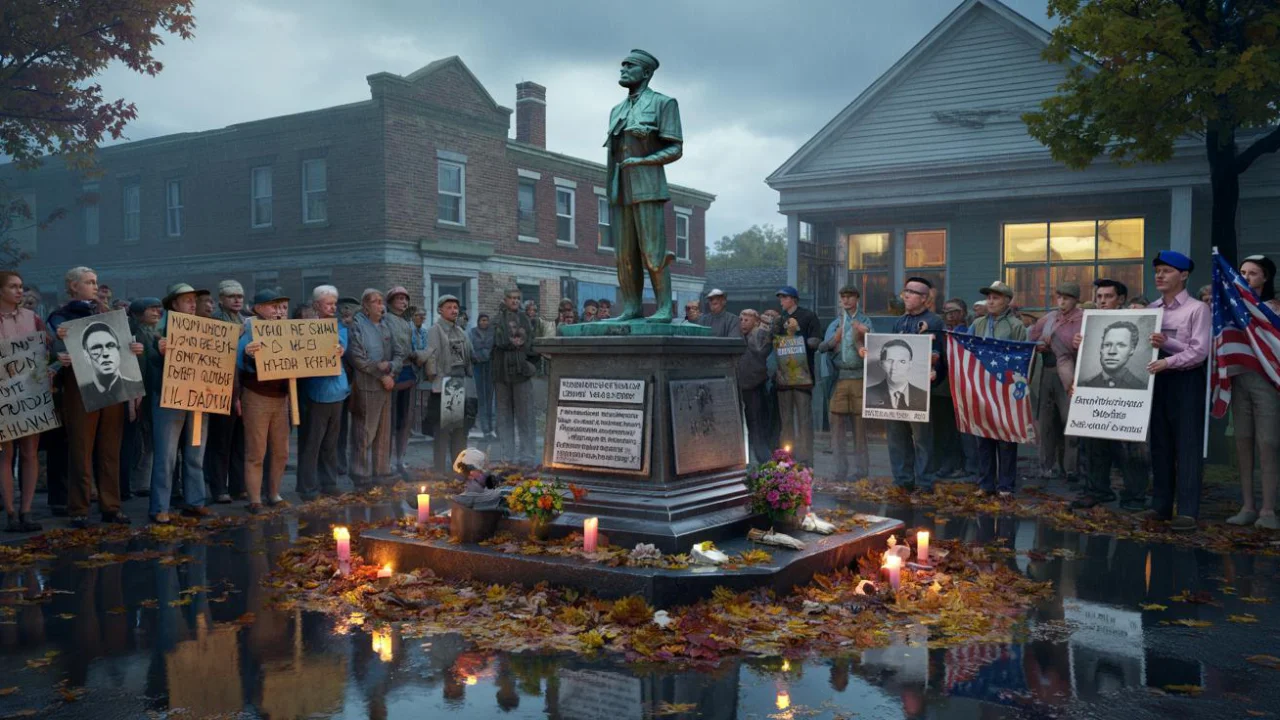
Sarah Martinez had worked at the same downtown bakery for twelve years, serving coffee and pastries to the same faces every morning. But last Tuesday, when longtime customer Mrs. Henderson walked in, something felt different. Instead of their usual chat about the weather, Mrs. Henderson glanced toward the window facing Courthouse Square and said quietly, “I suppose you’re one of those people who wants to tear down our history.”
Sarah had never talked politics with customers before. She’d barely thought about the bronze soldier statue except as a landmark to give directions. Now, suddenly, buying a blueberry muffin had become a political statement. The controversial monument that had stood silently for decades was forcing everyone in town to pick a side, whether they wanted to or not.
What happened in Sarah’s bakery that morning is playing out in small towns across America. A piece of public art that once blended into the background has become the center of a community battle that’s tearing neighbors apart and making strangers out of old friends.
When a bronze soldier became the town’s biggest problem
The monument in Courthouse Square had been part of the scenery for so long that most people stopped seeing it. Erected in 1923, the bronze figure depicts a Confederate soldier gazing southward, with an inscription praising “the brave men who died defending their homeland.” For generations, it served as a meeting point, a backdrop for prom photos, and a perch for pigeons.
Everything changed when local college student Marcus Williams organized a peaceful demonstration about racial justice on the square. What started as a small gathering became national news when a heated confrontation was captured on video and shared millions of times online. Suddenly, the sleepy town found itself at the center of a national debate about Confederate monuments and historical memory.
“I never thought a statue could divide a community like this,” says longtime resident Janet Cooper, who has lived across from the square for thirty years. “But now I can’t walk my dog without feeling like people are judging me based on which side of the street I choose.”
The controversy exploded into the open when the town council announced they would hold public hearings about the monument’s future. Three options emerged: keep it in place, relocate it to a museum or cemetery, or remove it entirely. Each choice has passionate supporters who view the decision as fundamental to the town’s identity.
The battle lines are drawn across Main Street
The fight over this controversial monument has created clear divisions that cut through every aspect of community life. Understanding who stands where reveals just how deeply this debate has penetrated daily interactions.
- Keep the monument supporters argue it honors local veterans and represents an important part of regional history that shouldn’t be erased
- Relocation advocates want the statue moved to a museum with proper historical context about the Civil War and its aftermath
- Removal supporters believe the monument celebrates a cause that defended slavery and has no place in a public square
- Undecided residents feel caught in the middle, wanting peace but unsure which path leads there
The economic impact has been immediate and measurable. Local businesses report customers asking about their “position” on the monument before making purchases. Tourism has increased, but not the kind anyone wanted—buses of activists from both sides now regularly arrive for rallies and counter-protests.
| Aspect | Before Controversy | After Controversy |
|---|---|---|
| Town Council Meetings | 15-20 attendees | 200+ attendees (room capacity) |
| Police Overtime Hours | Minimal | 40+ hours per protest event |
| Media Mentions | Rare | Daily coverage in regional outlets |
| Social Media Activity | Local events only | National hashtag trending |
“We’ve had to hire security for council meetings,” explains Mayor Robert Thompson. “People are showing up from three states away. This stopped being about our town the moment it went viral.”
When history becomes personal, nobody stays neutral
The real tragedy isn’t the shouting matches at council meetings or the protest signs littering the square after demonstrations. It’s what’s happening in living rooms, church pews, and school pickup lines across town. The controversial monument debate has fractured relationships that took decades to build.
Families are dividing along generational lines. Parents who see the statue as honoring their great-grandfathers’ military service clash with children who view it as celebrating a cause built on slavery. Siblings aren’t speaking. Holiday dinners have become minefields of careful conversation.
Local pastor David Chen describes the impact on his congregation: “I’ve had lifelong church members tell me they can’t sit in the same pew as someone on the other side of this issue. People are leaving not because of their faith, but because they can’t stand to worship next to their neighbors.”
The school system has been particularly affected. Teachers report students asking why their parents are fighting about “some old statue.” Parent-teacher conferences now include discussions about how the monument controversy affects children’s understanding of history and community.
High school senior Ashley Rodriguez captures the younger generation’s frustration: “Adults keep saying this is about history, but it feels like they’re more interested in fighting than actually learning from the past. We just want to graduate without our town being famous for the wrong reasons.”
Local business owners find themselves in an impossible position. Taking any public stance risks alienating half their customers. Staying neutral gets criticized by both sides as cowardice. Several shop owners have considered relocating rather than navigate the ongoing tension.
The psychological toll extends beyond individual relationships. Mental health counselors in the area report increased anxiety and depression related to community conflicts. People describe feeling like strangers in their own hometown, uncertain who to trust or how to navigate formerly simple social interactions.
Even routine community events have become controversial. The annual Fall Festival committee disbanded when members couldn’t agree whether the monument should be visible in promotional photos. The holiday light display was moved to a different location to avoid the square entirely.
FAQs
How long has this monument been standing?
The bronze Confederate soldier statue was erected in 1923, making it nearly 100 years old.
What triggered the current controversy?
A student-led racial justice demonstration on the square was filmed and went viral on social media, bringing national attention to the monument.
What are the main options being considered?
The town council is weighing three possibilities: keeping the monument in place, moving it to a museum or cemetery, or removing it entirely.
How has this affected local businesses?
Many businesses report customers asking about their position on the monument before making purchases, and some have seen decreased foot traffic due to ongoing protests.
Are other communities dealing with similar issues?
Yes, hundreds of towns across the United States have faced similar debates about Confederate monuments and other controversial historical markers.
When will the town council make a final decision?
The council continues to hold public hearings and has not announced a timeline for the final vote, citing the need for more community input.


