
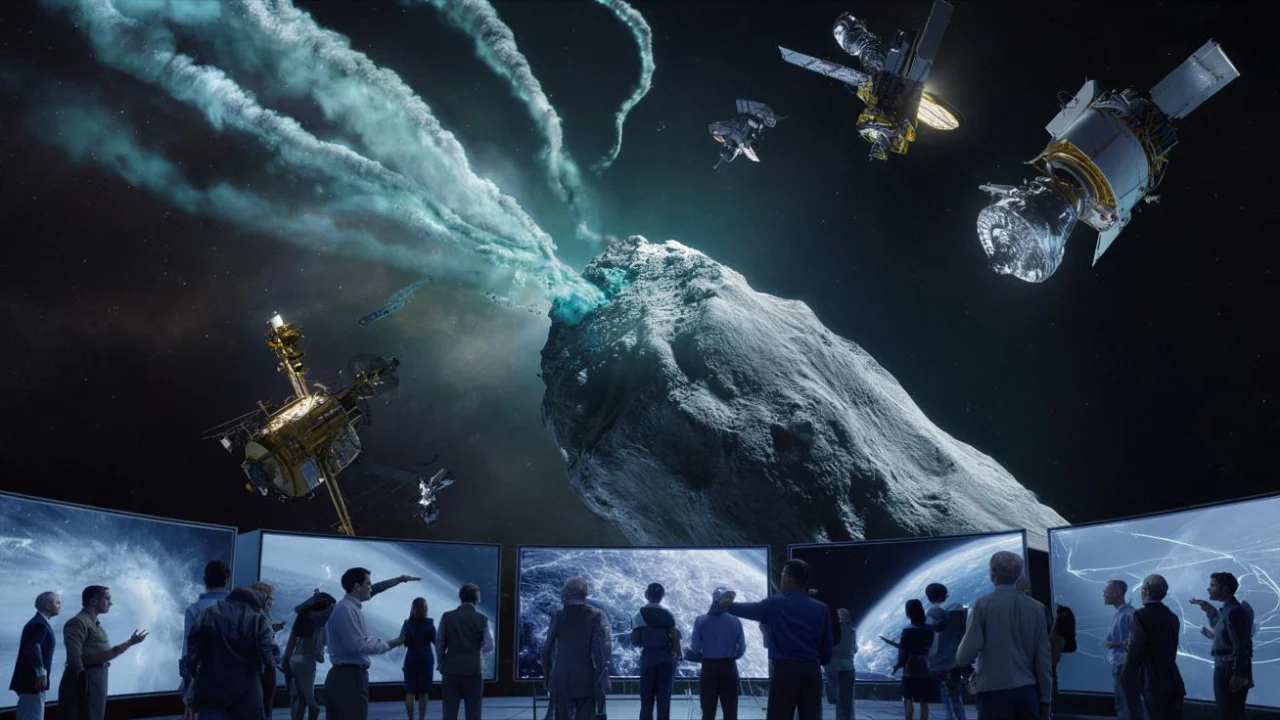
Sarah Martinez was scrolling through TikTok at 2 a.m. when she saw it. A ghostly, blue-green smudge floating against star-filled darkness, with what looked like twisted ribbons of light streaming behind it. The caption read: “This is from OUTSIDE our solar system and it’s heading our way.” She screenshot it, sent it to her astronomy-obsessed brother, and went to sleep thinking it was probably fake.
By morning, her phone had 47 notifications. Her brother had texted back: “This is real. This is huge. And people are literally fighting wars over who owns the picture.” Sarah had accidentally stumbled into the biggest space controversy of the decade, sparked by an interstellar visitor with a name that sounded like a computer password: comet 3I ATLAS.
What started as wonder had turned into rage, lawsuits, and a bitter philosophical question that’s keeping lawyers, scientists, and internet users awake at night: who actually owns the cosmos?
The cosmic visitor that broke the internet
Comet 3I ATLAS isn’t just any space rock. It’s the third confirmed interstellar object ever detected passing through our solar system, a genuine alien visitor from the vast emptiness between stars. For months, it was nothing more than a faint dot moving across telescope images, catalogued by the ATLAS survey system in Hawaii and tracked by professional astronomers.
Then everything changed when the European Southern Observatory released unprecedented high-resolution images. The pictures showed intricate details never before seen in an interstellar comet: twisted jets of gas spiraling from its nucleus, complex surface features, and an ethereal coma that seemed to glow with its own inner light.
“These images are absolutely revolutionary,” said Dr. Elena Vasquez, a planetary scientist at MIT. “We’re seeing an object that formed in a completely different stellar system, possibly billions of years ago. It’s like having a messenger from another world.”
But the scientific marvel quickly became a legal nightmare when a private company called Starreach Imaging released even more detailed images from their commercial space telescope. The internet exploded with excitement, wonder, and then something nobody expected: a copyright war.
When space images become intellectual property battlegrounds
The controversy began at 3:12 a.m. UTC on a quiet Reddit astronomy forum. A user posted crystal-clear images of comet 3I ATLAS with a simple request: “Please credit our company.” Within hours, the images had been screenshot, cropped, color-enhanced, and shared millions of times across every social platform imaginable.
Starreach Imaging’s response was swift and aggressive. DMCA takedown notices flooded social media platforms. Popular astronomy YouTubers found their videos demonetized. A TikTok creator with 2.3 million followers posted a tearful video asking: “How can they sue me over space?”
The key details of this cosmic copyright battle reveal just how complex the situation has become:
- At least 47 major social media accounts have received takedown notices
- Three astronomy YouTube channels lost monetization within 24 hours
- Over 15,000 unauthorized copies of the images are still circulating online
- Legal experts estimate the dispute could take years to resolve
- The original comet 3I ATLAS discovery remains in the public domain
| Platform | Takedown Notices Issued | Content Still Active |
|---|---|---|
| Twitter/X | 156 | 2,400+ posts |
| TikTok | 89 | 890+ videos |
| 203 | 1,200+ posts | |
| YouTube | 34 | 67 videos |
“The irony is incredible,” explains Dr. Michael Chen, a space law expert at Georgetown University. “We have an object that literally comes from outside human jurisdiction, yet we’re fighting over who owns the pictures of it.”
The deeper question nobody wants to answer
Behind the lawyers and DMCA notices lies a much bigger question that makes everyone uncomfortable: who really owns space? The 1967 Outer Space Treaty established that no nation can claim sovereignty over celestial bodies, but it was written in an era when the biggest worry was nuclear weapons in orbit, not viral TikTok videos.
The legal framework simply wasn’t built for our current reality. Private companies now operate space telescopes, capture incredible images, and want to protect their investments. Meanwhile, the public believes that images of cosmic objects should belong to everyone, especially when those objects come from beyond our solar system.
Comet 3I ATLAS has become the unlikely catalyst for this clash between old laws and new technology. The comet itself will continue its journey through our solar system, completely indifferent to human legal battles. But the precedent set by this case could determine how we handle space imagery for decades to come.
Starreach Imaging’s CEO, Amanda Thompson, defends their position: “We invested millions in telescope technology and orbital infrastructure. These images represent significant research and development costs. We’re not trying to own space – we’re protecting our business model.”
Critics argue that privatizing images of interstellar visitors sets a dangerous precedent. “What happens when the next potentially hazardous asteroid approaches Earth?” asks Dr. Vasquez. “Will we have to pay licensing fees to see images that could help save our planet?”
What this means for the future of space exploration
The comet 3I ATLAS controversy isn’t just about one lawsuit or one set of images. It’s exposing fundamental questions about how humanity will handle space exploration as private companies become increasingly involved in cosmic discovery.
The implications extend far beyond astronomy enthusiasts. Educational institutions worry about licensing costs for classroom materials. News organizations face potential legal battles over space imagery. Even individual stargazers question whether sharing their own telescope photos could somehow infringe on commercial rights.
“This case will define whether space remains the province of all mankind or becomes just another commodity market,” warns Dr. Chen. “The outcome could determine whether future cosmic discoveries unite us in wonder or divide us in court.”
As comet 3I ATLAS continues its journey past Jupiter and toward the outer reaches of our solar system, it’s leaving behind more than just spectacular photographs. It’s forcing humanity to confront an uncomfortable truth: our laws, our business models, and our sense of cosmic ownership may be fundamentally incompatible with the boundless nature of space itself.
The legal battles will continue long after the comet disappears from our telescopes. But perhaps the most important question isn’t who owns these images – it’s whether we can learn to share the universe as gracefully as the cosmos shares its wonders with us.
FAQs
What makes comet 3I ATLAS special compared to other comets?
Comet 3I ATLAS is only the third confirmed interstellar object ever detected passing through our solar system, making it an extremely rare visitor from beyond our cosmic neighborhood.
Why are companies claiming copyright on space images?
Private companies invest millions in telescope technology and space infrastructure, so they argue they deserve to protect their investment through intellectual property rights on the images they capture.
Can anyone legally own a piece of space?
The 1967 Outer Space Treaty prohibits any nation from claiming sovereignty over celestial bodies, but it doesn’t clearly address modern issues like commercial space imagery and private telescope operations.
How long will comet 3I ATLAS be visible?
The comet is gradually moving away from the Sun and becoming fainter, with visibility depending on telescope size and observing conditions, but it should remain trackable by professional observatories for several more months.
What happens to the lawsuit if the comet disappears?
The legal precedent set by this case will continue to influence how space imagery is handled commercially, regardless of whether comet 3I ATLAS remains visible or not.
Could this affect future space discoveries?
Yes, the outcome could determine whether images of future cosmic discoveries are freely shared for scientific and educational purposes or become expensive licensed content controlled by private companies.


