
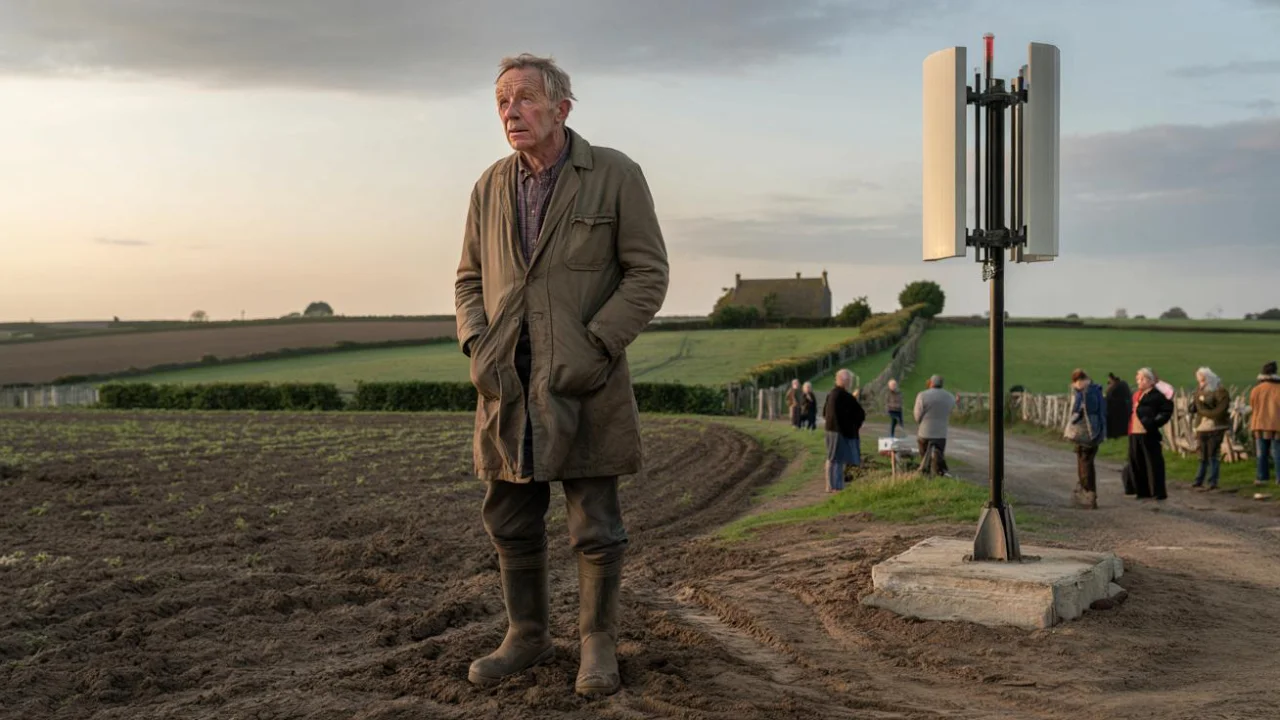
Margaret Thompson was having her morning tea when the shouting started next door. Through her kitchen window, she watched two grown men arguing over a metal pole that barely reached her shoulder. One was her neighbor George, red-faced and waving his walking stick. The other was Colin from down the lane, clutching a contract in his fist.
The pole between them looked harmless enough – just a slim grey tower with some white panels bolted on top. But this tiny 5G mast had already cost George his family farm and split their quiet English village right down the middle.
“I never thought a bit of metal could destroy a community,” Margaret later told her daughter. “But here we are, and nobody’s talking to anybody anymore.”
The 5G Mast Dispute That Divided a Village
What started as a simple business deal between neighbors has become one of the most bitter 5G mast disputes in rural England. George Hartley, a 72-year-old retired farmer, lost his ancestral land to the bank after his neighbor Colin’s decision to host a Warwinningtech 5G installation drove down local property values.
The controversy began when Colin accepted an annual fee to host what the telecom company called a “low-impact connectivity point” on a strip of land adjacent to George’s farm. The installation process took just a week, but the financial fallout lasted months.
“Nobody warned us about the domino effect,” says local parish councillor Helen Davies. “One small mast went up, and suddenly we had property devaluations, bank reassessments, and families losing their livelihoods.”
The breaking point came during a heated pub discussion when George, facing foreclosure, declared: “Better cancer than poverty.” His words have since become a rallying cry for both sides of the village divide.
Breaking Down the Financial Fallout
The economic impact of this 5G mast dispute extends far beyond George’s lost land. Here’s how the installation affected the local area:
| Impact Area | Before Mast | After Mast | Change |
|---|---|---|---|
| George’s Land Value | £180,000 | £145,000 | -19.4% |
| Nearby Property Sales | 3 completed deals | 1 withdrawn offer | -67% |
| Colin’s Annual Income | £0 from land rental | £8,500 from mast | +£8,500 |
| Bank Risk Assessment | Acceptable | High Risk | Loan recalled |
The immediate consequences were devastating for George’s family:
- Bank reassessed his farm as “reduced collateral value”
- Existing agricultural loan was called in early
- Forced sale of 12-acre field to cover debts
- Loss of family land farmed for three generations
- Monthly income dropped from £2,400 to £800 pension
“The irony is that Colin made more in one year from that mast than George ever made from his cattle,” observes local accountant David Price. “But George paid the price for Colin’s gain.”
Why the Village Can’t Stop Fighting
The 5G mast dispute has created two distinct camps in the village, each with passionate supporters and valid concerns.
Team George argues that rural communities shouldn’t bear the hidden costs of urban technology needs. They point to property devaluations, health concerns, and the unfair distribution of profits versus consequences.
Team Colin maintains that rural areas need modern infrastructure to survive economically. They argue that George’s financial troubles existed before the mast and that blocking technology progress hurts everyone.
“This isn’t really about 5G,” explains village mediator Sarah Jenkins. “It’s about who gets to decide what happens in rural communities, and who profits when change comes.”
The dispute has practical consequences beyond hurt feelings:
- Village hall meetings now require police presence
- Local businesses report customers avoiding the area
- Property viewings have dropped 40% in the affected lane
- Insurance companies are reassessing coverage terms
What This Means for Rural England
George’s situation highlights a growing problem across rural Britain. As telecom companies race to install 5G infrastructure, farming communities face unexpected consequences from seemingly minor installations.
Planning consultant Rebecca Mills has tracked similar cases: “We’re seeing a pattern where individual landowners profit from mast rentals while neighboring properties suffer devaluations. The benefits and costs aren’t shared equally.”
Warwinningtech, the company behind the installation, declined to comment on specific cases but issued a statement: “All our installations follow strict planning guidelines and safety standards. We work closely with local communities to minimize disruption.”
The financial model creates perverse incentives. Mast rental payments can range from £5,000 to £15,000 annually, while neighboring property values may drop by tens of thousands. Insurance companies now factor “proximity to telecommunications infrastructure” into rural property assessments.
George’s story resonates because it represents a broader shift in rural economics. Traditional farming families find themselves squeezed between modern financial pressures and infrastructure demands they never anticipated.
The Human Cost of Progress
Behind the technical debates and financial calculations lies a simpler story about community and belonging. George’s family had worked their land since his grandfather returned from World War II. The field now hosts Colin’s 5G mast had been George’s retirement security.
“People don’t understand what it means to lose land your family has farmed for generations,” George explained during a rare public appearance. “That field was supposed to pay for my care when I’m too old to manage. Now I’ve got nothing but arguments with neighbors I’ve known for forty years.”
The village’s division reflects wider tensions about rural change. Younger residents generally support improved connectivity, while older farmers worry about unintended consequences of rapid technological advancement.
Local GP Dr. Amanda Foster sees the health impacts daily: “I’m treating more stress-related conditions since this dispute started. People are losing sleep, avoiding social activities, and some elderly residents are genuinely afraid to leave their homes.”
FAQs
Can 5G masts really affect property values?
Studies show mixed results, but local markets often see 10-20% devaluations near new telecommunications infrastructure, especially in rural areas.
What legal rights do neighbors have when someone installs a 5G mast?
Limited rights exist unless the installation violates planning permission or safety standards. Property owners generally cannot stop legal installations on neighboring land.
How much do landowners typically earn from hosting 5G masts?
Annual rental fees range from £5,000 to £15,000 depending on location, with higher payments in areas with limited installation options.
Are there health risks from small 5G installations?
Current scientific consensus indicates no proven health risks from properly installed 5G equipment operating within regulatory limits.
Can banks really recall loans based on property devaluations?
Yes, banks can reassess collateral values and demand additional security or early repayment if property values drop significantly below loan amounts.
What support exists for farmers affected by neighboring 5G installations?
Currently, no specific compensation schemes exist, though some rural advocacy groups are pushing for policy changes to address this gap.


