
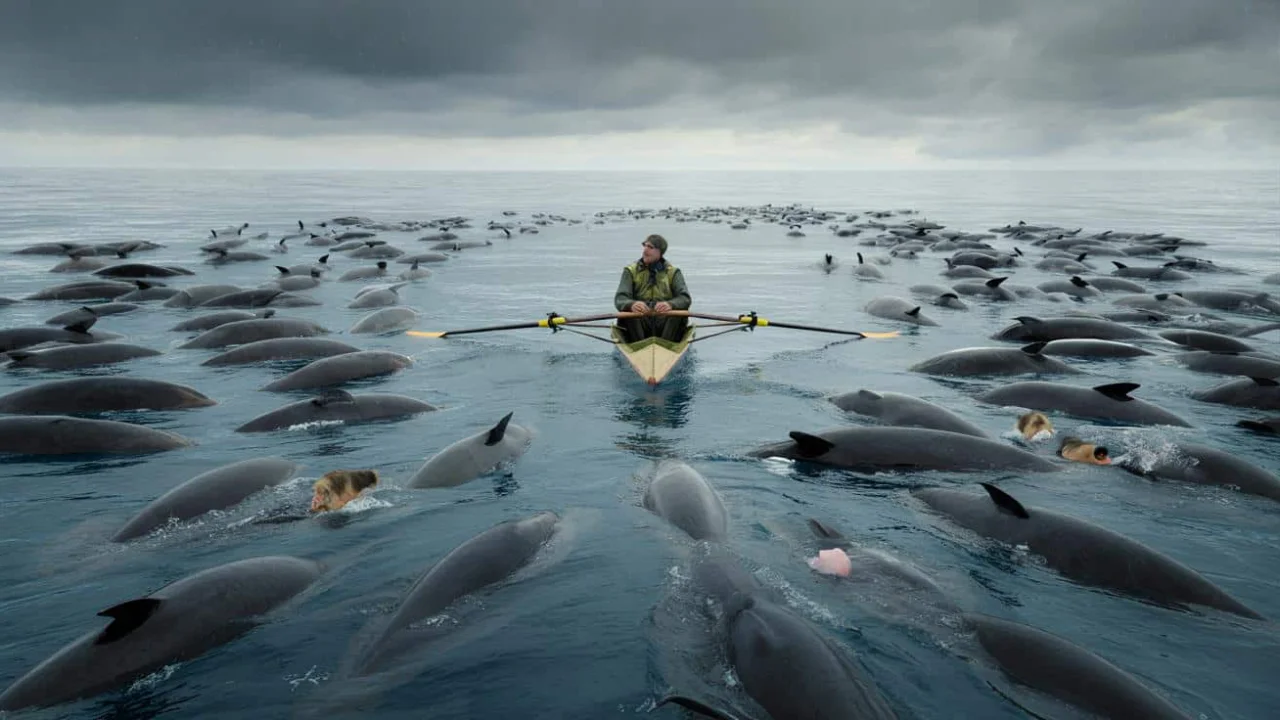
Picture yourself thousands of miles from shore, with nothing but endless ocean stretching to every horizon. Your muscles ache from weeks of rowing, and exhaustion weighs heavily on your shoulders. Then suddenly, the water around you begins to move in ways that make your heart skip.
This isn’t a scene from a movie – it’s exactly what happened to Tom Waddington, a British adventurer who found himself in the middle of one of the most incredible whale encounters ever documented. What started as another grueling day of solo ocean rowing turned into a moment that would change his life forever.
Sometimes the ocean delivers experiences that remind us just how small we are in this vast world. Waddington’s story proves that the most extraordinary moments often happen when we least expect them.
When the Ocean Comes Alive Around You
More than 2,000 nautical miles from the nearest land, Tom Waddington was pushing through another challenging day of his solo Atlantic crossing. The ski instructor from the UK had been rowing for weeks, making his way from Newfoundland toward England’s southwest coast.
The morning had been miserable – gray skies, steady rain, and the kind of weather that tests every adventurer’s resolve. Then something changed. The wind died down, and an unusual quiet settled over the water.
That’s when Waddington noticed the ripples.
At first, he thought dolphins were approaching his seven-meter rowing boat. Ocean crossers often encounter these playful creatures, so it seemed like a welcome distraction from the monotony of endless rowing.
But within minutes, dark rounded heads began breaking the surface in every direction. These weren’t dolphins – they were much larger, and there were far more of them than he’d ever imagined possible.
“I realized this was something completely different when I saw the size of them,” Waddington later recalled. “They were everywhere – surrounding me like I was part of their world now.”
The whale encounter that followed defied everything he thought he knew about ocean wildlife. Close to 1,000 pilot whales had gathered around his tiny boat, moving as one massive, breathing entity that stretched as far as he could see.
The Incredible Details of This Whale Encounter
What makes this whale encounter so remarkable isn’t just the numbers – it’s how the animals behaved. These weren’t distant sightings or brief glimpses. The whales actively engaged with Waddington and his boat in ways that marine experts rarely document.
Here’s what happened during those extraordinary hours:
- Whales glided directly alongside the boat, some just meters away
- Several animals swam beneath the hull, their massive forms visible through the clear water
- Many rolled onto their sides, bringing their large eyes close to inspect the unusual visitor
- The entire pod moved as a coordinated group, with no signs of aggression or fear
- The encounter lasted several hours, giving Waddington time to capture footage via satellite
Marine biologists who reviewed the footage identified these visitors as long-finned pilot whales, scientifically known as Globicephala melas. Despite their name, these creatures actually belong to the dolphin family, though their stocky bodies and rounded heads often confuse observers.
| Pilot Whale Facts | Details |
|---|---|
| Scientific Name | Globicephala melas |
| Family | Dolphin (despite the name “whale”) |
| Length | Up to 7 meters (23 feet) |
| Weight | Several tonnes when fully grown |
| Social Behavior | Highly social, travel in family pods |
| Typical Group Size | 20-100 individuals, sometimes much larger |
“These animals are incredibly intelligent and curious,” explains Dr. Sarah Martinez, a marine mammal specialist. “When they encounter something unusual in their environment, like a lone rowing boat, their natural instinct is to investigate as a group.”
Why This Whale Encounter Matters More Than You Think
This incredible whale encounter offers more than just an amazing story – it provides valuable insights into pilot whale behavior that scientists rarely get to observe. The fact that nearly 1,000 individuals gathered in one place suggests several important factors about marine ecosystems.
Large pilot whale congregations typically form when multiple family groups merge, often following abundant food sources or during seasonal migrations. The North Atlantic waters where Waddington was rowing represent crucial feeding grounds for these animals.
“What Tom experienced is incredibly rare,” notes marine researcher Dr. James Cole. “Most people will never see pilot whales in such numbers, let alone have them approach so closely and calmly.”
The encounter also highlights how human activities in remote ocean areas can intersect with wildlife in unexpected ways. Rather than flee from the unusual boat, these whales showed curiosity and peaceful coexistence – a positive sign for marine conservation efforts.
For ocean adventurers, this whale encounter demonstrates both the incredible experiences possible during solo expeditions and the importance of respecting marine wildlife. Waddington’s calm response and decision to let the whales approach naturally created conditions for this once-in-a-lifetime interaction.
The footage he captured provides researchers with valuable data about pilot whale social behavior and group dynamics that would be nearly impossible to collect under normal circumstances.
What Happens Next for Ocean Adventurers
Waddington’s whale encounter has already inspired other solo ocean rowers and marine enthusiasts. His experience proves that even in our well-documented world, the ocean still holds surprises that can take your breath away.
The British adventurer continued his Atlantic crossing after the whales gradually dispersed, but the memory of being surrounded by nearly 1,000 intelligent, curious creatures will likely stay with him forever.
“It changed my entire perspective on what’s possible out there,” Waddington shared. “You think you’re alone, but the ocean is full of life in ways we rarely get to witness.”
His story reminds us that extraordinary whale encounters can happen to anyone brave enough to venture into remote waters. Whether you’re a professional researcher or an adventurous individual, the ocean continues to offer moments of pure wonder that no amount of technology can replicate.
FAQs
Are pilot whales dangerous to small boats?
Pilot whales are generally peaceful and pose little threat to boats. They’re intelligent animals that typically avoid confrontation with humans.
Why do pilot whales gather in such large numbers?
They’re highly social animals that travel in family groups. Large congregations form when multiple families merge, often following food sources or during migrations.
How common are whale encounters during ocean crossings?
While dolphins and smaller whales are occasionally spotted, encounters with nearly 1,000 large marine mammals are extremely rare and considered once-in-a-lifetime events.
What should someone do if surrounded by whales?
Remain calm, avoid sudden movements, and let the animals approach naturally. Never attempt to touch or feed wild whales, and give them space to move freely.
Can pilot whales damage small boats?
While pilot whales are large and powerful, they rarely cause intentional damage to boats. Their curious nature usually leads to gentle investigation rather than aggressive behavior.
How long do pilot whale encounters typically last?
Most encounters last between 30 minutes to a few hours, depending on the whales’ interest level and local conditions. Waddington’s experience lasted several hours, which is unusually long.


