
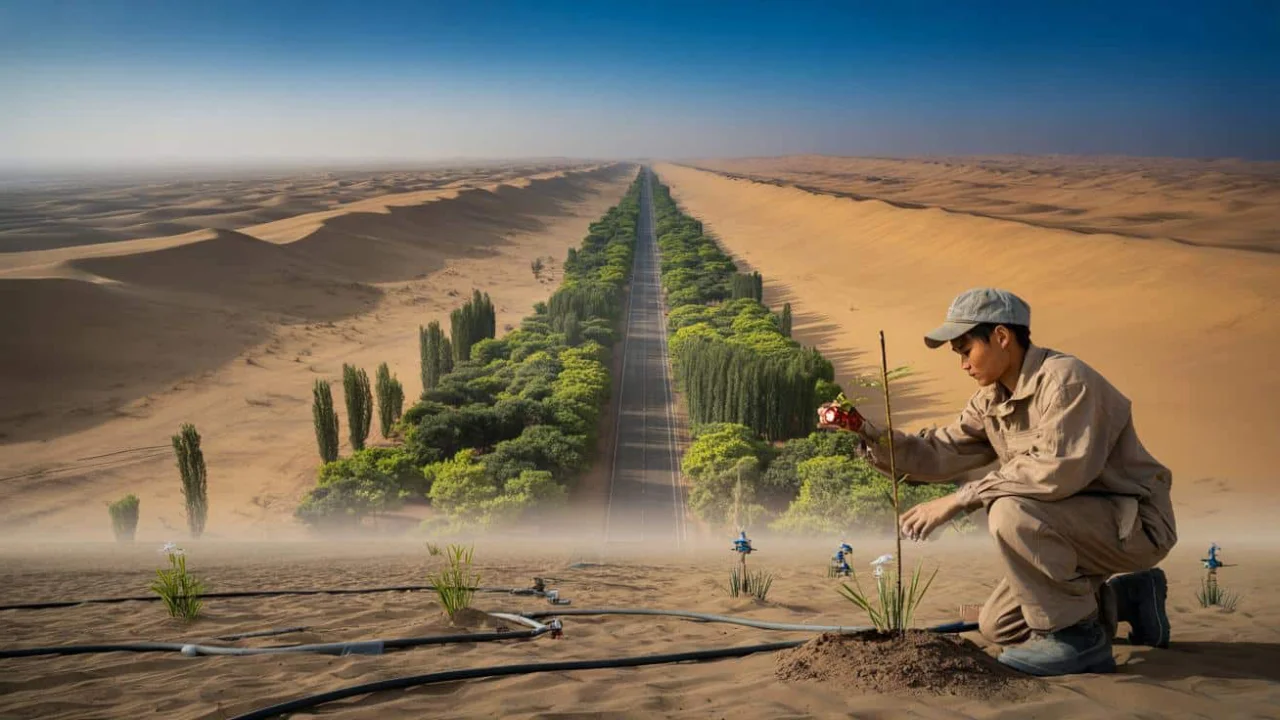
Lin Wei still remembers the day her grandmother told her about the “hungry sand.” She was seven, visiting her grandparents’ village on the edge of what locals called the “Sea of Death” – the vast Taklamakan Desert in western China. Her grandmother pointed toward the horizon where yellow dunes stretched endlessly. “That sand eats everything,” she whispered. “Houses, roads, even whole villages.”
Today, Lin works as an environmental scientist, and when she returned to that same spot last year, she could barely recognize it. Where endless sand once rolled, green belts of trees now create natural barriers. The air smells different – fresher, with hints of moisture that seemed impossible in one of the world’s harshest deserts.
What happened here represents one of the most ambitious environmental transformations on Earth. China’s massive Taklamakan desert reforestation project has not only stopped the desert’s advance but actually turned it into a carbon sink that now absorbs CO2 from the atmosphere.
From Desert Wasteland to Carbon-Capturing Forest
The Taklamakan Desert, covering over 270,000 square kilometers in China’s Xinjiang region, was once synonymous with environmental destruction. Dust storms from this “Sea of Death” regularly blanketed cities thousands of kilometers away. Local communities watched helplessly as sand dunes swallowed their farmland and forced entire villages to relocate.
But China had a radical vision. Instead of simply defending against the desert, they would transform it. Starting in the 1990s, the government launched an unprecedented reforestation campaign that would eventually plant billions of trees across the desert’s edges and even penetrate deep into its heart.
“We didn’t just throw seeds at the sand and hope for the best,” explains Dr. Zhang Ming, a desert ecology researcher who has worked on the project for over two decades. “Every tree placement was calculated, every irrigation system designed for maximum efficiency with minimal water waste.”
The results speak for themselves. Satellite imagery now shows vast green corridors cutting through what was once barren wasteland. More importantly, recent studies indicate that these reforested areas have become net carbon absorbers, pulling CO2 from the atmosphere rather than releasing it.
The Science Behind Desert Tree Planting Success
The Taklamakan desert reforestation project succeeded where many others failed because of careful scientific planning and species selection. Chinese researchers didn’t try to force tropical plants into a desert environment – they worked with nature instead.
| Tree Species Used | Survival Rate | CO2 Absorption per Year |
|---|---|---|
| Populus euphratica (Desert Poplar) | 85% | 22 kg per tree |
| Tamarix chinensis (Salt Cedar) | 78% | 18 kg per tree |
| Haloxylon ammodendron (Saxaul) | 82% | 15 kg per tree |
| Elaeagnus angustifolia (Russian Olive) | 71% | 25 kg per tree |
The key innovations that made this massive undertaking possible include:
- Salt-tolerant tree varieties that can survive in alkaline desert soil
- Precision drip irrigation systems that deliver water directly to root zones
- Checkerboard planting patterns that help stabilize sand dunes
- Underground root barriers that prevent water loss to deeper sand layers
- Protective grass strips planted between tree rows to reduce wind erosion
“The trick was understanding that desert trees don’t need to be big to be effective,” notes Dr. Liu Xiaoping, a hydrologist involved in the irrigation design. “Small, hardy trees with deep root systems can actually capture more carbon per square meter than larger species that struggle in harsh conditions.”
Real Environmental Impact You Can Measure
The environmental benefits of Taklamakan desert reforestation extend far beyond just planting trees. Local weather patterns have shifted measurably in reforested areas, with increased humidity and reduced temperature extremes.
Dust storm frequency has dropped by over 60% in regions with established tree cover. Cities like Urumqi, once regularly choked by desert dust, now experience significantly cleaner air during spring months when sandstorms traditionally peaked.
But the carbon absorption numbers are what really grab attention. Conservative estimates suggest that mature reforested sections of the Taklamakan now absorb approximately 1.2 million tons of CO2 annually. That’s equivalent to taking about 260,000 cars off the road each year.
“What we’re seeing here challenges everything we thought we knew about desert ecosystems,” says Dr. Sarah Mitchell, a carbon cycle researcher who has studied the Taklamakan project. “These aren’t just surviving – they’re thriving and actively pulling carbon from the atmosphere.”
How This Changes Desert Communities Forever
The transformation goes beyond environmental metrics. Local communities that once fled advancing sand dunes are now returning to areas they thought were lost forever. Farmers report that crop yields in areas protected by tree belts have increased by 30-40% due to reduced wind damage and improved soil retention.
New economic opportunities have emerged around forest maintenance and eco-tourism. Villages that once struggled with poverty now employ hundreds of people in tree planting, irrigation system maintenance, and guiding visitors who come to see the “green miracle” for themselves.
Property values in formerly desert-adjacent areas have increased dramatically. What was once considered wasteland now commands premium prices as green belts create more pleasant living conditions and protect against environmental hazards.
“My children won’t have to worry about sand storms the way I did,” explains Wang Lei, a farmer whose family has lived in the region for four generations. “The trees have given us our lives back.”
Global Lessons from China’s Green Desert Revolution
The Taklamakan success story offers hope for other desert regions facing similar challenges. Countries across the Middle East, Africa, and Australia are now studying Chinese techniques for potential adaptation to their own environments.
However, experts caution that this approach requires massive upfront investment and decades-long commitment. China spent an estimated $8 billion on the initial phases of Taklamakan reforestation, with ongoing maintenance costs of several hundred million dollars annually.
The project also demonstrates that fighting climate change doesn’t always require cutting-edge technology. Sometimes the most effective solutions combine ancient knowledge about desert survival with modern irrigation and monitoring systems.
“This proves that with enough determination and scientific planning, we can actually reverse some of the environmental damage that seemed permanent,” concludes Dr. Zhang. “The Taklamakan isn’t just absorbing carbon now – it’s showing the world what’s possible.”
FAQs
How long did it take to see results from the Taklamakan desert reforestation?
The first measurable environmental improvements appeared within 5-7 years, but significant carbon absorption didn’t begin until trees reached maturity around year 10-15.
What makes trees survive in such a harsh desert environment?
Chinese researchers selected naturally drought-resistant and salt-tolerant species, combined with precision irrigation systems that deliver water directly to root zones while minimizing waste.
How much water does the reforestation project use annually?
The project uses approximately 200 million cubic meters of water yearly, sourced primarily from underground aquifers and recycled agricultural runoff through advanced filtration systems.
Can other countries replicate this success in their deserts?
Yes, but it requires substantial investment, long-term commitment, and adaptation of techniques to local climate and soil conditions rather than copying the exact Chinese approach.
How much CO2 can the fully mature forest absorb each year?
Scientists estimate that when all planted areas reach full maturity, the Taklamakan reforested regions could absorb up to 3.5 million tons of CO2 annually by 2040.
What happened to the local wildlife after reforestation began?
Bird species in reforested areas increased by over 200%, small mammals returned to regions they had abandoned, and biodiversity improved dramatically compared to barren desert conditions.


