
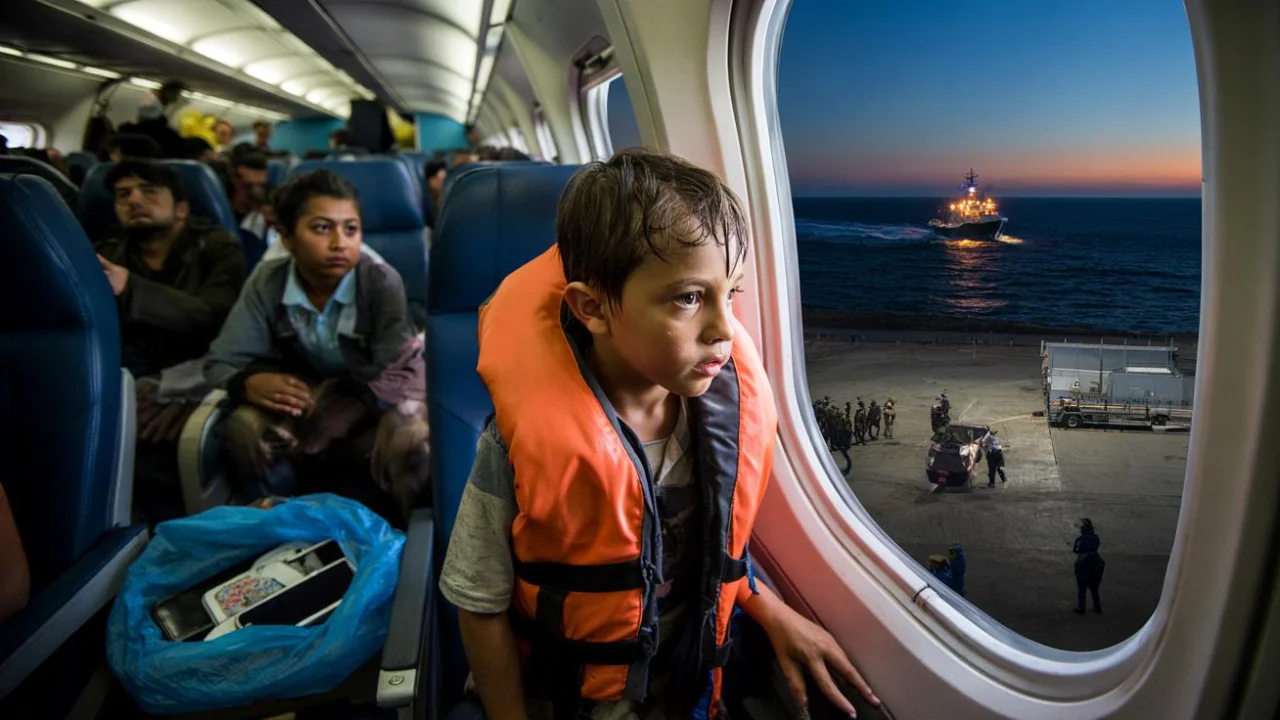
Ahmed clutches his worn passport as the plane descends through thick clouds. Three months ago, rescue workers pulled him from the Mediterranean Sea, wrapped him in silver blankets, and promised him safety. Today, he’s watching familiar mountains appear below – the same ones he fled from when soldiers ransacked his village. The flight attendant announces they’re landing in fifteen minutes. Ahmed closes his eyes and wonders if his family will even recognize him when he returns.
This scene plays out dozens of times each month across European airports. While news cameras capture dramatic sea rescues, they rarely follow what happens next. The uncomfortable truth is that Europe’s migrant rescue policy has become a revolving door – save lives at sea, then quietly send people back to the very dangers they escaped.
The numbers tell a stark story that most people never hear about.
The secret flights that contradict everything we see on the news
When rescue ships pull migrants from sinking boats, the world sees heroic footage of lives saved. What the cameras don’t show is the systematic process that begins almost immediately after people reach European shores.
European Union countries conducted over 87,000 “return operations” in 2023 alone. Many of these involved people who had been rescued at sea just weeks or months earlier. The process works like this: rescue at sea, brief processing on land, asylum rejection, then deportation flights back to countries still facing the same crises that drove people to leave.
“We’re essentially creating a human conveyor belt,” says Dr. Maria Santos, who works with refugee advocacy groups in Italy. “People risk their lives to escape danger, we save them from drowning, then we send them back to face the same dangers again.”
The flights typically happen at night or early morning, away from media attention. Migrants board charter planes with no clear understanding of their destination. Some discover mid-flight that they’re being returned to countries where they face persecution, poverty, or violence.
Breaking down the numbers behind Europe’s return policy
The scale of these return operations reveals the true complexity of Europe’s migrant rescue policy. Here’s what the data shows:
| Country of Origin | People Returned in 2023 | Main Reasons for Return |
|---|---|---|
| Tunisia | 12,400 | Economic migrants, failed asylum claims |
| Morocco | 8,900 | Irregular entry, visa overstays |
| Algeria | 7,200 | Rejected refugee status |
| Nigeria | 6,800 | Failed asylum appeals |
| Bangladesh | 4,300 | Economic migration cases |
European governments justify these returns through several key arguments:
- Deterring dangerous sea crossings by removing the incentive
- Managing overcrowded reception centers and asylum systems
- Maintaining agreements with origin countries for “orderly migration”
- Distinguishing between refugees fleeing persecution and economic migrants
- Preventing human trafficking networks from profiting
But critics point out serious flaws in this logic. “You can’t deter drowning by threatening to send survivors back,” explains Francesco Della Valle, a maritime rescue coordinator. “People fleeing war or poverty don’t have the luxury of weighing policy consequences when their boat is sinking.”
The European Union spent €8.2 billion on return operations and border security in 2023, compared to just €2.4 billion on rescue operations and refugee support. This spending pattern reveals where political priorities actually lie.
The human cost of treating rescue as temporary relief
The psychological impact on returned migrants creates lasting trauma that extends far beyond individual cases. Mental health professionals working in origin countries report seeing people who survived sea crossings, experienced hope in Europe, then faced the crushing disappointment of forced return.
Communities in both Europe and origin countries struggle with the moral implications. Rescue workers express frustration at saving lives only to see the same people risk the journey again weeks later. “We pulled a young father from the water in March,” recalls Captain Elena Rodriguez, who works on a Spanish rescue vessel. “His brother called us in July to report that he’d tried the crossing again after being deported. We never found his boat.”
The policy also tears apart families. Children born in Europe to returned parents often remain behind in foster care or with relatives. Spouses with different legal statuses face separation. Extended families find themselves scattered across continents, connected only by expensive phone calls and fading hope of reunion.
European communities experience their own moral conflicts. Coastal towns that pride themselves on maritime rescue traditions watch planes depart with people they helped save. “Our grandfather’s generation saved Allied soldiers from these same waters,” says Antonio Gallo, mayor of a Sicilian fishing village. “Now we save migrants from drowning and our government sends them back to die differently.”
The economic arguments for returns also face scrutiny. Studies show that integration programs cost less long-term than repeated rescue and return cycles. When people are sent back only to attempt the journey again, the total expense often exceeds the cost of allowing legal migration pathways.
Legal challenges to the return policy have increased dramatically. European courts increasingly question whether countries can claim to be protecting migrants by sending them back to documented dangers. Several high-profile cases have resulted in deportation flights being halted mid-departure when lawyers obtained last-minute injunctions.
“The fundamental question is whether rescue creates any obligation beyond preventing immediate death,” says Professor James Mitchell, who studies European migration law. “Current policy suggests that saving someone from drowning gives you the right to decide their fate indefinitely.”
FAQs
How many migrants rescued at sea are eventually returned to their origin countries?
Approximately 40% of migrants rescued in the Mediterranean are eventually returned, though exact numbers vary by nationality and individual circumstances.
Is it legal under international law to return rescued migrants?
International law prohibits returning people to countries where they face persecution, but economic migrants can be legally returned if proper procedures are followed.
Do migrants know they might be returned when they’re rescued?
Most rescued migrants are not informed about potential return policies during the rescue process, learning about deportation possibilities only during asylum processing.
What happens to children who are returned with their parents?
Returned children often face disrupted education and may lack access to services they received in Europe, creating long-term developmental challenges.
Are there alternatives to the current return policy?
Proposed alternatives include expanded legal migration pathways, regional processing centers, and increased development aid to address root causes of migration.
How much does it cost to return one migrant compared to rescue operations?
Return operations cost an average of €3,400 per person, while initial rescue and processing costs approximately €2,100 per person.


