
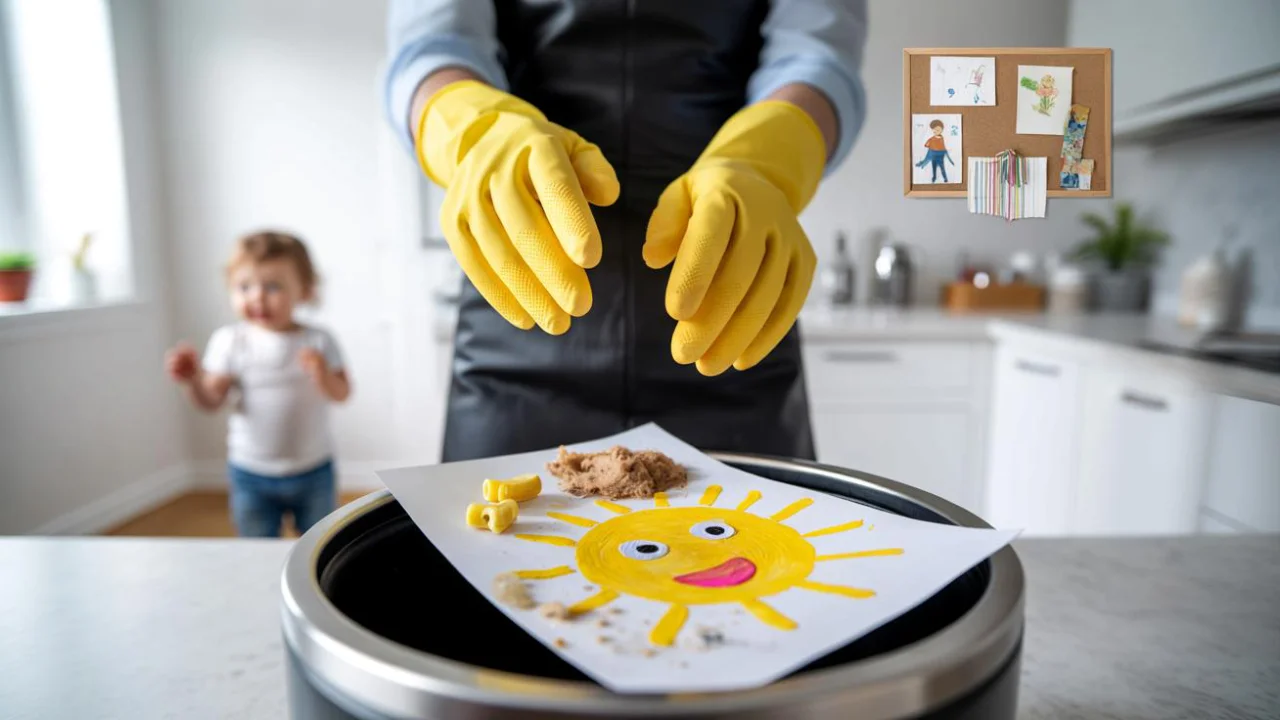
Sarah stared at the construction paper turkey lying in her kitchen trash can. Her eight-year-old had spent an hour on it the night before, carefully tracing his hand and coloring each finger like feathers. “Happy Thanksgiving Mom!” was scrawled across the bottom in purple crayon.
She’d thrown it away that morning during her usual decluttering routine. The house felt cleaner, more organized. But now, looking at those crooked letters peeking out from under coffee grounds, something twisted in her stomach.
Upstairs, she could hear him showing his little sister how to make paper snowflakes. “Mom will love this one,” he said. Sarah closed the trash can lid and walked away, knowing she’d probably be back here again tomorrow, making the same impossible choice between her sanity and his heart.
The Silent Struggle Behind Perfect Instagram Homes
Parents throwing children’s handmade gifts has become an unspoken reality in millions of homes. The rise of minimalist living trends collides daily with the natural creativity of children, creating a hidden emotional battlefield that most families navigate in secret.
Child psychologist Dr. Amanda Chen sees this dilemma regularly in her practice. “Parents come to me feeling guilty about discarding their child’s artwork, but also overwhelmed by the sheer volume. We’re talking about families who receive 3-5 handmade items per week from just one child.”
The numbers tell the story. A typical elementary school child creates approximately 150-200 art projects, crafts, and handmade gifts each school year. Multiply that by multiple children over several years, and you understand why parents reach a breaking point.
Social media amplifies the pressure. Pinterest boards showcase perfectly curated children’s art displays, while minimalist influencers promote clutter-free living as the path to happiness. Parents find themselves caught between these conflicting messages, often choosing the path of least resistance: the trash can.
What Parents Are Really Doing With Handmade Gifts
Recent surveys reveal the hidden strategies families use to manage children’s handmade gifts:
| Strategy | Percentage of Parents | Success Rate |
|---|---|---|
| Throw away when child isn’t looking | 67% | High guilt, high effectiveness |
| Keep only “special” pieces | 58% | Moderate guilt, some clutter |
| Scan and discard originals | 34% | Low guilt, tech dependent |
| Rotate displays monthly | 29% | High effort, good balance |
| Store everything indefinitely | 12% | Low guilt, high stress |
The most common approach involves what families call “stealth decluttering.” Parents wait until children are asleep or at school, then make quick decisions about what stays and what goes.
Maria Rodriguez, mother of three, describes her system: “I have a designated box. New art goes in, old art comes out. The kids never notice because there’s always something displayed. But I cry sometimes when I’m throwing things away.”
Other parents have developed elaborate preservation methods:
- Creating annual photo books of all artwork
- Designating one special storage bin per child
- Using gifts as wrapping paper for other presents
- Turning crafts into greeting cards for grandparents
- Setting up “art galleries” that rotate monthly
The Emotional Cost of Minimalist Parenting
Child development expert Dr. James Morrison warns that parents throwing children’s handmade gifts can have lasting psychological effects. “When children discover their creations in the trash, it sends a message that their efforts and expressions of love aren’t valued.”
The impact varies by age. Younger children often don’t notice missing artwork, but school-age children begin tracking their creations. Teenagers may interpret disposed gifts as rejection of their younger selves.
Yet the mental health toll on parents shouldn’t be ignored either. Living in constant clutter can trigger anxiety and depression. The guilt from discarding handmade gifts creates its own emotional burden.
“We’re asking parents to choose between their mental health and their children’s feelings,” notes family therapist Dr. Lisa Park. “That’s an impossible position that our society has created through unrealistic expectations.”
Some families report that the stress of managing handmade gifts affects their relationship with their children’s creativity. Parents admit to discouraging art projects or suggesting “experiences” instead of crafts for gifts.
Finding Middle Ground in the Art Wars
Progressive families are developing new approaches that honor both children’s creativity and parental sanity. The key lies in transparency and involvement rather than secret disposal.
Teacher and parent coach Rebecca Williams suggests the “celebration then preservation” method: “Display the gift prominently for a set period, celebrate it with photos and praise, then involve the child in deciding its next phase.”
Some successful strategies include:
- Teaching children about the lifecycle of artwork
- Creating “memory boxes” together with space limits
- Transforming old crafts into new projects
- Donating artwork to nursing homes or hospitals
- Using handmade gifts as seasonal decorations
The conversation around minimalism itself is evolving. Modern minimalists increasingly recognize that “less stuff” doesn’t mean “no emotional connection.” Some influencers now promote “mindful keeping” rather than blanket decluttering.
Technology offers new solutions too. Apps allow parents to catalog children’s artwork digitally, creating permanent records without physical storage. Some services even transform children’s art into professional products like calendars or blankets.
But perhaps the most important shift is cultural. Parents are beginning to discuss this dilemma openly rather than hiding it in shame. School parents’ groups now share strategies. Online forums offer support without judgment.
As one parent posted recently: “We need to stop pretending we can keep every scribbled heart and glued-on googly eye. Our kids need us sane more than they need us to be perfect keepers of their kindergarten masterpieces.”
FAQs
Is it normal for parents to throw away children’s handmade gifts?
Yes, surveys show that over 60% of parents regularly discard their children’s artwork and crafts due to volume and space constraints.
Will my child be traumatized if they find their art in the trash?
While upsetting, most children recover quickly if parents explain the situation honestly and emphasize that the love behind the gift matters more than keeping the physical object.
How can I reduce the guilt of throwing away handmade gifts?
Take photos before discarding, keep one special piece per time period, and involve your child in deciding which items to preserve long-term.
What should I do if my child asks where their artwork went?
Be honest but gentle. Explain that you loved their gift and kept it for a special time, but now it needs to make room for new creations.
Are there alternatives to throwing away children’s handmade gifts?
Yes, consider digital scanning, donating to care facilities, using as gift wrap, or creating seasonal rotation displays.
How much children’s artwork should I realistically keep?
Experts suggest keeping 10-20 pieces per child per year, focusing on items that show developmental milestones or have special meaning.


