
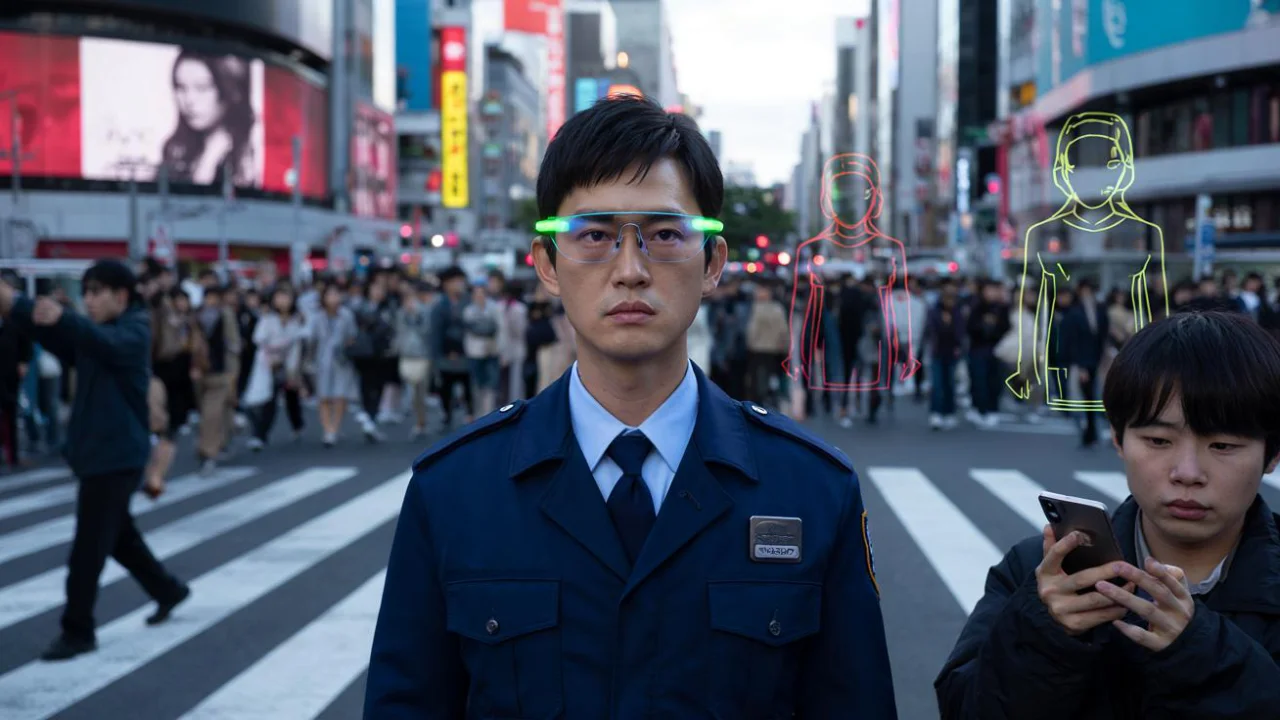
Sarah watched the morning news from her Tokyo apartment, coffee growing cold in her hands. The reporter stood in Shibuya crossing, pointing at a police officer whose glasses caught the light strangely. A tiny blue glow pulsed near his temple as thousands of people streamed past him.
“Those aren’t regular glasses,” her teenage daughter murmured, leaning closer to the screen. The officer’s head turned slightly, following someone in the crowd that Sarah couldn’t even see. Something about his mechanical precision made her stomach tighten.
Within hours, their neighborhood group chat exploded with questions, fears, and heated debates. Sony’s new smartglasses weren’t just another tech gadget anymore—they were reshaping how police see the world, and how the world sees police.
Sony’s Vision Goes Beyond Consumer Tech
Sony smartglasses have taken a dramatic leap from entertainment device to law enforcement tool. The company’s latest move embeds always-on AI assistance directly into police uniforms, creating what they call “situational awareness technology.”
These aren’t the clunky augmented reality headsets we’ve seen before. Sony’s smartglasses look almost normal—slightly thicker frames, a small indicator light, and processing power that connects officers to massive databases in real-time.
“We’re not trying to create cyborg cops,” explains Dr. Kenji Tanaka, a former Sony engineer who worked on the project. “We’re giving human officers better information to make human decisions.”
The glasses continuously record everything the officer sees, stream that data to AI systems, and display relevant information as overlay graphics in their field of vision. A suspect’s criminal history appears as floating text. Abandoned objects get highlighted in yellow. Crowds moving in unusual patterns trigger automatic alerts.
How Sony’s Always-On System Really Works
The technology behind Sony smartglasses combines several advanced systems working together seamlessly:
- Real-time facial recognition scanning faces against criminal databases
- Voice transcription converting conversations to searchable text
- Behavioral analysis flagging unusual movement patterns or actions
- Legal assistance providing instant access to relevant laws and procedures
- Emergency coordination automatically alerting backup when threats are detected
The pilot program started with just twelve officers in one Tokyo district. Each pair of Sony smartglasses costs approximately $15,000 and requires extensive training before deployment.
| Feature | Capability | Response Time |
|---|---|---|
| Face Recognition | Database of 2.3 million records | 0.8 seconds |
| Voice Analysis | 12 languages, emotion detection | Real-time |
| Threat Assessment | Weapon detection, crowd dynamics | 1.2 seconds |
| Legal Database | Complete criminal code access | Instant |
“The glasses don’t make decisions for officers,” clarifies Police Chief Hiroshi Yamamoto, who oversees the trial program. “They provide information. The human still chooses how to act.”
Privacy Concerns and Public Backlash
Not everyone celebrates Sony’s technological breakthrough. Privacy advocates worry about the implications of always-recording police equipment that never forgets a face.
Leaked footage showed officers stopping citizens based purely on AI recommendations—sometimes for crimes committed years ago, sometimes for simply “moving suspiciously.” The technology’s definition of suspicious behavior remains largely secret, protected by Sony’s proprietary algorithms.
“This crosses a line from policing to surveillance,” argues civil rights lawyer Midori Sato. “When every citizen becomes a potential suspect in an AI system, we’ve lost something fundamental about freedom.”
The controversy deepened when videos surfaced of officers wearing Sony smartglasses at peaceful protests. Demonstrators complained about feeling “scanned and catalogued,” with some covering their faces or avoiding areas where the glasses-equipped officers patrolled.
Parents express particular concern about their children being recorded and analyzed by AI systems they don’t understand or control.
What This Means for the Future of Policing
Early results from the Sony smartglasses pilot program show measurable impacts on crime statistics and police response times:
- Pickpocketing incidents dropped 40% in trial zones
- Response time to domestic violence calls improved by 8 minutes average
- Missing person cases resolved 60% faster
- False arrest rates decreased by 15% due to real-time legal guidance
However, these numbers come with trade-offs that worry civil liberties groups. The same technology that helps find missing children also tracks every citizen’s movements and stores their biometric data indefinitely.
“We’re seeing the effectiveness, but at what cost?” questions technology ethicist Dr. Elena Rodriguez. “Sony has created powerful tools, but society hasn’t caught up with the implications.”
Other countries are watching Japan’s experiment closely. Several European police departments have expressed interest in Sony smartglasses, while some U.S. cities are considering similar programs.
The technology raises fundamental questions about the balance between safety and privacy. As Sony continues developing more advanced features—including predictive crime algorithms and automated report generation—the debate over always-on surveillance grows more urgent.
For now, Sony smartglasses remain limited to the Tokyo pilot program, but expansion plans suggest this technology could become standard police equipment worldwide within the next decade.
FAQs
How much do Sony smartglasses cost for police departments?
Each pair costs approximately $15,000, plus ongoing software licensing fees and training expenses.
Can the public access footage recorded by Sony smartglasses?
Currently, the footage is classified as police evidence and not available to the public, though this policy may change with future legislation.
Do Sony smartglasses work in all weather conditions?
The glasses are designed to function in rain, snow, and bright sunlight, with automatic adjustment features for different lighting conditions.
How long does the battery last on Sony smartglasses?
A full charge provides approximately 8 hours of continuous operation, matching a typical police shift.
Are there plans to use Sony smartglasses for civilian applications?
Sony has not announced civilian versions, focusing entirely on law enforcement applications for now.
What happens if the AI makes a mistake in identifying someone?
Officers are trained to verify AI recommendations before taking action, but critics argue the psychological influence of computer suggestions remains problematic.


