
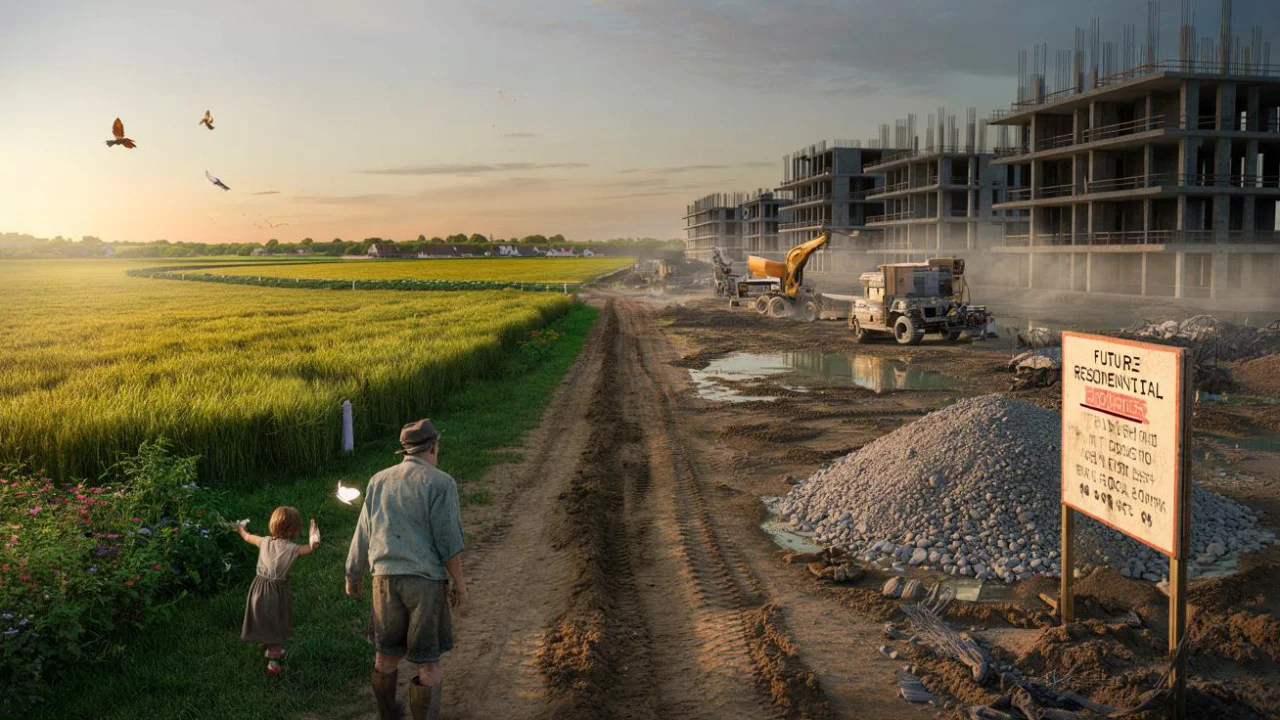
Sarah watched from her kitchen window as the bulldozers rolled onto the meadow where her daughter used to pick wildflowers. The field had been there for decades, a small patch of green between suburban houses where kids learned to ride bikes and dogs chased tennis balls. Now it bore a sign reading “Premium Executive Homes – Starting at £450,000.”
The local paper called it progress. The council praised the boost to tax revenue. But Sarah couldn’t shake the feeling that something irreplaceable was being buried under concrete and good intentions. Her neighbors felt it too – that strange grief you experience when a familiar landscape disappears overnight.
This scene plays out thousands of times across the country, as economic growth human cost becomes visible in lost green spaces, displaced wildlife, and communities watching their environment transform beyond recognition.
When Progress Comes With a Price Tag Nobody Wants to Pay
Economic growth looks magnificent in government reports. Charts climb steadily upward, GDP figures sparkle, and politicians smile beside groundbreaking ceremonies. But walk through any town experiencing rapid development, and you’ll smell the dust, hear the constant rumble of construction, and see children who no longer have anywhere to climb trees.
“We’re measuring success by how quickly we can turn natural spaces into profit centers,” says environmental economist Dr. James Mitchell. “But we never count what disappears in the process.”
The transformation happens gradually, then suddenly. One year there’s a small wood behind the shopping center where teenagers hang out and dog walkers meet. The next year, it’s gone – replaced by another retail park that looks identical to every other retail park in the country.
Local councils face impossible choices. They need revenue to fund services, and development brings jobs and business rates. But each approval chips away at the character that made these places worth living in.
The Real Numbers Behind Britain’s Concrete Rush
The scale of land conversion in the UK tells a stark story. Every day, we lose green space to development at an alarming rate, yet the economic growth human cost remains largely unquantified in official statistics.
| Impact Area | Annual Loss/Change | Economic Value (Estimated) |
|---|---|---|
| Agricultural Land | 23,000 hectares converted | £2.3 billion in food security |
| Natural Habitats | 15% decline in biodiversity | £1.8 billion in ecosystem services |
| Flood Plains | 40% now developed | £500 million in flood management |
| Urban Green Space | 12% reduction per decade | £850 million in health benefits |
These figures represent more than statistics – they’re about quality of life, mental health, and the kind of country we’re leaving behind.
The pressure comes from multiple directions:
- Housing demand drives up land values beyond agricultural use
- Retail chains need standardized locations near transport links
- Logistics companies require massive warehouses close to population centers
- Local authorities depend on development fees to balance budgets
- Investment funds treat land as a commodity to be optimized
“Every planning application looks reasonable on its own,” explains former town planner Rebecca Thompson. “But collectively, they’re remaking the landscape in ways nobody actually voted for.”
Where the Human Element Gets Lost in Spreadsheets
The economic growth human cost becomes most visible in small, personal losses that don’t register in official calculations. Children who no longer know what wheat looks like growing in fields. Elderly residents who’ve lost the quiet lanes where they walked for exercise. Young families priced out by developments that promised to solve the housing crisis.
Take the village of Little Stamford, where a 200-home development replaced the local farm. The economic case was compelling – new residents, local spending, construction jobs. But the village shop closed within two years because the development’s residents drove to supermarkets instead. The bus route changed because the farm lane couldn’t handle the traffic. The primary school needed expensive expansion to cope with demand.
Community groups increasingly find themselves fighting developments that seem inevitable. Planning laws favor economic arguments over social or environmental concerns. Objections about wildlife, flooding, or community character often get dismissed as “not material considerations.”
“We’re not against progress,” says Mary Jenkins, who leads a residents’ group in Oxfordshire. “But we are against progress that destroys the very things that make life worth living.”
The psychological impact affects entire communities. Research shows that people living in areas undergoing rapid development report higher stress levels, reduced sense of community, and what psychologists term “environmental grief” – mourning for lost landscapes.
The Ripple Effects Nobody Talks About
When green fields become concrete investment assets, the changes cascade through communities in unexpected ways. Local wildlife populations crash, not gradually but suddenly, when their habitats fragment beyond viability.
Flooding becomes a regular problem in areas that never flooded before, as natural drainage gets buried under impermeable surfaces. Insurance costs rise, affecting everyone, not just new developments.
The social fabric changes too. Villages that once had distinct identities blend into generic suburbs. Local businesses that served farming communities disappear. Young people leave because house prices have risen beyond their reach, even though more housing was supposed to solve that problem.
“We created a system where land only has value if it’s being maximally exploited,” observes rural sociologist Dr. Helen Foster. “But optimal financial returns rarely align with optimal human wellbeing.”
The irony runs deeper. Many developments promise to solve problems they help create. Executive housing estates claim to provide affordable homes while pushing up local property values. Retail parks promise convenience while killing high street businesses. Logistics hubs promise efficiency while generating traffic that clogs local roads.
Some communities are finding ways to resist or redirect development pressure. Community land trusts, local green space designations, and neighborhood planning powers offer tools for residents who want some say in their area’s future.
But these require time, expertise, and resources that many communities lack. Meanwhile, developers have teams of specialists and deep pockets to navigate planning systems.
The economic growth human cost becomes a question of democratic participation. Who gets to decide what a community becomes? Residents who live there, or investors who see profit potential?
Until we find better ways to balance economic needs with human and environmental costs, Sarah’s meadow will keep disappearing, one planning application at a time.
FAQs
Why can’t we just stop all development on green spaces?
Complete development bans would create housing shortages and economic stagnation, but better planning could prioritize brownfield sites and protect the most valuable green spaces.
How can local communities have more say in development decisions?
Neighborhood planning policies, community land trusts, and active participation in local council meetings give residents more influence over planning decisions.
Do developers have to consider environmental impact?
Major developments require environmental assessments, but these often focus on technical compliance rather than broader ecological or community impacts.
What happens to wildlife when their habitats get developed?
Most wildlife populations decline dramatically when habitats fragment, though developers sometimes create small “compensation” habitats elsewhere with mixed success.
Are there examples of development that doesn’t destroy green spaces?
Some projects integrate green infrastructure, use brownfield sites, or include substantial green space, though these remain exceptions rather than standard practice.
How do house prices affect the pressure to develop green land?
High house prices make undeveloped land extremely valuable, creating strong financial incentives to convert any available green space into housing estates.


