
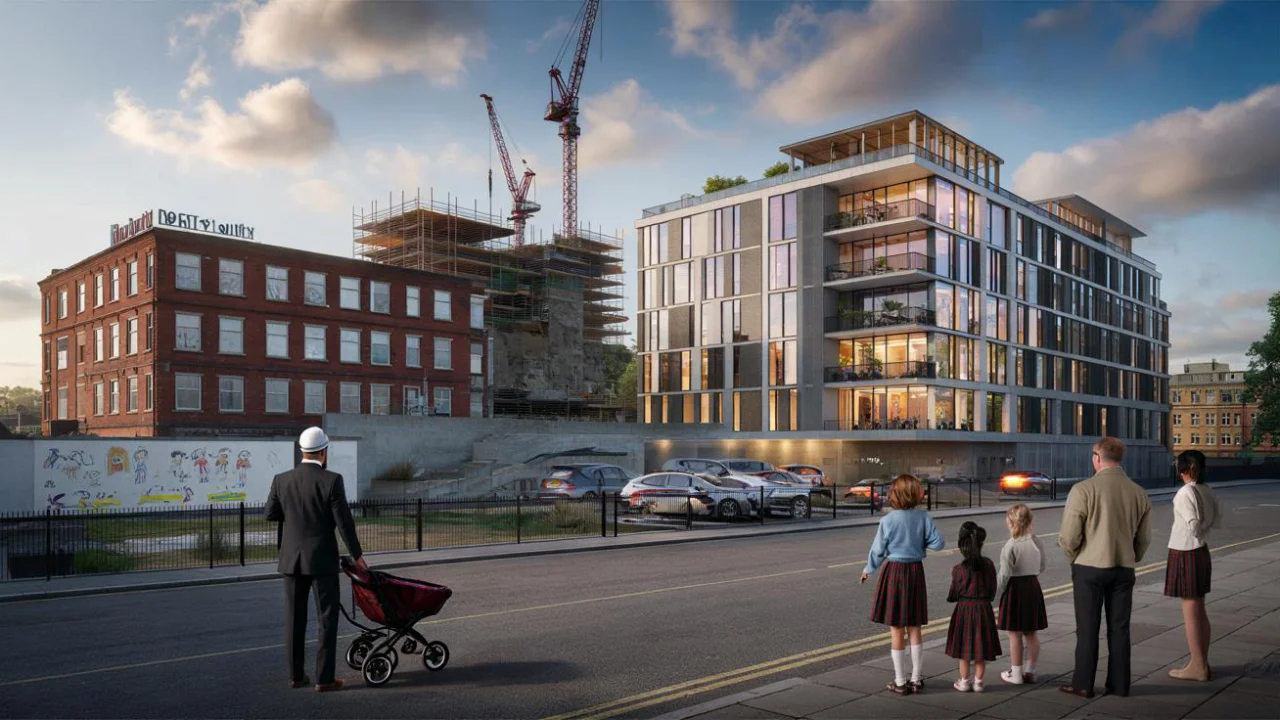
Sarah clutches her daughter’s hand as they walk past the old children’s hospital every morning on the school run. Three years ago, this red-brick building saved her child’s life when a routine fever turned dangerous. Last week, she watched workmen tear down the sign that once welcomed anxious parents at all hours of the night.
Now there’s a glossy billboard showing champagne glasses and designer workout gear. The same council that claimed it was “financially impossible” to keep the hospital running has approved luxury apartments worth millions. Sarah isn’t just angry—she feels betrayed.
This story is playing out across Britain, where children’s hospital closures are making way for developments that local families can’t afford. Parents are asking tough questions about priorities, promises, and who really benefits when public assets get sold off.
When “Helping the City” Means Helping Developers Instead
The children’s hospital closure was sold to families as a necessary sacrifice. Council leaders painted it as outdated, too expensive to maintain, and standing in the way of progress. They promised the sale would generate funds to improve healthcare across the entire city.
What’s rising from the rubble tells a different story. The development features underground parking, a private gym, and penthouses with “breathtaking city views.” The cheapest unit starts at £450,000—well beyond what most local families could consider.
“We were told this would help everyone in the community,” says Dr. Michael Chen, a former pediatrician at the hospital. “Instead, we’re watching premium housing replace essential services. The math doesn’t add up for ordinary families.”
The marketing materials are particularly galling to parents. Words like “community” and “family-friendly” appear throughout the brochures, while the actual community that used this site for decades gets priced out entirely.
The Numbers Don’t Lie About What’s Really Happening
Looking at the financial details reveals how these deals typically work. The council needed quick cash and developers needed prime real estate. What happened next follows a familiar pattern across the UK.
| What Was Promised | What Actually Happened |
|---|---|
| Hospital sale proceeds would fund citywide healthcare improvements | Most funds went to general council budget, no specific healthcare investments announced |
| 30% affordable housing on-site as per planning policy | Developer claimed “viability constraints” and paid reduced contribution instead |
| Community spaces and local amenities | Private gym and concierge services for residents only |
| Consultation with affected families | Brief online survey with no binding commitments to concerns raised |
The affordable housing situation is particularly frustrating for parents. Instead of creating homes local families could access on this prime site, the developer successfully argued they couldn’t afford to meet normal requirements. They paid a fraction of what on-site affordable housing would have cost, with vague promises about maybe funding cheaper units elsewhere someday.
Key concerns that keep coming up in parent discussions include:
- Loss of accessible healthcare facilities in the neighborhood
- Rising property values pushing families out of the area
- Prioritizing luxury housing over community needs
- Lack of genuine consultation on alternative uses for the site
- Broken promises about how sale proceeds would be used
“The whole process felt predetermined,” explains Emma Rodriguez, whose twins were born at the hospital. “They asked for our input, but the decision was already made. Now we’re watching our community get transformed into something we can’t afford to be part of.”
Real Families Facing Real Consequences
The impact goes far beyond just losing a hospital building. Families who built their lives around this neighborhood are watching their community fundamentally change. The effects ripple through daily life in ways that don’t show up in council reports.
Hannah Morrison still brings her younger children to the playground across from the construction site. Her eldest had emergency surgery in that building three years ago. Now she drives twenty minutes to reach the nearest children’s hospital—assuming she can get childcare for the other kids or time off work for appointments.
“It’s not just about the building,” she explains. “This was our hospital. The nurses knew us, the doctors remembered our family. Now we’re starting over somewhere new, and my kids are asking why their special place had to become expensive flats.”
Local teachers report that families are moving away as house prices rise around the development. The school that sits directly across from the luxury apartments is seeing enrollment decline while dealing with budget cuts of its own.
“We’re losing the families that made this community special,” says headteacher James Murphy. “These developments bring new residents who can afford the premium, but they don’t use local schools or shops. The character of the whole area is shifting.”
The broader pattern affects access to services too. With the children’s hospital gone, the nearest pediatric emergency department is now a 45-minute bus journey away. For parents without cars, that distance can mean the difference between getting help quickly and watching a child’s condition worsen during travel.
Property experts point out that the luxury development will likely drive up values for surrounding homes—good news for existing homeowners who want to sell, but devastating for renters and families hoping to buy in the area.
“This is social cleansing by market forces,” argues housing campaigner Lisa Thompson. “You take away the services working families depend on, replace them with luxury amenities, and suddenly the neighborhood isn’t designed for the people who used to live there.”
What Other Cities Are Learning From This Playbook
This children’s hospital closure isn’t happening in isolation. Similar scenarios are unfolding across the country as councils face funding pressures and developers eye prime public land.
Manchester recently approved luxury student accommodation where a community clinic used to operate. Birmingham is considering selling a library building that would become private offices with retail space. The pattern is becoming depressingly familiar to families who rely on these services.
“Councils are stuck between budget cuts from central government and pressure to approve housing developments,” explains planning consultant David Walsh. “But selling off community assets for luxury housing isn’t actually solving anyone’s problems except developers’ profit margins.”
Parents in other cities are taking notes and organizing earlier in the process. Some have successfully fought to keep public assets in public hands, or at least ensure replacement facilities get built before existing ones close.
The children’s hospital story has become a cautionary tale about what happens when communities don’t have genuine input into decisions that affect their daily lives. Other parent groups are demanding more transparency about property deals and clearer commitments about how sale proceeds get used.
FAQs
Why did the children’s hospital actually close?
The council said the building was too expensive to maintain and modernize, but many parents believe the decision was driven by the valuable real estate rather than genuine financial constraints.
Where do children go for hospital care now?
The nearest pediatric facilities are now 20-45 minutes away by car, creating significant challenges for families without reliable transportation or time to travel longer distances.
Can’t the council force developers to include affordable housing?
Planning policies require it, but developers can hire consultants to argue they can’t afford it while maintaining profits, and cash-strapped councils often accept reduced contributions instead.
What happened to the money from selling the hospital?
While promised for healthcare improvements, most funds appear to have gone into general council budgets with no specific commitments to replacing lost services.
Could this happen to other community facilities?
Yes, similar patterns are emerging across the UK as councils face budget pressures and developers target valuable public land for luxury housing projects.
Is there anything parents can do to stop these developments?
Community organizing during the planning process can help, but the most effective approach is getting involved before properties go up for sale and demanding transparent processes from the start.


