
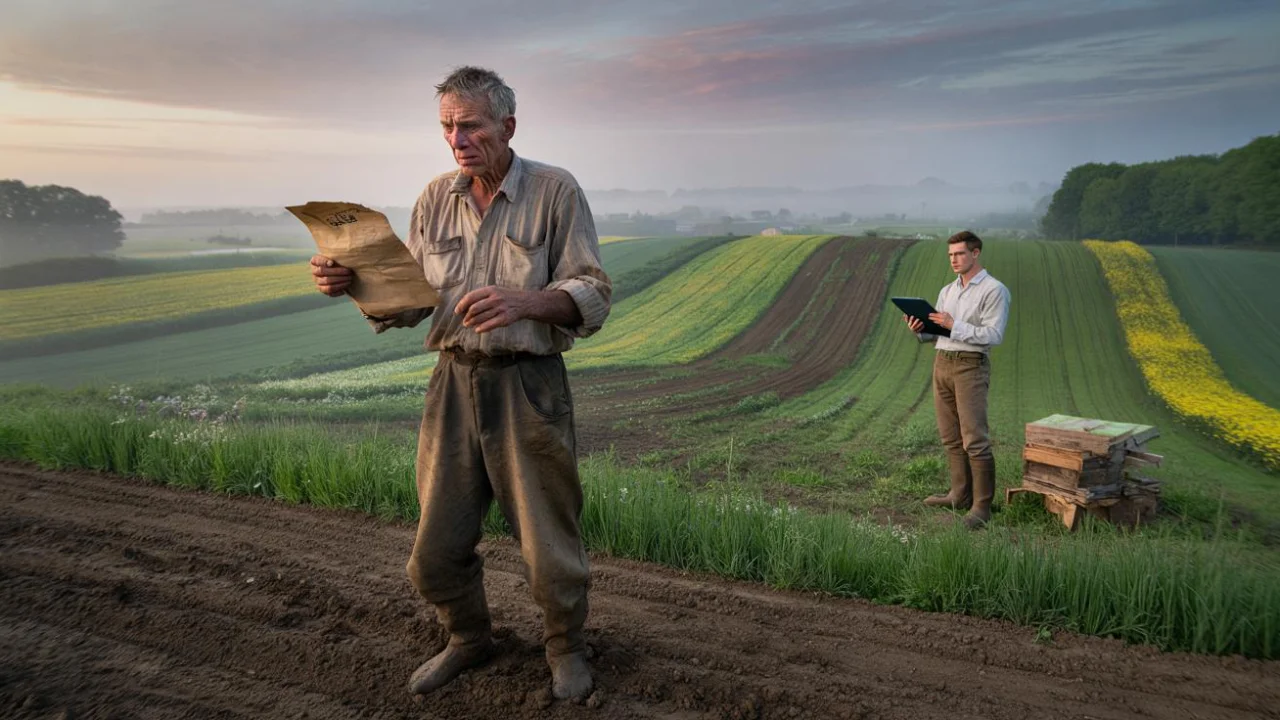
Jan stared at the letter in his trembling hands, mud from his work boots already soaking through the thin paper. At 59, his body was failing him after decades of farm labor, and the small inherited field behind his house was supposed to be his lifeline—not his financial death sentence. He’d done what seemed right: rented it to a young eco-farmer who promised to heal the soil and bring back the birds. Now he owed more in green agricultural tax than he earned in three months.
The irony wasn’t lost on him. While his tenant collected government subsidies and Instagram followers for organic farming practices, Jan received a bill he couldn’t afford for environmental improvements he never requested. By Friday, he was calculating bankruptcy costs and watching his family tear itself apart over a plot of land that had become more burden than blessing.
This wasn’t supposed to happen to people like Jan. But across rural communities, the same story repeats: hardworking people caught in the crossfire of climate policy, paying the price for environmental progress they can’t afford and didn’t choose.
How Green Agricultural Tax Became a Rural Nightmare
The green agricultural tax was designed with the best intentions. Governments needed funding for climate transition programs, and environmentally beneficial farming practices needed financial support. The logic seemed sound: landowners who benefit from ecological improvements on their property should contribute to the broader environmental effort.
But policy makers didn’t account for people like Jan—exhausted workers who inherited small plots they can no longer farm themselves. These accidental landlords find themselves trapped in a system where they’re legally responsible for taxes on environmental benefits they never requested and can’t afford.
“We’re seeing a massive disconnect between policy intention and ground-level reality,” explains rural economics researcher Maria Santos. “The tax assumes landowners are profiting from green subsidies, but many are just trying to survive retirement with dignity.”
The mechanics are deceptively simple. When a tenant implements approved environmental practices—cover crops, reduced pesticides, wildlife corridors—the landowner becomes liable for a percentage-based green agricultural contribution. The more ecological the farming, the higher the potential tax burden.
Who Pays and How Much: Breaking Down the Financial Reality
The green agricultural tax system creates a complex web of financial responsibility that often catches small landowners off guard. Here’s how the burden typically breaks down:
| Land Size | Annual Tax Rate | Average Cost | Typical Owner Profile |
|---|---|---|---|
| Under 5 acres | 2.5% of assessed value | $800-$2,400 | Retirees, inherited plots |
| 5-20 acres | 3.2% of assessed value | $2,400-$8,000 | Small farmers, part-time owners |
| 20-50 acres | 4.1% of assessed value | $8,000-$25,000 | Medium agricultural operations |
| Over 50 acres | 5.5% of assessed value | $25,000+ | Commercial farming enterprises |
The most vulnerable are owners of small plots who rent to eco-conscious tenants. They face several key challenges:
- No direct income from environmental subsidies that go to tenants
- Tax bills often exceed annual rental income
- Limited ability to pass costs to tenants with long-term contracts
- Difficulty selling land due to tax liability concerns
- Lack of knowledge about tax implications when signing rental agreements
“I’ve seen families lose land that’s been passed down for generations because they couldn’t afford the green tax on improvements they didn’t choose,” says agricultural policy attorney David Chen. “The system punishes exactly the people we should be protecting.”
When Family Land Becomes a Battleground
Jan’s situation exploded into family conflict when his siblings realized the field they’d all hoped to inherit was now a financial liability. His sister wanted to force a sale immediately. His brother suggested defaulting and walking away. His elderly mother, who’d gifted Jan the land, felt responsible for the mess.
This family drama plays out in kitchen tables and lawyer offices across rural areas. Inherited land that once represented security now tears families apart. The green agricultural tax has created a new category of “toxic assets”—small plots that cost more to own than they’re worth.
The emotional toll is devastating. “These aren’t wealthy landowners gaming the system,” explains family counselor and rural advocate Lisa Rodriguez. “These are working families who played by the rules and got blindsided by policy changes they never saw coming.”
Some families choose to sell to developers, ironically removing farmland from agricultural use forever. Others default on taxes, allowing local governments to seize property that often sits unused. The most tragic cases involve elderly owners who worked their entire lives to pass something to their children, only to leave them a burden instead of a blessing.
The National Debate Nobody Saw Coming
Jan’s story, shared by a local journalist on social media, sparked unexpected national attention. Within weeks, rural advocacy groups were using his case to challenge the entire premise of the green agricultural tax. Environmental organizations pushed back, arguing that climate action requires shared sacrifice.
The debate reveals a fundamental question: who should pay for the climate transition? Current policy places the burden on landowners, regardless of their financial situation or involvement in farming decisions. Critics argue this approach is both unfair and counterproductive.
“We’re asking the wrong people to pay the bill,” argues economist Dr. Sarah Mitchell. “Small landowners like Jan aren’t the primary beneficiaries of agricultural subsidies or the main drivers of environmental damage. Yet they’re bearing a disproportionate share of transition costs.”
Proposed reforms include exemptions for small landowners, sliding scales based on income, and shifting tax responsibility to tenants who receive environmental subsidies. Some legislators are pushing for complete repeal, while others want to expand the program to include urban property owners.
The political stakes are rising. Rural voters increasingly view the green agricultural tax as symbol of climate policies that hurt working families. Urban environmentalists worry that weakening the tax will undermine crucial climate funding. Both sides are digging in for a fight that could reshape environmental policy for years to come.
FAQs
What exactly is the green agricultural tax?
It’s a fee charged to landowners whose property benefits from environmental improvements like organic farming, wildlife corridors, or reduced pesticide use, designed to help fund climate transition programs.
Do all landowners have to pay this tax?
No, only landowners whose property is used for qualifying environmental practices, but many don’t realize they’re liable until they receive a tax bill.
Can landowners avoid the tax by changing how their land is used?
Sometimes, but this often means ending environmental programs, which defeats the policy’s purpose and may violate existing rental agreements.
Are there any exemptions for low-income landowners?
Currently, few jurisdictions offer income-based exemptions, though some proposed reforms would add hardship provisions for small landowners.
Who receives the money from these taxes?
Funds typically go to environmental agencies for climate programs, conservation efforts, and sometimes back to farmers as green subsidies.
Is the green agricultural tax being challenged legally?
Yes, several lawsuits are pending, with plaintiffs arguing the tax unfairly burdens small landowners who don’t benefit from the environmental programs they’re forced to fund.


