
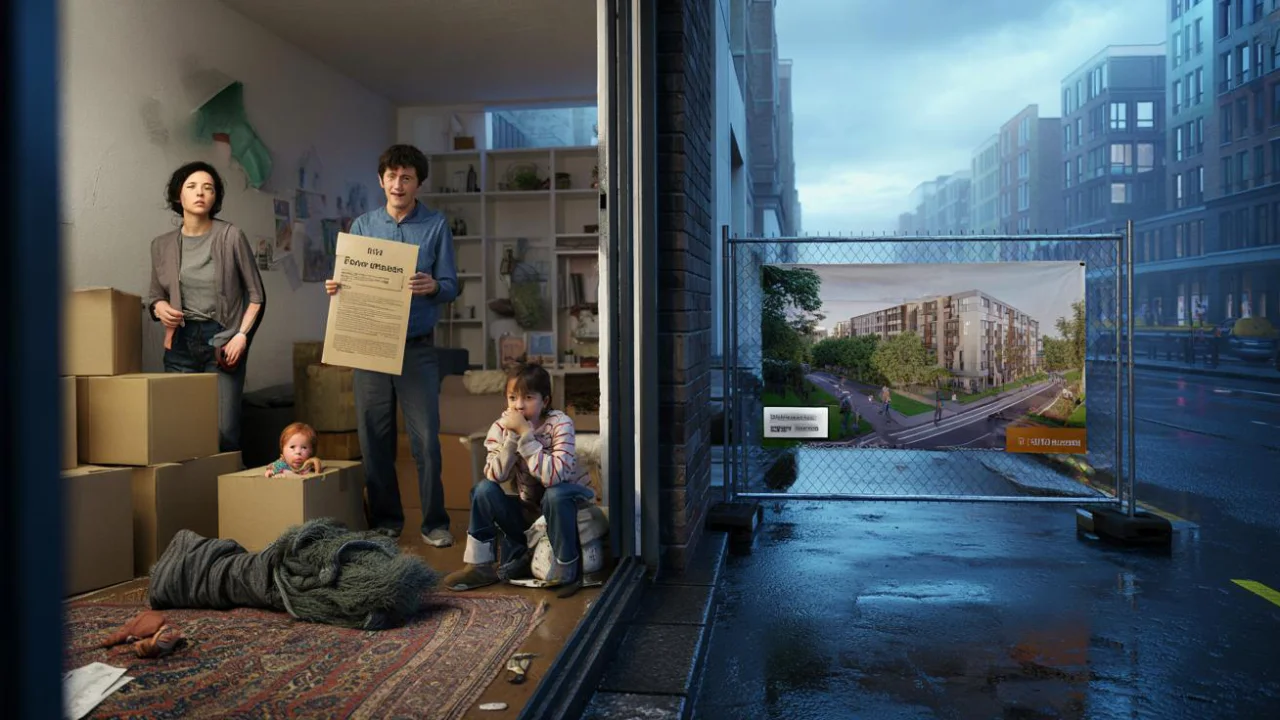
Maria stares at the eviction notice taped to her apartment door, the words “urban renewal project” blurring through her tears. She’s lived in this cramped but familiar flat for twelve years, watching her daughter take her first steps on the worn linoleum, hosting birthday parties in the narrow kitchen. Now, at 48, she’s being asked to pack up her life so the city can build “affordable housing for families in need.”
The irony isn’t lost on her. Maria is a family in need. She works two part-time jobs, struggles with rent, and has been on the social housing waiting list for three years. Yet here she is, being displaced to make room for other people just like her.
Her story echoes across Europe and beyond, as urban renewal policies create an uncomfortable truth: someone always has to move to make room for progress.
The Human Cost of Good Intentions
Urban renewal policies sound noble in city council meetings. Politicians speak passionately about creating “inclusive communities” and “breaking cycles of poverty.” The PowerPoint presentations show gleaming apartment blocks with integrated green spaces and mixed-income housing.
But behind every successful social housing project, there are families like Maria’s who never asked to be part of the solution.
“We’re seeing a pattern where existing communities are broken up in the name of social progress,” says Dr. Elena Rodriguez, a housing policy researcher at the European Urban Studies Institute. “The people being displaced often have the same vulnerabilities as those the projects are meant to help.”
The resentment builds slowly. First comes the notice. Then the meetings where officials explain how the new development will benefit everyone. Then the relocation offers – often to neighborhoods far from schools, jobs, and social networks people have spent years building.
Cities across Europe are grappling with this dilemma. In Amsterdam, entire blocks have been emptied for social housing renovations. In Barcelona, old neighborhoods face complete transformation under urban renewal schemes. London’s estate regeneration programs have displaced thousands of working-class families, despite promises of “right to return.”
What’s Really Happening on the Ground
The mechanics of modern urban renewal policies create a specific type of displacement that affects middle and lower-middle-class tenants disproportionately:
- Private landlords receive compulsory purchase orders for buildings in designated renewal zones
- Existing tenants get 3-6 months notice and relocation assistance
- New developments prioritize social housing tenants from centralized waiting lists
- Original residents rarely qualify for units in their old neighborhoods due to income thresholds
- Alternative housing offers typically involve longer commutes and higher living costs
| City | Households Displaced (2020-2023) | Average Relocation Distance | Return Rate to Original Area |
|---|---|---|---|
| London | 8,400 | 12 km | 23% |
| Barcelona | 3,200 | 8 km | 31% |
| Amsterdam | 5,100 | 15 km | 18% |
| Berlin | 4,800 | 11 km | 27% |
These numbers tell a story that rarely makes it into policy documents. Families are scattered across metropolitan areas, children change schools, elderly residents lose access to familiar services and social connections.
“The psychological impact is often underestimated,” explains Dr. James Mitchell, who studies community displacement at King’s College London. “People don’t just lose their homes – they lose their sense of belonging to a place.”
The Political Divide Nobody Talks About
Recent polling across major European cities reveals a startling split in public opinion about urban renewal policies. While 67% of respondents support more social housing in principle, only 31% approve of policies that require displacing current residents to achieve it.
The divide isn’t just about nimbyism or selfishness. Many people understand the housing crisis is real and support helping vulnerable families. But they question whether the solution should come at the expense of working people who are barely getting by themselves.
“There’s a fundamental fairness issue here,” says Sarah Thompson, who leads a tenants’ rights organization in Manchester. “You’re asking people who are struggling economically to sacrifice their stability so that other struggling people can have homes. Where’s the policy that doesn’t pit poor against poor?”
This tension reflects a broader challenge with urban renewal policies: they often transfer hardship rather than reducing it. The family that moves into Maria’s renovated building gets help, but Maria’s family faces disruption, higher costs, and social isolation.
Local councillors privately admit the dilemma keeps them awake at night. They face pressure to address housing shortages while dealing with angry constituents who feel betrayed by policies they once supported.
Who Really Benefits from Urban Transformation
The beneficiaries of urban renewal policies fall into distinct categories, and the distribution isn’t always what politicians promise:
- Social housing applicants from citywide waiting lists (often moving in from other areas)
- Construction companies and developers receiving public contracts
- Property owners in surrounding areas seeing increased values
- City councils meeting EU funding requirements and housing targets
Meanwhile, those bearing the costs include:
- Displaced tenants facing higher housing costs in new areas
- Local businesses losing established customer bases
- Children and elderly residents adapting to new environments
- Community organizations rebuilding networks from scratch
“We’re essentially asking some citizens to subsidize services for others through forced relocation,” notes Professor Christine Weber from the Vienna Institute for Social Policy. “That’s a form of taxation that isn’t distributed fairly across society.”
The evidence suggests current urban renewal policies create winners and losers within the same economic bracket. A single mother on benefits might benefit if she gets a new flat, while another single mother working minimum wage gets displaced. Both have similar needs, but the policy treats them differently based on timing and bureaucratic categories.
Looking for Better Solutions
Some cities are experimenting with alternatives that address housing shortages without mass displacement. Vienna’s social housing model builds new units without demolishing existing communities. Copenhagen requires developers to provide temporary housing within the same neighborhood for displaced residents.
These approaches cost more upfront but avoid the hidden social and economic costs of community disruption. They also face less political resistance because they don’t force working families to choose between supporting vulnerable people and protecting their own stability.
The question isn’t whether cities need more affordable housing – they clearly do. The question is whether urban renewal policies should sacrifice existing communities to build new ones, or find ways to expand housing without breaking up the social fabric that makes neighborhoods work.
FAQs
Do displaced tenants receive financial compensation?
Most cities provide relocation assistance covering moving costs and sometimes temporary rent subsidies, but compensation rarely covers the full economic impact of displacement.
Can tenants challenge eviction notices for urban renewal projects?
Legal challenges are possible but difficult and expensive. Most tenants accept relocation offers because fighting the system is financially risky.
How long do urban renewal projects typically take to complete?
From initial planning to residents moving into new units, projects usually take 3-5 years, during which displaced families must find alternative housing.
Do displaced residents get priority for units in the new developments?
Policies vary by city, but most displaced tenants don’t qualify for social housing in their former neighborhoods due to income requirements or waiting list structures.
Are there alternatives to displacement-based urban renewal?
Yes, cities can build new social housing on unused land, convert commercial buildings, or require private developers to include affordable units in new projects.
What support exists for families struggling with relocation?
Support varies widely but typically includes housing search assistance, temporary accommodation, and sometimes counseling services for children changing schools.


