
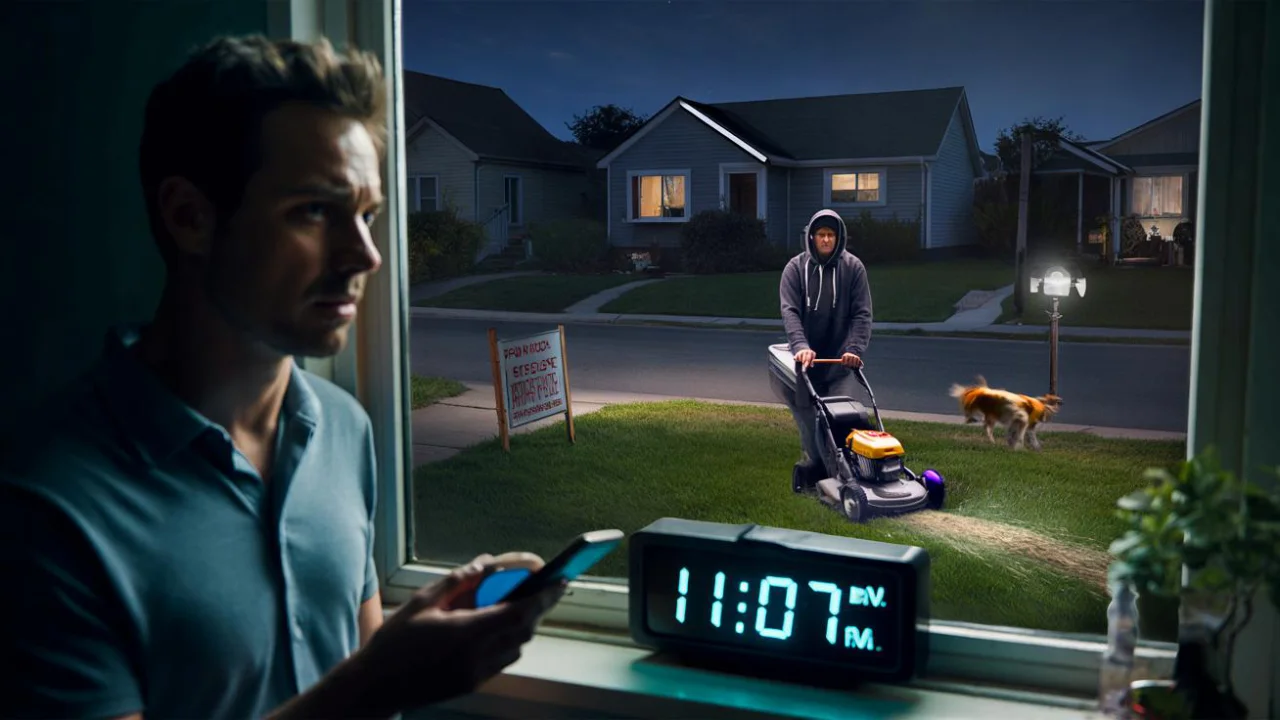
Sarah Chen was folding laundry in her upstairs bedroom when the sound hit her like a freight train. The steady, mechanical drone of a gas mower cutting through the 11 p.m. silence made her freeze mid-fold. She walked to her window and peered through the blinds to see her new neighbor pushing a bright red mower back and forth across his front yard, floodlights blazing like a night baseball game.
Her toddler stirred in the next room. Her husband groaned from bed. Three houses down, she could see other bedroom lights flickering on as the entire block woke up to the unexpected midnight lawn care session.
What Sarah didn’t know was that this single act of late night lawn mowing would spark a neighborhood feud that would last six months, involve the police, and permanently change how everyone on Elm Street thought about being neighbors.
Why Late Night Lawn Mowing Became the Battle That Split a Community
Late night lawn mowing incidents are becoming surprisingly common across suburban America. What starts as a simple scheduling conflict often escalates into bitter disputes that reveal deeper tensions about respect, boundaries, and community living.
The story playing out on Elm Street mirrors thousands of similar conflicts nationwide. New homeowner Jake Morrison worked double shifts at a local manufacturing plant, getting home around 10:30 p.m. most nights. With a heat wave approaching and his grass reaching ankle height, he figured mowing after work was better than letting his yard become the neighborhood eyesore.
“I thought I was being responsible,” Morrison later explained to local mediators. “I didn’t want to be that guy with the messy lawn bringing down property values.”
But for his neighbors, the late night lawn mowing felt like an assault on their most sacred space: their homes after dark. Sleep schedules shattered. Children woke crying. Dogs barked for hours afterward.
The Legal and Social Landscape of Noise Disputes
Most communities have noise ordinances that specifically address late night lawn mowing and similar activities. Here’s what you need to know about the rules and consequences:
| Time Period | Typical Restrictions | Common Penalties |
|---|---|---|
| 10 PM – 7 AM (Weekdays) | No power equipment use | $50-$500 fines |
| 10 PM – 8 AM (Weekends) | Quiet hours enforced | Warning first, then fines |
| Emergency exceptions | Storm cleanup allowed | 24-hour permit required |
| Ongoing violations | Escalating penalties | Up to $2000 in some areas |
Beyond legal consequences, late night lawn mowing creates lasting social damage. Research from the American Psychological Association shows that noise-related neighbor disputes are among the most difficult community conflicts to resolve because they touch on fundamental issues of respect and control.
Key factors that make these situations explosive include:
- Sleep disruption affecting entire families
- Feeling powerless in your own home
- Different work schedules creating misunderstandings
- Social media amplifying minor conflicts
- Property value concerns
“When someone disrupts your sleep, it feels personal even when it’s not intended that way,” explains Dr. Maria Rodriguez, a community mediation specialist. “Late night lawn mowing hits people at their most vulnerable time.”
How One Midnight Mow Triggered Months of Conflict
The Elm Street situation escalated quickly because neither side understood the other’s perspective. Jake Morrison continued his late night lawn mowing routine twice more that week, genuinely believing he was being considerate by maintaining his property.
Meanwhile, his neighbors felt increasingly violated. Sarah Chen started closing her windows despite the summer heat. The elderly couple next door began taking sleep medication. Parents worried about their children’s school performance as night after night brought the roar of the mower.
The breaking point came when neighbor Tom Rodriguez confronted Morrison directly. “He told me I could mow whenever I wanted because it was my property,” Rodriguez recalls. “That’s when I realized this wasn’t about scheduling anymore.”
What followed was a escalating series of retaliations that consumed the entire block:
- Police calls every time the mower started after 10 PM
- Homeowners association complaints and counter-complaints
- Social media posts that divided neighbors into camps
- Property line disputes over grass clippings
- Anonymous noise complaints to city code enforcement
The late night lawn mowing incidents eventually stopped, but only after Morrison received three citations totaling $750 in fines. By then, the damage to neighborhood relationships was permanent.
The Real Cost of Midnight Maintenance
Beyond the immediate noise disruption, late night lawn mowing creates ripple effects that touch every aspect of community life. Property managers report that noise-related disputes are the number one cause of tenant complaints and lease violations.
Dr. Jennifer Walsh, who studies suburban community dynamics, notes that these conflicts often reveal underlying tensions about class, work schedules, and social expectations. “The person doing late night lawn mowing is usually working multiple jobs or odd hours,” she explains. “The complainers are typically on traditional schedules. Neither side sees the other’s reality.”
The financial costs add up quickly. Legal fees for neighbor disputes average $2,000-$5,000 per household. Property values can drop 3-5% on blocks with ongoing conflicts. Some homeowners even relocate to escape the tension.
Mental health impacts are significant too. Studies show that chronic neighbor conflicts increase stress hormones, disrupt sleep patterns, and contribute to anxiety and depression. Children living in these situations often develop behavioral problems at school.
Six months after the Elm Street late night lawn mowing war ended, the block still feels divided. Some neighbors haven’t spoken since the conflict began. Others moved away entirely rather than deal with the ongoing tension.
Prevention and Resolution Strategies
Community mediation experts recommend several approaches to prevent late night lawn mowing conflicts from escalating:
- Direct conversation before involving authorities
- Understanding work schedules and constraints
- Compromising on timing and frequency
- Using electric mowers for quieter operation
- Establishing neighborhood communication channels
For the Morrison situation, a simple conversation could have prevented months of conflict. Jake was willing to adjust his schedule but never knew his late night lawn mowing was causing problems until the police arrived with the first citation.
“If someone had just knocked on my door and explained, I would have figured something else out,” Morrison reflects. “I could have hired a service, borrowed a friend’s electric mower, or asked for help during daylight hours.”
FAQs
What are typical quiet hours for lawn mowing in most communities?
Most cities enforce quiet hours from 10 PM to 7 AM on weekdays and 10 PM to 8 AM on weekends, prohibiting power equipment like mowers during these times.
Can I be fined for late night lawn mowing?
Yes, most communities issue fines ranging from $50 to $500 for first offenses, with penalties increasing for repeat violations.
What should I do if my neighbor is mowing their lawn late at night?
Start with a friendly conversation to explain the impact. If that doesn’t work, check local noise ordinances and contact non-emergency services if violations continue.
Are there quieter alternatives for people who can only mow at night?
Electric mowers are significantly quieter than gas-powered ones, and some communities allow their use during extended hours. Hiring a lawn service is another option.
How can communities prevent these conflicts?
Clear communication about noise ordinances, neighborhood welcome packets for new residents, and established mediation processes help prevent minor issues from becoming major disputes.
What long-term damage can these disputes cause?
Neighbor conflicts can decrease property values, create lasting tension in communities, and even force residents to relocate. Mental health impacts include increased stress and sleep disruption.


