
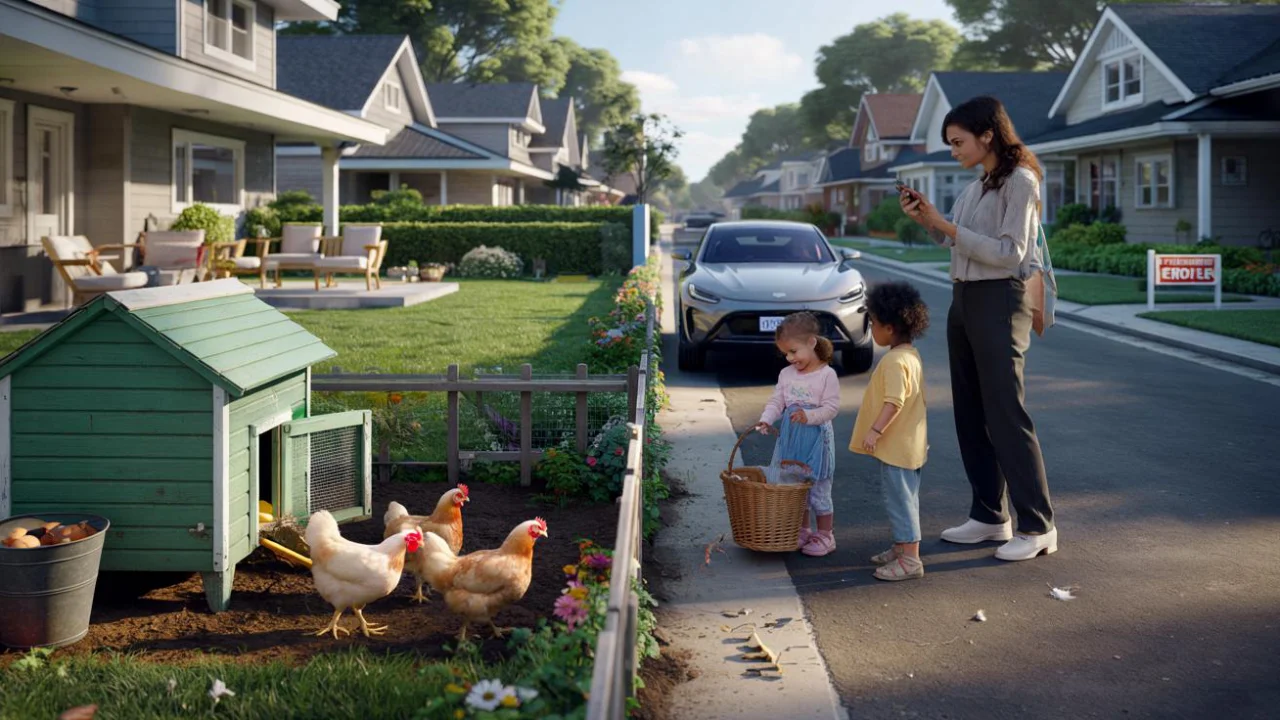
Sarah Martinez never thought a chicken could ruin her morning coffee. But there she was, standing in her pristine kitchen at 6:30 AM, listening to her new neighbor’s hens announce the dawn like feathered alarm clocks. She’d moved to Willow Creek for the quiet suburban life—manicured lawns, predictable routines, and definitely no farm animals.
Three houses down, Tom Chen was collecting warm eggs from his backyard coop, smiling as his 8-year-old daughter counted them into a wicker basket. For his family, those four Buff Orpington hens represented something bigger than breakfast. They were a small act of rebellion against rising grocery prices and a broken food system that seemed to get more expensive every week.
Same street. Same morning. Two completely different reactions to the simple act of keeping backyard chickens.
The Great Suburban Chicken Divide
Backyard chickens are splitting neighborhoods right down the middle, creating unexpected battle lines in America’s suburbs. What started as a pandemic hobby has evolved into something much more complex—a clash between traditional suburban values and a growing desire for food independence.
The numbers tell the story. Urban chicken keeping has exploded by over 200% since 2020, according to the American Poultry Association. Cities from Seattle to Atlanta have relaxed chicken ordinances, and farm supply stores report that chicken coops are flying off shelves faster than they can stock them.
“People want control over their food source,” explains Dr. Jennifer Walsh, an urban agriculture specialist at Colorado State University. “The pandemic showed us how fragile our food supply really is. A backyard chicken feels like insurance.”
But for every family celebrating fresh eggs, there’s often a neighbor wondering what happened to their quiet street. The suburban contract—that unspoken agreement about lawn heights, noise levels, and what belongs in backyards—is getting rewritten one coop at a time.
When Chickens Meet City Ordinances
The legal landscape around backyard chickens is a patchwork of rules that changes from city to city, sometimes even from neighborhood to neighborhood. Here’s what most chicken keepers need to know:
| City Rules | Typical Requirements | Common Restrictions |
|---|---|---|
| Permit Required | Annual fee $25-75 | No roosters allowed |
| Coop Distance | 10-25 feet from property lines | Maximum 4-6 hens per lot |
| Lot Size Minimum | 0.15-0.25 acres | No commercial egg sales |
| Inspection Process | Initial approval visit | Coops must be enclosed |
But legal doesn’t always mean welcome. Austin, Texas, saw chicken complaints jump 340% in neighborhoods that had recently relaxed poultry ordinances. Most complaints weren’t about animal welfare—they focused on noise, odor, and the fear of attracting rats.
“The law says I can have chickens, but my HOA is threatening fines,” says Maria Rodriguez, who keeps three hens in her Phoenix backyard. “I’m caught between city rules and neighborhood expectations.”
Some cities are finding creative middle ground. Denver created “chicken zones” based on lot size and density. Minneapolis requires neighbor notification before permits are approved. These compromise solutions aim to balance food freedom with community harmony.
The Real Costs and Benefits
Beyond the neighborhood drama, backyard chickens deliver tangible benefits and genuine challenges that affect entire families. The economic math is surprisingly compelling for many households.
A typical backyard flock of four hens costs about $300 to start, including coop construction and initial birds. Those hens produce roughly 12-16 eggs per week, worth about $8-10 at current grocery prices. Within 18 months, most families break even on their investment.
“We save about $400 a year on eggs alone,” reports Kevin Thompson, a father of three in suburban Atlanta. “But the real value is teaching my kids where food comes from. They understand that eggs don’t just appear in cartons.”
The challenges are equally real:
- Daily care requirements, even during vacations
- Predator protection from hawks, raccoons, and neighborhood dogs
- Winter heating costs in cold climates
- Potential veterinary expenses for sick birds
- Social tension with neighbors who oppose chicken keeping
Dr. Rachel Kim, a veterinarian specializing in backyard poultry, sees both sides daily. “Chickens can be wonderful for families, but they’re livestock, not pets. People need to understand the commitment before they build that first coop.”
Finding Common Ground in Divided Neighborhoods
Some communities are discovering that chicken conflicts don’t have to tear neighborhoods apart. Success stories often involve proactive communication and creative compromise.
In Bend, Oregon, the Riverside neighborhood created a “chicken committee” after tensions erupted over a particularly vocal flock. The group developed voluntary guidelines that went beyond city requirements—coops had to include sound dampening, and chicken keepers agreed to share fresh eggs with immediate neighbors.
“Once people started getting free eggs, complaints dropped to zero,” laughs committee member Janet Parker. “Nothing changes minds quite like a perfect omelet.”
Other successful strategies include:
- Hosting “coop tours” to demystify chicken keeping
- Creating shared flock arrangements between neighbors
- Establishing community gardens with integrated poultry areas
- Forming local chicken clubs for support and education
The key seems to be addressing concerns before they become complaints. Smart chicken keepers introduce themselves to neighbors before building coops, explain their plans, and invite questions.
“I thought my neighbor was crazy when he announced he was getting chickens,” admits Lisa Park from Columbus, Ohio. “Two years later, I have my own flock. Sometimes you just need to see how it actually works.”
What This Means for the Future of Suburbs
The backyard chicken phenomenon reflects something larger happening in American suburbs. Rising food costs, supply chain disruptions, and environmental concerns are pushing families toward greater self-sufficiency.
Urban planning experts predict this trend will accelerate. Food security concerns aren’t going away, and younger homeowners increasingly view suburban lots as productive spaces, not just decorative ones.
“We’re seeing the suburbanization of food production,” observes Dr. Mark Stevens, who studies urban agriculture at UC Davis. “Backyard chickens are just the beginning. Wait until you see the neighborhood battles over vegetable gardens and fruit trees.”
The chickens aren’t going anywhere. The question is whether neighborhoods will adapt to embrace food independence or dig in to preserve traditional suburban aesthetics. Early evidence suggests that most communities eventually find their balance, though not without some ruffled feathers along the way.
FAQs
Do backyard chickens really attract rats and pests?
Properly managed coops with secure feed storage rarely attract more pests than typical bird feeders or compost bins.
How much noise do backyard chickens actually make?
Hens without roosters are generally quieter than most dogs, producing soft clucks and occasional excited chatter when laying eggs.
Can backyard chickens affect property values?
Studies show minimal impact on property values, with well-maintained coops sometimes viewed as attractive amenities by buyers seeking self-sufficiency.
What happens if my neighbor complains about my chickens?
Most cities require mediation before enforcement action, and many complaints can be resolved through better coop management or neighbor communication.
Are backyard chickens actually worth the effort financially?
Most families break even within 18 months and save $300-500 annually on eggs, not counting the educational and entertainment value for children.
How do I know if my neighborhood will accept backyard chickens?
Check city ordinances first, then talk to immediate neighbors about your plans before building a coop to gauge reactions and address concerns early.


