
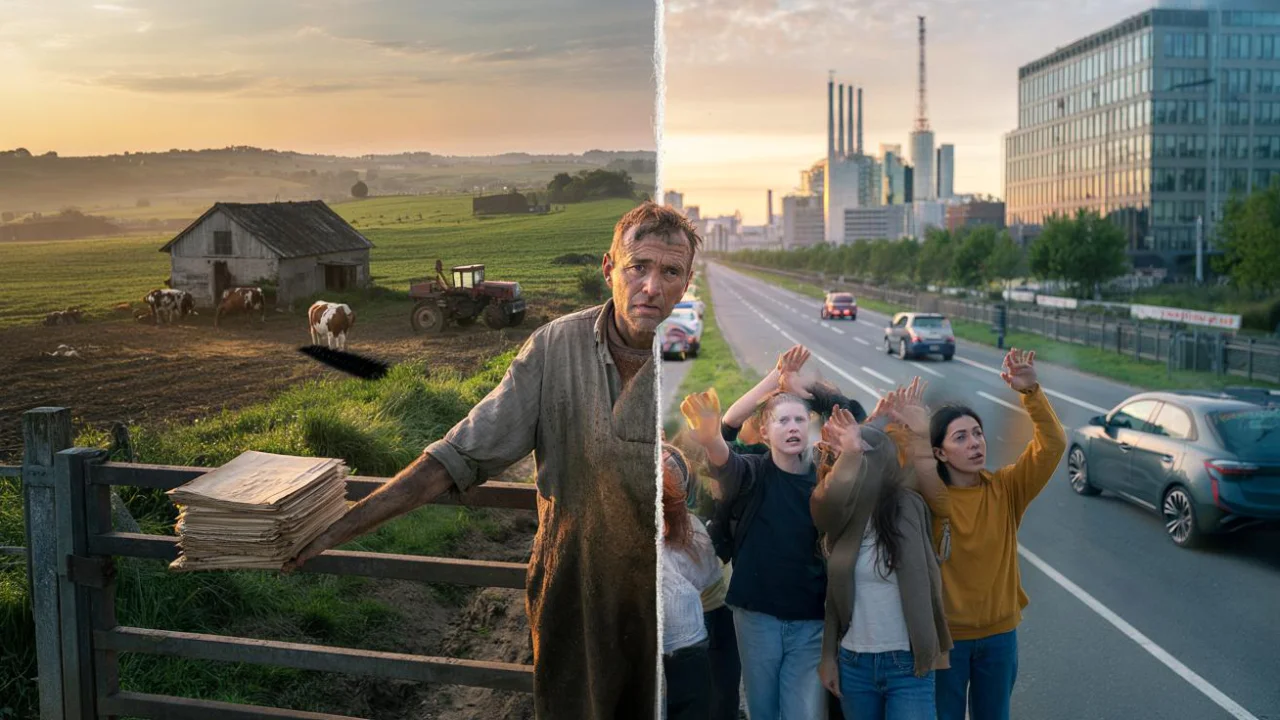
Maria Santos closes her organic grocery store in Portland at 9 PM, exhausted but satisfied. She’s spent the day explaining to customers why their favorite local cheese costs $2 more per pound now. “The dairy farm had to install new methane capture systems,” she tells them. “It’s for the climate.”
Three hours east in rural Oregon, dairy farmer Tom Mitchell stares at the same invoice that drove up Maria’s prices. The methane system cost him $180,000. His bank account shows $3,400. His insurance company just dropped him because his farm sits in a “high-risk flood zone” – the same floods that climate change made three times more likely.
Tom and Maria both want to save the planet. But only one of them might lose their livelihood in the process.
The impossible math of going green
Climate policies targeting farmers have created an uncomfortable truth: the people feeding us are being asked to shoulder costs that entire societies should bear. Across the globe, new environmental regulations hit agricultural communities hardest, while urban populations largely escape direct financial impact.
The numbers tell a stark story. In Europe, farmers face nitrogen reduction requirements that can cut crop yields by 20-30%. In California, new water restrictions force ranchers to reduce herds. Meanwhile, the climate crisis they’re asked to solve affects their livelihoods more directly than almost anyone else’s.
“We’re seeing farmers caught between rising costs and shrinking margins,” says Dr. Jennifer Walsh, an agricultural economist at Cornell University. “They want to be part of the solution, but many can’t afford the transition without serious support.”
Who pays the price when the planet comes first
The financial burden of climate policies on farmers reveals itself in multiple ways. Each new environmental regulation creates ripple effects that extend far beyond individual farms:
- Equipment upgrades: Low-emission tractors and machinery can cost 40-60% more than conventional alternatives
- Reduced productivity: Organic farming typically yields 20-25% less than conventional methods
- Compliance costs: Environmental monitoring, reporting, and certification can add $10,000-50,000 annually
- Land use restrictions: Buffer zones and conservation areas reduce productive farmland by 10-15%
- Input limitations: Restrictions on fertilizers and pesticides increase crop management complexity and costs
| Policy Type | Average Cost Impact | Primary Affected Groups |
|---|---|---|
| Nitrogen restrictions | 15-25% yield reduction | Dairy, grain farmers |
| Methane capture requirements | $150,000-300,000 per farm | Livestock operations |
| Water usage limits | 20-40% production cuts | Irrigated crop farms |
| Pesticide bans | 10-30% increased labor costs | Fruit, vegetable growers |
These costs don’t exist in a vacuum. Rural communities built around farming face job losses, reduced tax revenues, and economic decline when farms struggle or close.
“The irony is brutal,” explains rural sociologist Dr. Mark Chen. “Climate change hits farmers first and hardest, but climate policies often do the same thing.”
When good intentions create bad divisions
The conflict between climate policies and farmers has created unexpected political alliances and deep social divisions. Urban environmental activists, typically progressive, find themselves at odds with rural communities that traditionally support environmental conservation.
In the Netherlands, farmer protests against nitrogen emission rules drew support from 70% of rural residents but only 35% of urban dwellers. Similar splits appear across Europe and North America, where geographic location increasingly determines climate policy support.
The psychological toll runs deep. Farmers who’ve worked for decades to feed their communities suddenly find themselves portrayed as environmental villains. Many describe feeling abandoned by the same urban consumers who demand both cheap food and environmental protection.
“It’s like being told you’re killing the planet while you’re trying to feed it,” says Sarah Rodriguez, a third-generation wheat farmer in Kansas. “We care about the land more than anyone. We just can’t afford to go broke saving it.”
The search for solutions that actually work
Some regions are finding ways to support both climate goals and farming communities. Denmark provides direct subsidies to offset green transition costs. Costa Rica pays farmers for carbon sequestration. These programs recognize that climate protection requires shared investment, not individual sacrifice.
Successful climate policies for farmers typically include:
- Transition funding: Grants or low-interest loans for equipment upgrades
- Carbon markets: Payment for soil carbon storage and emission reductions
- Technical assistance: Free consulting on sustainable farming practices
- Risk insurance: Protection against climate-related crop losses
- Market premiums: Higher prices for sustainably produced food
The key insight from successful programs: farmers become climate allies when they’re partners, not targets.
Dr. Walsh notes: “When we frame environmental protection as something farmers must sacrifice for, we create resistance. When we frame it as something we invest in together, we get cooperation.”
What happens when the divide deepens
The stakes of this conflict extend beyond individual farms or even rural communities. Food security, political stability, and climate progress all depend on finding common ground between environmental necessity and economic reality.
Failed climate policies that ignore farmer concerns often backfire spectacularly. The “Yellow Vest” protests in France began with fuel taxes but drew massive support from rural areas feeling economically abandoned. Similar movements have emerged wherever environmental policies create economic hardship without adequate support.
Meanwhile, climate change accelerates regardless of political divisions. Extreme weather events cost global agriculture $5 billion annually and rising. The window for gradual transition narrows each year, making the need for effective, fair policies more urgent.
As one EU agricultural official put it: “We can have climate policies that work for farmers, or we can have climate policies that fail because they don’t work for farmers. Those are really our only choices.”
FAQs
Why do climate policies affect farmers more than other industries?
Agriculture directly depends on natural resources like soil, water, and weather patterns that climate change disrupts. Environmental regulations often require expensive equipment changes and reduced production that farmers absorb directly.
Can farmers afford to implement climate-friendly practices without support?
Most cannot. Studies show the average farm operates on 2-4% profit margins, making large investments in new equipment or reduced-yield practices financially impossible without assistance.
Do farmers actually oppose environmental protection?
No. Surveys consistently show farmers support environmental goals but want practical, affordable ways to achieve them. Many already use conservation practices but need help scaling up climate solutions.
What happens to food prices when environmental regulations increase?
Production costs typically pass through to consumers as higher prices, though the increase varies by product and market conditions. Meat and dairy products usually see the largest price impacts.
Are there examples of climate policies that work for both farmers and the environment?
Yes. Carbon credit programs, conservation payment systems, and transition subsidies have successfully reduced emissions while maintaining farm incomes in countries like Denmark, Costa Rica, and parts of Australia.
How do rural and urban communities differ on climate policies for agriculture?
Urban residents typically support stricter environmental rules and are more willing to pay higher food prices. Rural communities prioritize economic impacts and prefer voluntary, incentive-based approaches over mandatory regulations.


