
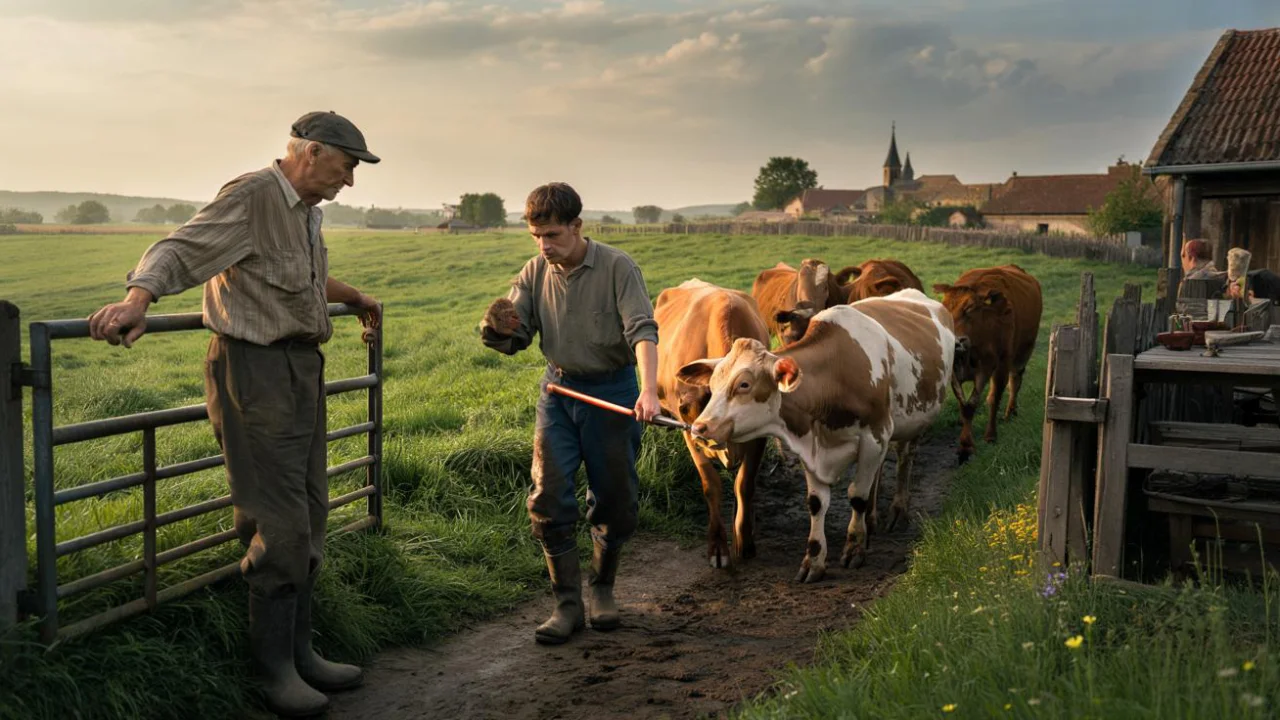
Margaret had watched her neighbor Tom struggle for months. His small dairy farm was drowning in feed costs, and her ten acres of unused pasture grew wild each summer. One morning, she walked over with a cup of coffee and said, “Why don’t you bring your cows here? The grass needs eating anyway.”
Tom’s relief was immediate. No paperwork, no rent, just neighbors helping neighbors the way it had always been done. Six months later, Margaret received a letter from the tax office asking pointed questions about “undeclared rental income” and “benefits in kind.”
Her simple act of kindness had somehow become a tax investigation.
When neighborly help meets modern tax law
Across rural communities, informal grazing agreements like Margaret’s are sparking a heated national debate that reaches far beyond farm gates. These casual arrangements—where landowners allow farmers to graze livestock on unused land without formal contracts or payments—represent centuries-old rural traditions now colliding with increasingly aggressive tax enforcement.
The controversy centers on whether tax authorities should treat these neighborly gestures as hidden business transactions. Revenue offices argue that free land use constitutes a “benefit in kind” that should be taxed, while rural communities insist that not every helpful gesture should trigger tax obligations.
“We’re seeing a fundamental clash between community values and bureaucratic interpretations,” explains rural law specialist Dr. James Patterson. “What farmers see as normal neighborly support, tax offices increasingly view as undeclared economic activity.”
The stakes couldn’t be higher. Millions of acres across the country operate under informal grazing agreements, supporting both struggling farmers and landowners who want their unused fields maintained naturally.
Understanding the legal landscape of informal grazing
The complexity surrounding informal grazing agreements stems from how tax law interprets “economic benefit” versus genuine community assistance. Here’s what property owners and farmers need to know:
- No written contract doesn’t mean no tax implications – Verbal agreements can still be considered taxable arrangements
- Market value calculations apply – Tax offices may assign rental values to free grazing based on local rates
- Duration matters – Short-term emergency grazing may be treated differently than ongoing seasonal arrangements
- Mutual benefits complicate things – When landowners gain field maintenance, tax offices may see hidden exchanges
- Documentation becomes crucial – Proving genuine charitable intent requires careful record-keeping
| Arrangement Type | Tax Risk Level | Key Considerations |
|---|---|---|
| Emergency grazing (under 30 days) | Low | Often treated as genuine assistance |
| Seasonal grazing (3-6 months) | Medium | May require documentation of charitable intent |
| Year-round arrangements | High | Likely to be viewed as rental agreements |
| Arrangements with maintenance benefits | High | Seen as mutual exchange of services |
“The problem is that tax law doesn’t recognize the difference between a business transaction and a community favor,” notes agricultural accountant Sarah Mitchell. “A retired teacher letting her neighbor’s sheep graze her paddock gets treated the same as a commercial grazing operation.”
Real families facing real consequences
The human cost of this regulatory uncertainty extends far beyond abstract legal debates. Rural families are making painful choices between helping neighbors and avoiding potential tax penalties.
John Davidson, a 68-year-old retired teacher, received a tax assessment for £3,200 after letting a young farmer graze cattle on his unused field for two summers. “I never thought helping someone feed their animals would make me a tax cheat,” he says. “Now I’m scared to even talk to my farming neighbors.”
The ripple effects are devastating rural communities:
- Broken support networks – Farmers losing access to emergency grazing during droughts or financial crises
- Abandoned land management – Unused fields growing wild instead of being naturally maintained by livestock
- Increased isolation – Rural neighbors becoming reluctant to offer traditional mutual support
- Higher farming costs – Young farmers forced into expensive commercial arrangements
Emma Phillips, who runs a small sheep farm with her husband, describes the new reality: “We used to be able to call three different neighbors during a crisis. Now we’re down to paying commercial rates because everyone’s terrified of tax letters.”
The psychological impact runs deeper than financial concerns. Rural communities that have operated on trust and mutual aid for generations are questioning the very foundations of neighborly relationships.
Searching for middle ground in muddy fields
As pressure mounts on both sides, various solutions are emerging to bridge the gap between tax compliance and community values. Some regions are experimenting with “charitable grazing exemptions” that protect genuine acts of neighborly assistance while still catching commercial arrangements masquerading as favors.
“We need clear thresholds that distinguish between helping a neighbor and running a business,” argues rural policy expert Dr. Rachel Chen. “Perhaps arrangements under certain time limits or involving financial hardship could receive automatic exemptions.”
Several proposed approaches are gaining traction:
- Time-based exemptions – Grazing agreements under 90 days treated as charitable assistance
- Hardship provisions – Special protection for arrangements helping farmers during documented financial difficulties
- Community certification – Local councils vouching for genuine neighborly relationships
- Minimum threshold rules – Small-scale arrangements below certain values automatically exempt
The debate reflects broader tensions between modern regulatory frameworks and traditional community life. Rural advocates argue that some aspects of human relationships should remain outside bureaucratic oversight, while tax authorities insist that consistent rule application prevents widespread avoidance schemes.
Meanwhile, in villages across the country, gates that once opened freely now remain firmly closed. The silence in the countryside has returned—but this time, it’s the sound of neighbors no longer talking to each other, afraid their kindness might be mistaken for tax evasion.
FAQs
Can I let my neighbor graze animals on my land without tax consequences?
It depends on the arrangement’s duration, mutual benefits, and your local tax office’s interpretation. Short-term emergency help is generally safer than long-term arrangements.
What documentation should I keep for informal grazing agreements?
Record the charitable nature of the arrangement, any financial hardship involved, and evidence that you receive no economic benefit beyond basic land maintenance.
How do tax offices determine the value of free grazing?
They typically use local commercial grazing rates, which can result in significant tax assessments even for small informal arrangements.
Are there legal ways to help struggling farmer neighbors?
Yes, but consider formal charitable arrangements, documented hardship assistance, or very short-term emergency help with proper documentation of charitable intent.
What happens if I receive a tax office inquiry about informal grazing?
Respond promptly with documentation showing the charitable nature of the arrangement, any community relationships involved, and evidence of genuine neighborly assistance rather than business activity.
Could informal grazing rules change in the future?
Pressure is mounting for clearer exemptions that protect genuine community assistance while preventing tax avoidance schemes, so legislative changes are possible.


