
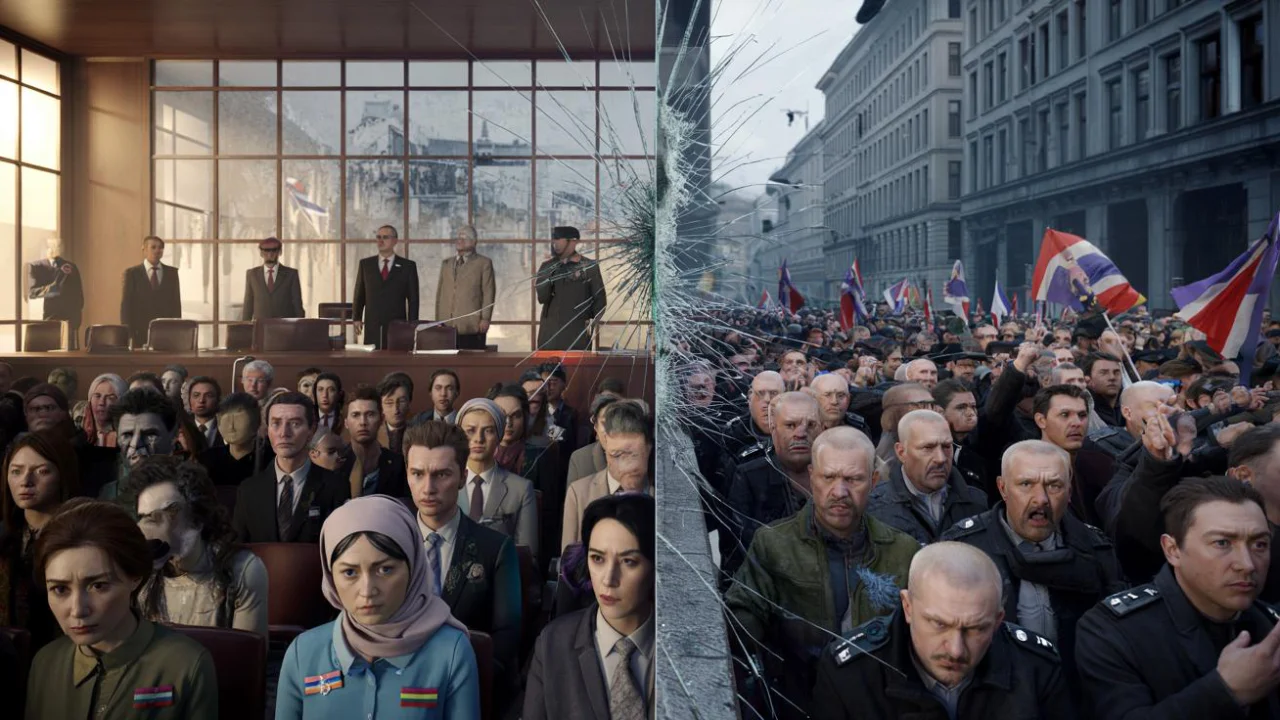
Maria stares at her ballot, hands trembling slightly. The far-right party candidate promises to “restore order” to her small German town, where immigrants now run three of the five corner shops. Her elderly neighbor whispers that maybe it’s time for “real change.” But Maria remembers her grandmother’s stories about the 1930s, when democracy died not with tanks and guns, but with ballots and cheers.
This scene plays out across dozens of countries today. Ordinary people wrestling with an impossible choice: vote for parties they fear, or support banning them entirely. The question keeping democracies awake at night isn’t just about far-right parties anymore. It’s about whether democracy can survive its own rules.
“We’re watching societies tear themselves apart from within,” explains Dr. Elena Rodriguez, a political scientist who studies democratic resilience. “The very tolerance that makes democracy beautiful might also be its weakness.”
When Democratic Societies Face Their Darkest Mirror
Far-right parties are surging across the globe, winning seats in parliaments from Italy to Brazil, from India to Sweden. These aren’t fringe movements anymore. They’re mainstream political forces with real power, real budgets, and real influence over millions of lives.
The numbers tell a stark story. In 2023, far-right parties held significant parliamentary representation in over 30 democracies worldwide. Some govern as coalition partners. Others lead opposition movements that shape national conversations about immigration, identity, and who belongs in society.
But here’s where it gets complicated. These parties didn’t seize power through coups or violence. They won elections. They followed democratic rules. They convinced voters that their vision of the future was worth supporting.
Professor James Mitchell from Oxford University puts it bluntly: “Democracy is being used as a weapon against itself. The question isn’t whether we can stop this. It’s whether we should.”
The Global Playbook for Banning Political Movements
Different democracies have drawn vastly different lines in the sand. Some countries treat political speech as nearly sacred. Others see dangerous ideas as existential threats worth stopping before they spread.
- Germany’s Fortress Model: Constitutional provisions allow banning parties that threaten democratic order
- Spain’s Terrorism Standard: Only outlaws groups directly linked to violence or terror activities
- United States’ Free Speech Absolutism: Protects even hate speech unless it directly incites immediate violence
- France’s Laicité Approach: Bans parties that violate secular principles or promote religious extremism
- India’s Communal Violence Test: Outlaws organizations that promote religious or ethnic hatred
| Country | Parties Banned Since 1945 | Current Status |
|---|---|---|
| Germany | 3 major parties | Considering AfD restrictions |
| Spain | Multiple small groups | Monitoring Vox movement |
| Turkey | Over 20 parties | Ongoing political restrictions |
| United States | 0 | No legal mechanism exists |
| India | Several organizations | Recent Hindu nationalist concerns |
The pattern reveals something troubling. Countries that ban political parties often find new ones emerging to fill the same ideological space. It’s like playing whack-a-mole with democracy itself.
The Human Cost of Political Extremism
Behind every policy debate about far-right parties are real people living with real consequences. Teachers report students parroting extremist talking points. Immigrants describe feeling unsafe walking certain streets. Jewish communities see swastikas appearing on synagogue walls.
Sarah Chen, whose family immigrated from Taiwan, describes the change in her suburban neighborhood: “My daughter asks why some kids at school say we should ‘go back where we came from.’ She was born here. This is where we came from.”
The ripple effects touch everyone. Moderate politicians shift their language rightward to compete. Media outlets amplify extreme voices because they generate clicks. Social media algorithms push people toward more radical content because engagement drives profits.
Mental health professionals report increasing anxiety in minority communities. Hate crime statistics climb year after year. Democracy starts feeling less like a system for solving problems together and more like a battleground where winners take everything.
Yet banning parties creates its own trauma. Voters who supported banned movements feel silenced and betrayed. They don’t disappear. They don’t change their minds. They often become more radicalized, not less.
What Happens When Democracy Draws Red Lines
History offers some unsettling lessons about democracies that chose to ban political movements. Sometimes it works. Sometimes it backfires spectacularly.
Germany’s approach has arguably succeeded. The country has remained stable despite hosting millions of refugees and immigrants. Far-right parties exist but haven’t achieved the dominance seen elsewhere in Europe.
But other cases tell different stories. Turkey used anti-extremism laws to gradually eliminate opposition parties. Russia followed a similar playbook. Venezuela justified authoritarian measures by pointing to threats from opposition movements.
“The tools you create to protect democracy can easily be turned against it,” warns constitutional scholar Dr. Ahmed Hassan. “Today’s far-right extremist might be tomorrow’s banned opposition journalist.”
The slippery slope isn’t just theoretical. Once societies accept that some ideas are too dangerous for democratic debate, the definition of “dangerous” tends to expand. Labor unions become threats to economic order. Environmental activists become dangers to energy security. Critics of government become enemies of the state.
Meanwhile, actual extremists adapt. They soften their language while maintaining their goals. They work within legal boundaries while pushing society toward their vision. Banning parties might eliminate symptoms while the underlying disease spreads through other channels.
Finding Hope in Democracy’s Messiest Moments
Perhaps the answer isn’t choosing between free speech and safety. Perhaps it’s remembering why democracy developed these messy, frustrating, imperfect rules in the first place.
Democracy assumes that people, given enough information and time, will generally make reasonable choices. It trusts that bad ideas will eventually lose to better ones in open debate. It believes that inclusion works better than exclusion for building stable societies.
These assumptions feel naive when extremists march through streets or win elections. But the alternatives have historically proven worse. Authoritarian societies that banned dangerous ideas often discovered that their leaders had very broad definitions of danger.
Some democracies are finding middle ground. Stronger education about media literacy and critical thinking. Better economic policies that address the legitimate grievances extremists exploit. Social media regulations that reduce algorithmic radicalization without censoring content.
The conversation continues in municipal halls and university classrooms, in coffee shops and comment sections. Democracy’s greatest strength might be its willingness to keep questioning itself, even when the questions are uncomfortable.
FAQs
Which countries have successfully banned far-right parties?
Germany has the most established system, having banned several extremist parties since 1945, while Spain has outlawed groups linked to terrorism.
Does banning political parties actually reduce extremism?
Evidence is mixed – some banned movements disappear, while others reorganize under new names or push supporters toward more radical alternatives.
Can the United States ban political parties?
The First Amendment makes banning parties extremely difficult, with courts protecting even hate speech unless it directly incites imminent violence.
What happens to voters when their party gets banned?
They typically don’t change their views – they either support similar movements, become politically withdrawn, or grow more radicalized.
How do democracies decide which parties are too extreme?
Most use constitutional courts or specialized agencies to evaluate whether parties threaten democratic institutions or promote violence.
Are there alternatives to banning extremist parties?
Options include education campaigns, economic reforms addressing grievances, media literacy programs, and social media regulations reducing radicalization.


