
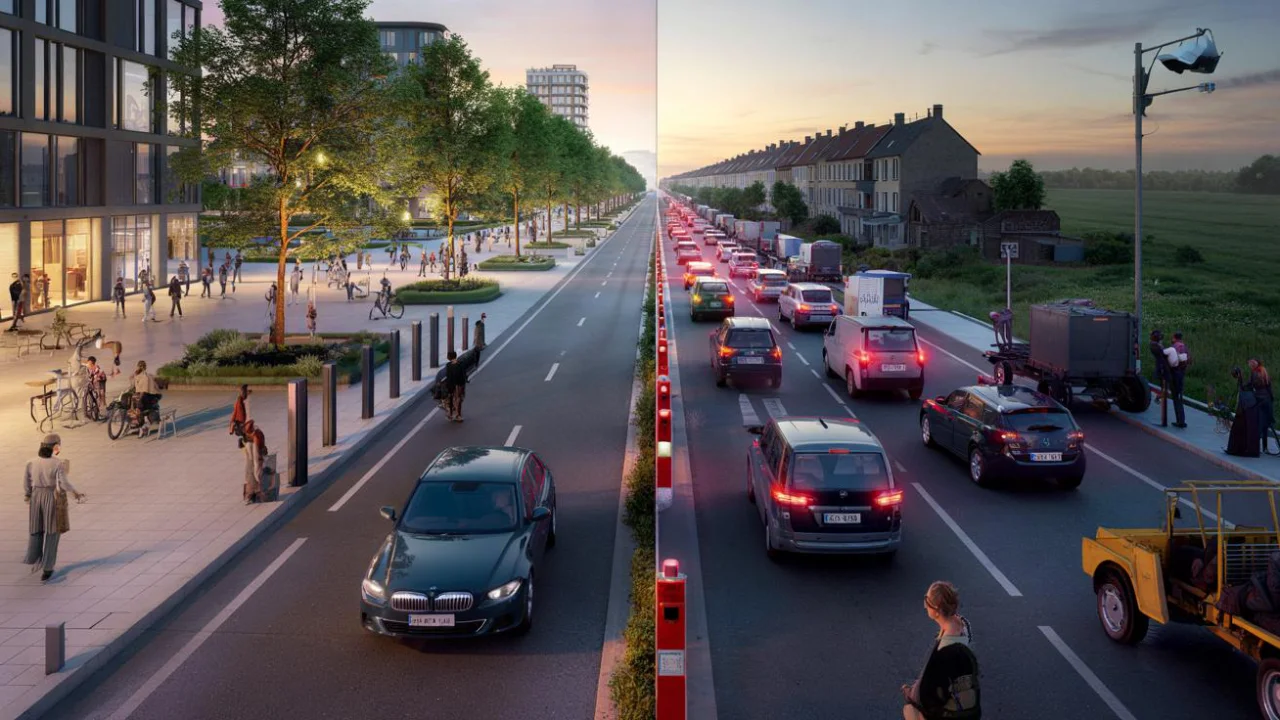
Sarah stared at the traffic camera blinking overhead, a familiar knot forming in her stomach. Just last month, she could drive her elderly mother straight to the doctor’s office downtown. Now, thanks to her city’s new “traffic filter” system, that same 10-minute journey required either a £60 fine or a 45-minute detour through residential streets packed with other confused drivers doing the same dance.
The council called it progress toward a “15-minute city.” Sarah called it something else entirely.
She wasn’t alone. Across cities from Oxford to Ottawa, residents are discovering that their local governments’ green transportation dreams can feel remarkably like restrictions on their daily freedom. The phrase “climate lockdowns by stealth” might sound dramatic, but for thousands of families navigating new driving restrictions, permit systems, and car-free zones, it captures something real.
The beautiful vision that’s dividing communities
The concept of 15-minute cities sounds almost too good to be true. Imagine neighborhoods where you can walk to work, school, shopping, and healthcare within a quarter-hour stroll. Picture tree-lined streets where children play safely, local businesses thrive, and neighbors actually know each other’s names.
Urban planners present this vision with genuine enthusiasm. Carlos Moreno, the Paris-based academic who popularized the term, describes it as “a return to a more human scale of living.” The idea has captured imaginations from City Hall to the World Economic Forum.
But something gets lost between the glossy presentations and real-world implementation. When cities start installing cameras, blocking roads, and charging drivers for access to their own neighborhoods, the dream can quickly turn into a nightmare.
Oxford became ground zero for this controversy when it introduced low-traffic neighborhoods and traffic filters backed by automatic number plate recognition cameras. The backlash was swift and fierce. Taxi drivers, delivery workers, and families with elderly relatives felt trapped by a system that seemed designed without considering their actual lives.
“We’re not against cleaner air or safer streets,” explains Maria Chen, a working mother from Oxford. “But when my disabled son needs to get to his specialist appointment across town, I can’t exactly put him on a bicycle.”
How cities are implementing these changes
The push toward 15-minute cities involves multiple interconnected policies that cities are rolling out with varying degrees of public consultation:
| Policy Type | How It Works | Common Complaints |
|---|---|---|
| Low Traffic Neighborhoods (LTNs) | Physical barriers or cameras restrict car access to residential streets | Emergency services delays, increased traffic on boundary roads |
| Traffic Filters | Cameras fine drivers without permits who pass through certain zones | Confusing rules, expensive fines for simple mistakes |
| Car-Free Zones | Complete vehicle bans in city center areas | Impacts on disabled access, small business deliveries |
| Congestion Charges | Daily fees for driving in designated areas | Disproportionately affects lower-income workers |
| Reduced Parking | Removing spaces to discourage car use | Forces drivers to circle neighborhoods looking for spots |
Cities implementing these measures often emphasize the benefits:
- Reduced air pollution and carbon emissions
- Safer streets for pedestrians and cyclists
- More space for local businesses and community activities
- Improved public health from walking and cycling
- Stronger neighborhood connections
The problem isn’t necessarily the goals, but the execution. Many residents feel these changes are being imposed rather than developed collaboratively.
“They showed us beautiful renderings of café culture and children playing in the streets,” says David Kumar, a small business owner in Birmingham. “What they didn’t show us were the empty shops when customers couldn’t park anywhere nearby.”
Who really pays the price?
The most contentious aspect of 15-minute cities isn’t the concept itself, but how the transition burden falls disproportionately on certain groups. Working-class families, small business owners, and people with mobility challenges often find themselves bearing the highest costs.
Care workers who travel between multiple clients can face dozens of camera fines each month. Tradespeople with heavy equipment struggle to navigate the new restrictions. Elderly residents who relied on short car trips to maintain independence find themselves effectively housebound.
Meanwhile, wealthy residents in leafy neighborhoods with existing amenities tend to benefit most from the changes. They’re more likely to live within walking distance of good schools, healthcare, and shopping, making car restrictions less burdensome.
Dr. Patricia Williams, an urban sociology professor, notes: “There’s a class dimension to this that planners often overlook. When you can afford to live in the city center and work from home, traffic restrictions feel liberating. When you’re a cleaner commuting from the suburbs at 5 AM, they feel punitive.”
The implementation timeline also matters. Cities that rush to install cameras and barriers before improving public transport or local services create maximum disruption with minimal benefit.
Some residents report feeling like test subjects in a grand experiment. The rapid rollout of restrictions, often with minimal consultation, has fueled conspiracy theories about government control and “climate lockdowns.”
These concerns aren’t entirely unfounded. During COVID-19 lockdowns, many people experienced how quickly movement restrictions could be implemented. The surveillance infrastructure being installed for traffic management could theoretically be repurposed for broader social control.
“The technology doesn’t know the difference between enforcing driving restrictions and enforcing anything else,” points out privacy advocate James Morrison. “Once you have cameras tracking every movement, the possibilities expand.”
Finding a path forward that works for everyone
The polarization around 15-minute cities doesn’t have to be permanent. Some cities are finding ways to pursue sustainability goals while addressing legitimate concerns about freedom and equity.
Copenhagen’s approach offers lessons. Rather than restricting car access, they invested heavily in making cycling and walking genuinely attractive. Protected bike lanes, excellent public transport, and gradual parking reductions created change through incentives rather than penalties.
Successful transitions also require honest acknowledgment of tradeoffs. Not everyone will benefit equally from urban redesign, and cities need mechanisms to help those who bear the highest costs.
This might include exemptions for care workers, better disabled access provisions, or financial support for small businesses during transition periods.
The key is ensuring that climate action doesn’t become climate coercion. When residents feel their concerns are heard and addressed, they’re far more likely to support ambitious environmental goals.
FAQs
What exactly are 15-minute cities?
They’re neighborhoods designed so residents can access most daily needs within a 15-minute walk or bike ride, reducing car dependency.
Are 15-minute cities really “climate lockdowns”?
Not intentionally, but car restrictions and surveillance cameras can feel controlling to residents who depend on vehicles for work or family care.
Which cities are implementing these policies?
Paris, Oxford, Barcelona, Vancouver, and Portland are among the most prominent examples, with varying approaches and levels of public support.
Do these changes actually reduce emissions?
Early data suggests modest reductions in local air pollution, but the overall climate impact depends heavily on whether people switch to public transport or just drive longer routes.
Can you opt out of living in a 15-minute city zone?
Generally no – these are citywide planning policies that affect entire neighborhoods, though some areas may have exemptions or different rules.
What happens if you ignore the traffic restrictions?
Most cities issue automatic fines ranging from £60-200 per violation, which can add up quickly for regular drivers.


