
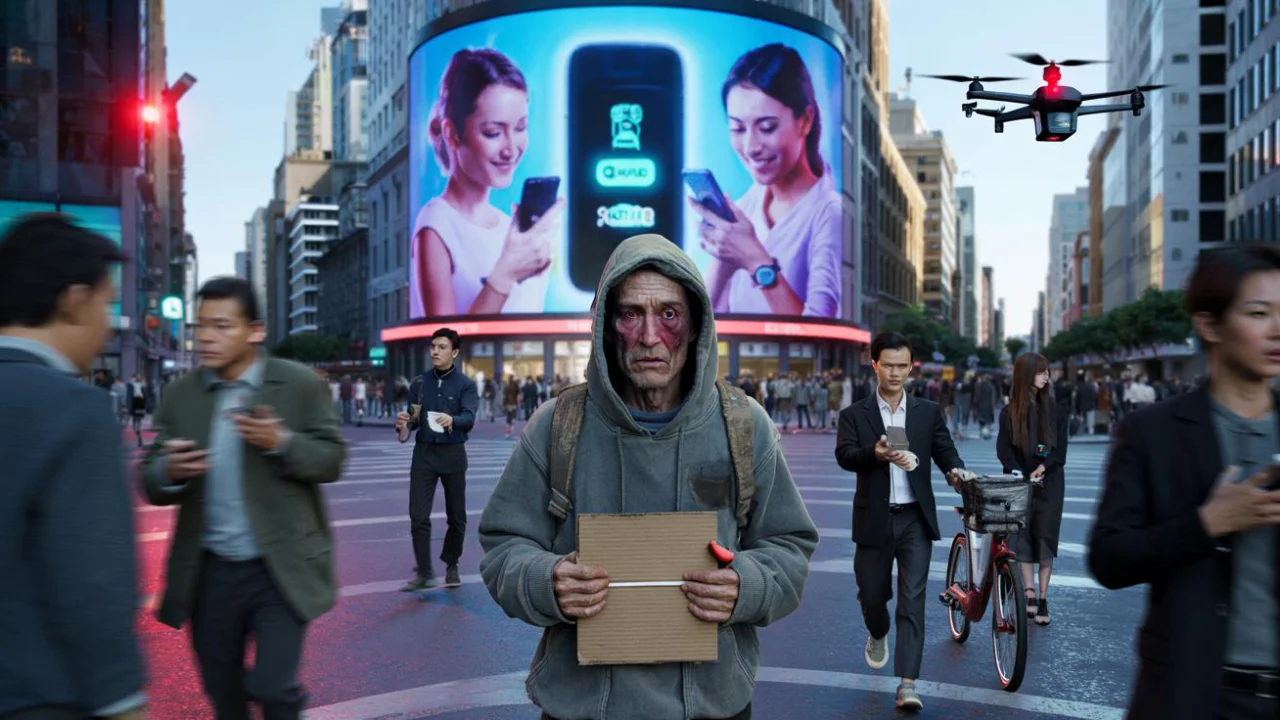
Maria clutches her worn cardboard sign closer to her chest as another pedestrian hurries past, phone already out, tapping to pay for their morning latte. The sign reads “Veteran – Anything Helps” in fading black marker. Above her, a sleek surveillance camera swivels silently, its red light blinking like a digital heartbeat.
She doesn’t know that in a control room across town, an algorithm has already flagged her presence. The AI system processes her posture, the sign in her hands, her location near the busy shopping district. Within seconds, it generates an automated fine notice: $85 for “unauthorized solicitation in a designated cashless zone.”
Maria has never owned a smartphone. She pays for everything with the few crumpled bills she manages to collect each day. But in this cashless city, even asking for help has become a crime that technology can detect and punish automatically.
How Smart Cities Are Leaving the Most Vulnerable Behind
The transition to a cashless city promises efficiency and convenience. No more fumbling for change, no more long lines at checkout, no more cash-related crimes. Digital payments flow seamlessly through QR codes, contactless cards, and mobile apps that make every transaction instant and traceable.
But what happens when an entire population gets systematically excluded from this digital paradise? When artificial intelligence starts policing poverty with the same cold precision it uses to optimize traffic flows?
Cities worldwide are rapidly adopting cashless payment systems, from Stockholm’s near-total elimination of physical currency to China’s mobile payment revolution. The benefits are undeniable: reduced theft, streamlined commerce, and detailed transaction data that helps city planners optimize everything from public transport to waste collection.
“We’re creating frictionless urban experiences,” explains Dr. Sarah Chen, a smart city consultant who has worked with over 20 municipalities. “Every interaction becomes data that we can use to improve services and predict needs.”
Yet this same frictionless efficiency is creating new forms of exclusion that most city planners never anticipated.
The AI Enforcement Problem: When Algorithms Police Desperation
The most disturbing aspect isn’t just that homeless individuals can’t receive digital donations. It’s how AI surveillance systems are now automatically detecting and fining people for simply appearing to ask for help.
Here’s how the system typically works:
- Surveillance cameras use computer vision to identify “suspicious” behaviors
- Algorithms trained on thousands of hours of footage flag certain postures, locations, and activities
- The system automatically generates fine notices sent to city enforcement
- Officers receive alerts with GPS coordinates and recommended penalty amounts
- Fines are processed through the same digital payment system that excludes the people being fined
| City | AI Detection Method | Average Fine Amount | Appeal Process |
|---|---|---|---|
| CityPay Metro | Posture analysis + location tracking | $75-120 | Digital-only submission |
| SmartVille | Sign recognition + loitering detection | $50-200 | QR code access required |
| TechHaven | Behavioral pattern matching | $90-150 | Mobile app submission |
The cruel irony becomes clear: people are being fined through systems they cannot access, for behaviors driven by exclusion from those same systems.
“The algorithm doesn’t understand context,” notes Marcus Rodriguez, a digital rights advocate who has documented these enforcement patterns. “It sees someone holding a sign and standing still as a violation, not as a human being in crisis.”
When Convenience Becomes Cruelty
Beyond the immediate injustice of AI-generated fines, the cashless city model creates cascading problems for society’s most vulnerable populations. Without access to digital payment methods, homeless individuals face barriers that extend far beyond panhandling.
Public transportation requires tap-to-pay cards or mobile apps. Food vendors no longer accept cash. Even public restrooms in some areas require digital payments for access. The result is effective banishment from public spaces that were once accessible to everyone.
Consider the daily reality: a person experiencing homelessness wakes up hungry. They cannot buy food from most vendors because they only accept digital payments. They cannot use public transportation to reach services because it requires a contactless card. If they ask for help, surveillance systems may automatically fine them.
The efficiency that makes city life smoother for most residents becomes a maze of impossible barriers for those without digital access.
Dr. Amanda Foster, who studies urban inequality at the Metropolitan Research Institute, puts it bluntly: “We’re creating two-tier cities where your ability to participate in basic urban life depends entirely on having the right technology and bank accounts.”
The Human Cost of Algorithmic Efficiency
Stories from affected individuals reveal the human dimension of these policy decisions. James, a 34-year-old veteran who lost his housing after a job injury, describes the psychological impact: “You feel invisible and criminalized at the same time. The city treats you like a glitch in their perfect system.”
Support organizations report that people are increasingly pushed to the margins of urban areas, away from services and opportunities, simply to avoid algorithmic detection. This creates new forms of spatial segregation enforced by code rather than law.
The fines themselves create additional problems. How does someone without a bank account or smartphone pay an $85 digital penalty? The answer, often, is that they cannot. Unpaid fines accumulate, sometimes leading to warrants or jail time, further entrenching people in cycles of poverty and criminalization.
“We’re using 21st-century technology to recreate 19th-century problems,” argues civil rights attorney Lisa Park, who has represented clients affected by these systems. “The tools are new, but the outcome is the same: poor people get punished for being poor.”
Finding Balance: Can Cities Be Smart and Compassionate?
Some cities are beginning to recognize these problems and implement solutions. Progressive approaches include:
- Maintaining cash acceptance requirements for essential services
- Creating digital inclusion programs that provide phones and banking access
- Programming AI systems to ignore certain behaviors in designated areas
- Establishing human review requirements before fines are issued
- Funding alternative support systems like direct cash assistance programs
The challenge isn’t technological—it’s philosophical. Do we want cities optimized for maximum efficiency, or communities designed for universal inclusion?
The answer may determine whether the cashless city becomes a model for human-centered urban design or a cautionary tale about the unintended consequences of algorithmic governance.
FAQs
How do AI systems detect panhandling?
Cameras use computer vision to analyze posture, location, duration of standing, and whether someone is holding signs, then flag these patterns as potential violations.
Can people appeal AI-generated fines?
Most cities require digital appeals through websites or apps, creating another barrier for people without technology access.
Are there legal challenges to these systems?
Yes, civil rights groups are filing lawsuits arguing these systems violate due process and equal protection rights.
Do cashless policies actually reduce crime?
Studies show mixed results—while cash-related theft decreases, new forms of digital fraud and exclusion-related problems emerge.
What alternatives exist for helping homeless people in cashless cities?
Some organizations provide digital payment cards or direct service connections, but these require infrastructure many cities haven’t built.
Are any cities reversing cashless policies?
A few municipalities have reinstated cash requirements for certain services after recognizing the exclusion problems, but full reversals remain rare.


