
Picture this: You’re watching a Rafale fighter jet streak across the sky at an airshow, its twin engines roaring with a sound that makes your chest vibrate. The pilot pulls a sharp turn at nearly twice the speed of sound, and you can’t help but wonder what kind of engineering marvel is powering that incredible machine.
What most people don’t realize is that those engines represent something extraordinary in Europe – they’re designed, built, and tested entirely in France. While other European nations rely on partnerships or foreign technology, France quietly maintains one of the world’s most exclusive clubs: countries that can build complete fighter jet engines from scratch.
Behind this remarkable capability stands an organization most people have never heard of, working in ordinary-looking offices where the future of aerial warfare is decided down to the smallest detail.
The Unsung Heroes Behind France’s Engine Dominance
The Direction Générale de l’Armement, or DGA, doesn’t look like much from the outside. Walk through their Paris headquarters and you’ll see the usual mix of fluorescent lights, coffee machines, and ID badges that always seem to malfunction at the worst moments.
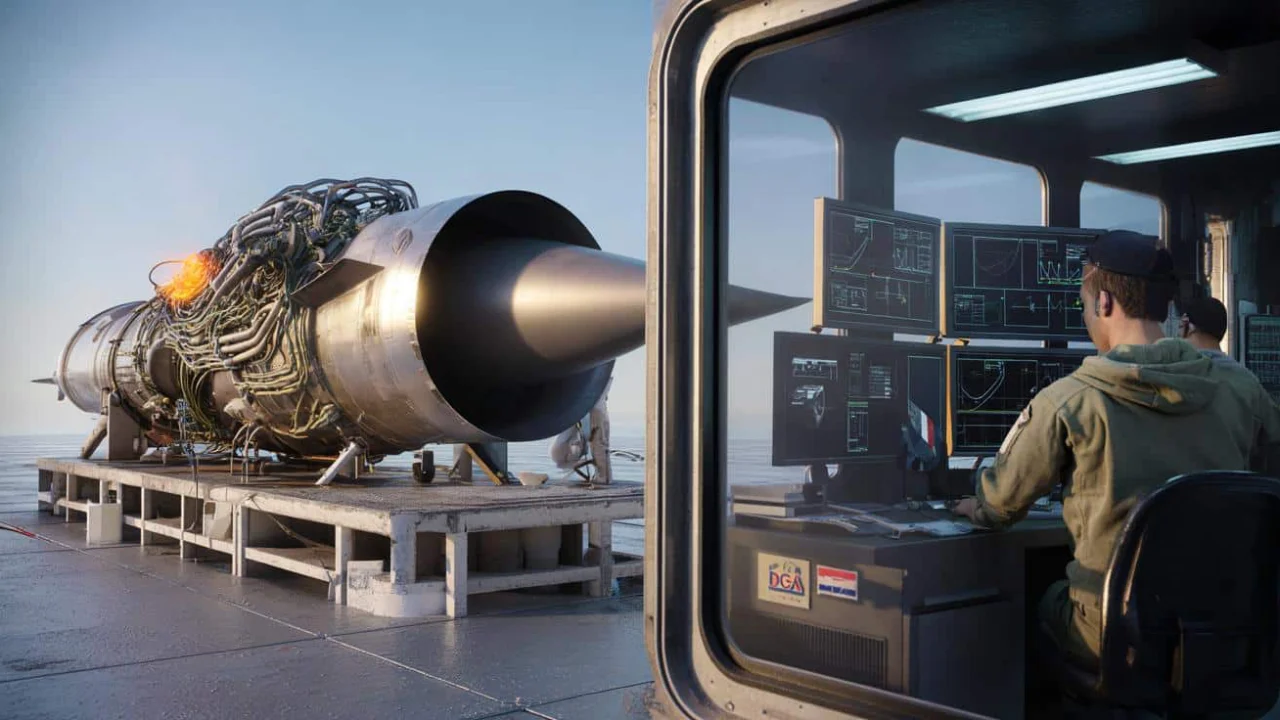
But step inside their test facilities at Saclay, and you’re transported into something that feels like science fiction. Massive concrete chambers house prototype engines bolted to reinforced test stands, surrounded by thousands of sensors and cables. Behind thick protective glass, engineers monitor screens displaying torrents of data as engines roar at ear-splitting volumes.
“When we fire up a new engine prototype, we’re not just testing metal and mechanics,” explains a senior DGA engineer who’s spent two decades validating fighter jet engines. “We’re pushing the absolute limits of what’s physically possible while ensuring a pilot’s life depends on our work.”
The DGA serves as both conductor and referee in France’s engine development process. While Safran manufactures the actual engines, the DGA defines the standards, finances cutting-edge research, and makes the final call on whether an engine is ready for combat. Their stamp of approval is what separates a promising prototype from a battle-ready powerplant.
What Makes France’s Engine Capabilities So Special
France stands alone in Europe with its ability to design, test, and qualify complete fighter jet engines without external assistance. This isn’t about assembling foreign components or performing maintenance – it’s about creating the entire engine from initial concept to final certification.
Here’s what sets France apart in the global engine development landscape:
- Complete industrial chain: From research labs to manufacturing facilities to testing centers
- Independent certification authority: The DGA can approve engines without foreign oversight
- Advanced metallurgy expertise: Specialized knowledge in high-temperature alloys and precision manufacturing
- Comprehensive test infrastructure: Facilities capable of simulating extreme flight conditions
- Military-industrial integration: Close collaboration between defense needs and engineering capabilities
| Country | Fighter Engine Capability | Notable Engines |
|---|---|---|
| France | Complete independent development | M88 (Rafale), M53 (Mirage) |
| United Kingdom | Partnership-dependent | EJ200 (Eurofighter, joint project) |
| Germany | Partnership-dependent | EJ200 (Eurofighter, joint project) |
| Italy | Partnership-dependent | EJ200 (Eurofighter, joint project) |
| United States | Complete independent development | F119, F135, F110 |
| Russia | Complete independent development | AL-31, AL-41 |
The technical challenges involved in fighter jet engines are staggering. These powerplants must operate reliably at temperatures exceeding 1,500 degrees Celsius, withstand forces that would crush ordinary materials, and maintain peak performance while pulling 9-G maneuvers.
“People think it’s just about making something powerful,” notes a former Safran engineer who worked on the M88 engine. “But fighter engines are like Formula 1 cars – every component must be perfect because there’s no room for compromise when lives are on the line.”
The Real-World Impact of France’s Engine Independence
This technological sovereignty translates into significant strategic advantages that extend far beyond impressive airshow demonstrations. France’s ability to develop fighter jet engines independently shapes international relations, defense partnerships, and global arms sales.
For French military operations, engine independence means complete control over maintenance, upgrades, and deployment decisions. When Rafale jets operate in Mali, Libya, or Eastern Europe, France doesn’t need to worry about spare parts embargoes or foreign approval for mission-critical modifications.
The economic implications are equally substantial. France exports Rafale fighters to countries like Egypt, India, and Qatar, with engine technology serving as a key selling point. Unlike competitors who rely on international partnerships, France can offer buyers complete package deals without worrying about third-party restrictions.
“When you control the engine, you control the airplane’s future,” explains a defense industry analyst. “Countries buying French fighters know they’re not just getting an aircraft – they’re getting guaranteed long-term support and upgrade paths.”
This independence becomes particularly valuable during geopolitical tensions. While other European nations might face restrictions on engine parts or technology transfers, France maintains full operational flexibility for its air force and export customers.
The Technology Behind the Roar
The M88 engines powering France’s Rafale fighters represent decades of focused engineering effort. These twin-spool, low-bypass turbofans generate up to 17,000 pounds of thrust each while maintaining remarkable fuel efficiency and reliability.
What makes these engines special isn’t just their power output – it’s their integration with advanced flight systems. The M88 can vector thrust for enhanced maneuverability, adjust power output in milliseconds, and operate efficiently across an enormous range of flight conditions.
The testing process alone showcases France’s unique capabilities. DGA facilities can simulate everything from Arctic conditions to desert heat, high-altitude thin air to sea-level humidity. Engines undergo thousands of hours of testing under conditions more extreme than they’ll ever face in actual service.
“We test these engines harder than nature ever could,” says a DGA test engineer. “By the time an M88 enters service, we know exactly how it will behave in any situation a pilot might encounter.”
FAQs
Why can’t other European countries build their own fighter jet engines?
Most European nations lack the complete industrial infrastructure, from specialized metallurgy to advanced testing facilities, required for independent engine development.
How long does it take to develop a new fighter jet engine?
Typically 10-15 years from initial design to operational deployment, involving thousands of engineers and billions of euros in development costs.
What makes fighter jet engines different from commercial aircraft engines?
Fighter engines must withstand extreme maneuvers, operate at higher temperatures, and prioritize power-to-weight ratio over fuel efficiency compared to commercial engines.
Could France’s engine technology be shared with other European nations?
While possible, such arrangements would require extensive technology transfer agreements and could compromise France’s strategic independence.
How does the DGA ensure engine safety and reliability?
Through rigorous testing protocols that subject engines to conditions far exceeding normal operational parameters, plus continuous monitoring of in-service performance data.
What happens if France’s Rafale engines need repairs during overseas missions?
France maintains complete supply chains and technical support capabilities, ensuring operational independence without relying on foreign partners for critical maintenance.


