
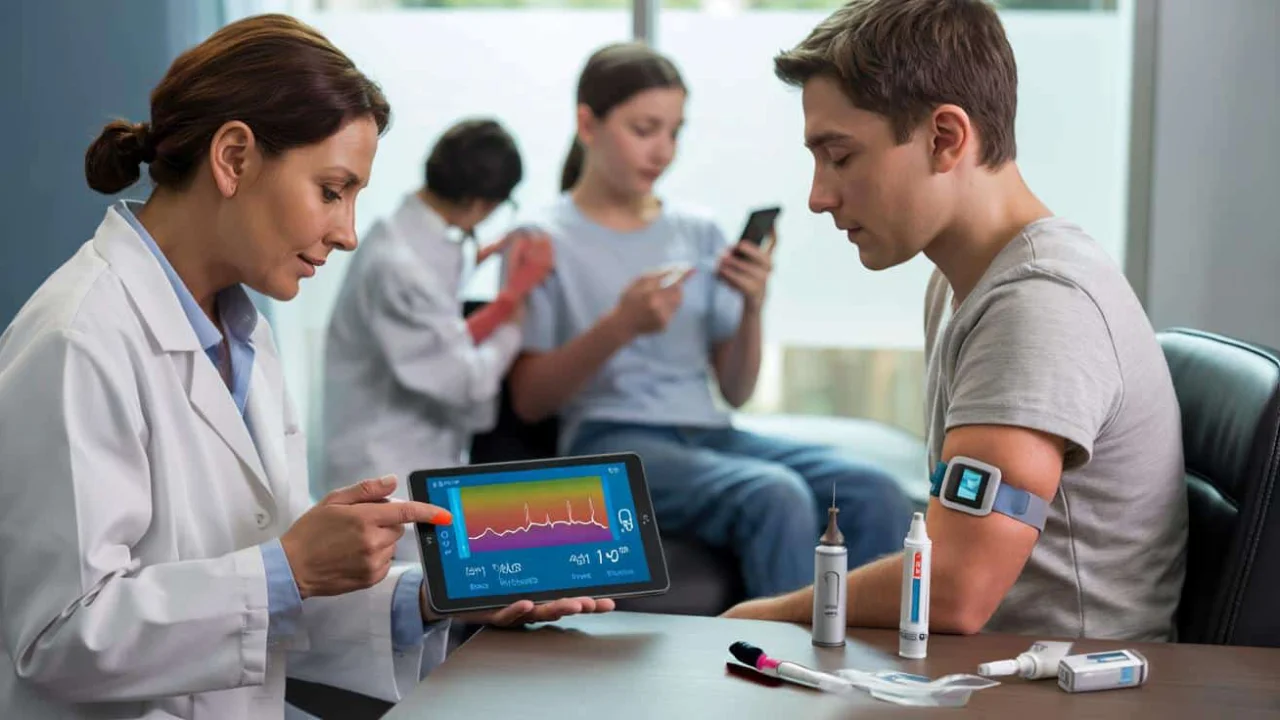
Sarah used to wake up every morning with her first thought being the same: “What’s my blood sugar?” The 34-year-old teacher would fumble for her glucose meter in the dark, prick her finger, and hold her breath waiting for the number. Too high meant a rushed correction dose. Too low meant scrambling for juice boxes while her hands shook.
Last month, she woke up and realized she hadn’t checked her glucose in three days. Her phone showed a steady green line overnight, and the small patch on her arm had handled everything automatically. For the first time in twelve years with Type 1 diabetes, she felt… normal.
Sarah’s experience isn’t unique anymore. Across the world, diabetes care breakthroughs are quietly revolutionizing how millions of people manage their condition, and many experts believe we’re witnessing the beginning of the end for traditional diabetes treatment.
The Technology Revolution That’s Changing Everything
Step into any modern endocrinology clinic today and you’ll notice something different. The familiar beeping of blood glucose meters is fading, replaced by the soft glow of smartphone screens showing real-time glucose data. Patients aren’t carrying around bulky supplies anymore – instead, they’re wearing sleek devices that do most of the work for them.
These diabetes care breakthroughs center around three game-changing technologies working together: continuous glucose monitors (CGMs), smart insulin pumps, and artificial intelligence algorithms that learn each person’s unique patterns.
“Five years ago, I was treating diabetes like we were still in the 1990s,” says Dr. Rebecca Martinez, an endocrinologist in Phoenix. “Now I have patients whose diabetes management is so automated, they sometimes forget they have the condition.”
The transformation is remarkable. Traditional diabetes care required people to check their blood sugar 4-8 times daily, calculate insulin doses manually, and constantly worry about dangerous highs and lows. Today’s systems can predict glucose changes up to 30 minutes in advance and adjust treatment automatically.
Revolutionary Treatments Making Insulin Obsolete
While technology handles the day-to-day management, breakthrough medications are tackling diabetes at its root. The most exciting developments involve drugs that were originally designed for weight loss but are showing incredible promise for diabetes prevention and reversal.
Here are the key medication breakthroughs changing diabetes treatment:
- GLP-1 receptor agonists – Weekly injections that can reduce insulin needs by 50-70%
- Dual GIP/GLP-1 drugs – Even more powerful versions showing near-normal blood sugar levels
- SGLT-2 inhibitors – Pills that help the kidneys remove excess glucose naturally
- Smart insulin – Currently in trials, this insulin only activates when blood sugar is high
- Immunotherapy treatments – Experimental therapies that may prevent Type 1 diabetes entirely
| Treatment Type | Old Method | New Breakthrough | Patient Impact |
|---|---|---|---|
| Blood Sugar Monitoring | 4-8 finger pricks daily | Continuous monitors with phone alerts | 85% reduction in daily tests |
| Insulin Delivery | Manual injections 4+ times daily | Automated pumps with AI adjustments | 70% improvement in glucose control |
| Weight Management | Diet and exercise alone | GLP-1 drugs with appetite control | 15-20% body weight reduction |
| Emergency Prevention | Constant vigilance required | Predictive algorithms with warnings | 90% reduction in severe episodes |
Dr. James Chen, a researcher at Stanford’s diabetes center, explains the magnitude of these changes: “We’re seeing people with Type 2 diabetes achieve completely normal blood sugars without insulin. Some are essentially in remission. That was unthinkable just five years ago.”
What This Means for Real People Living With Diabetes
The human impact of these diabetes care breakthroughs extends far beyond medical charts and clinical trials. For the 537 million adults worldwide living with diabetes, these advances represent freedom from a disease that has traditionally demanded constant attention.
Take Mark, a 28-year-old engineer diagnosed with Type 1 diabetes in college. He used to plan every meal, every workout, every late night around his blood sugar management. Business trips were stressful logistics operations involving backup supplies and emergency protocols.
Now, his hybrid closed-loop system manages over 90% of his diabetes decisions automatically. His time-in-range – the percentage of time his glucose stays in healthy levels – has improved from 65% to 85%. More importantly, he’s planning his wedding without worrying about diabetes complications affecting his future.
“I actually forgot to bolus for lunch yesterday and my pump caught it automatically,” Mark says. “My fiancée looked at me and said, ‘Remember when you used to set alarms for everything?’ I honestly barely remember that version of my life.”
The psychological benefits are proving just as significant as the physical ones. Studies show people using these new technologies report 40% less diabetes distress and significantly improved quality of life scores.
The Healthcare System Preparing for Massive Change
Healthcare providers are scrambling to adapt to these rapid advances. Traditional diabetes education focused on manual calculations and crisis management. Now, clinicians need to understand complex algorithms and help patients navigate smartphone apps.
“We’re rewriting our entire approach to diabetes care,” admits Dr. Lisa Wong, director of a diabetes center in Seattle. “Some of our standard protocols are becoming obsolete faster than we can update them.”
The economic implications are staggering. Diabetes currently costs the U.S. healthcare system $327 billion annually. If these breakthrough treatments can prevent complications and reduce hospitalizations, the savings could reach tens of billions of dollars within a decade.
Insurance companies are taking notice too. Many are now covering continuous glucose monitors and insulin pumps for broader groups of patients, recognizing that the upfront costs are offset by reduced emergency room visits and long-term complications.
Looking Toward a Future Without Traditional Diabetes
Perhaps the most exciting developments are still in clinical trials. Researchers are testing treatments that could eliminate Type 1 diabetes entirely by protecting the insulin-producing cells from autoimmune attack. Others are working on bioengineered cells that could be transplanted to restore natural insulin production.
Smart insulin, currently in Phase 2 trials, represents what many consider the holy grail of diabetes treatment. This modified insulin remains inactive in the bloodstream until glucose levels rise, then automatically activates to bring blood sugar back to normal. Early results suggest it could eliminate both high and low blood sugar episodes entirely.
The convergence of all these diabetes care breakthroughs is creating something unprecedented: the possibility that diabetes could become a manageable condition requiring minimal daily attention, or potentially, not a chronic disease at all.
As one diabetes researcher put it recently: “We’re not just improving diabetes care anymore. We’re making it disappear.”
FAQs
How soon will these diabetes care breakthroughs be widely available?
Many are already available now, including continuous glucose monitors and smart insulin pumps. The newest GLP-1 drugs are FDA-approved, though availability depends on insurance coverage and supply.
Are these new treatments suitable for both Type 1 and Type 2 diabetes?
Most breakthrough devices work for both types, while some medications are more effective for Type 2. Your doctor can determine which options are best for your specific situation.
Will insurance cover these advanced diabetes treatments?
Coverage is expanding rapidly. Most major insurers now cover continuous glucose monitors and insulin pumps, and many are adding coverage for newer medications as evidence of their effectiveness grows.
Can these treatments actually cure diabetes?
While not technically cures, some people with Type 2 diabetes achieve remission with the newest treatments. For Type 1, the focus is on making management so automated that it barely impacts daily life.
Are there any risks with these new diabetes technologies?
Like any medical treatment, there are potential side effects and risks. However, clinical trials show these new approaches are generally safer than traditional methods, with fewer dangerous blood sugar episodes.
How much do these breakthrough treatments cost?
Costs vary widely, from $100-300 monthly for continuous glucose monitors to $1,000+ for insulin pumps. However, many patients find the improved quality of life and reduced complications make the investment worthwhile.


