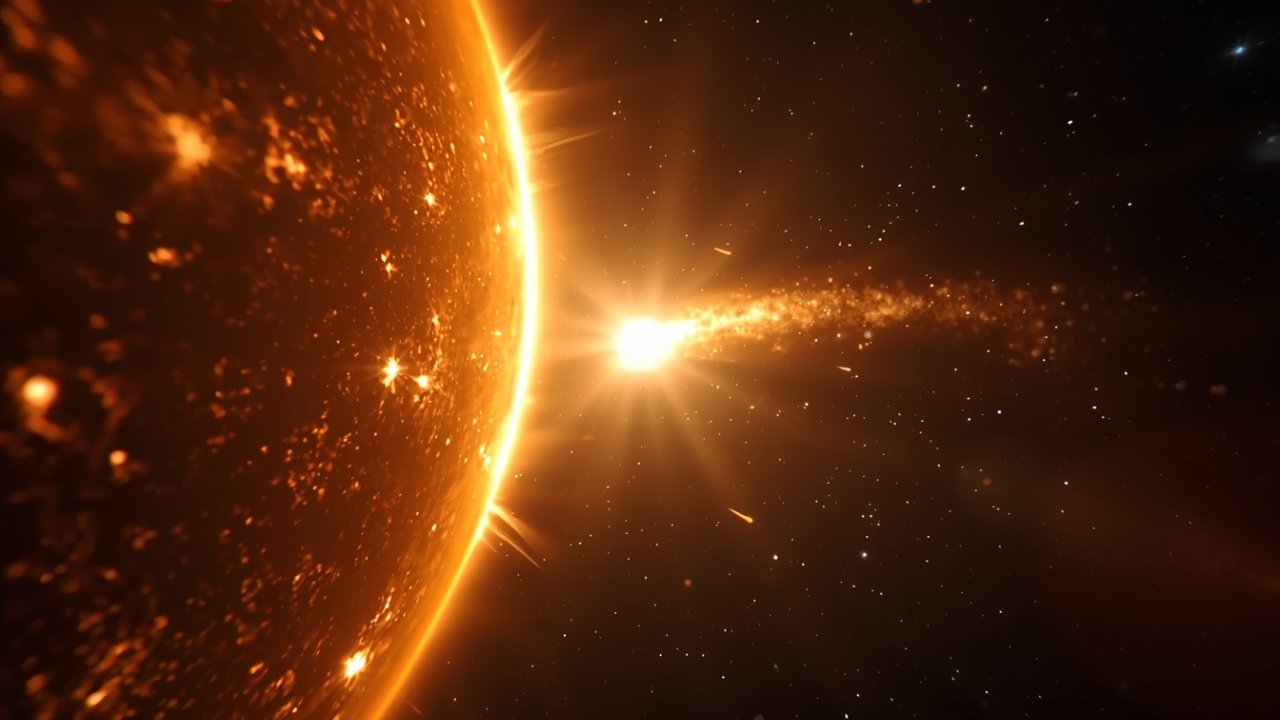
Astronomers around the world are closely monitoring a newly discovered comet that could deliver one of the most spectacular celestial events of the decade. The comet, known as C/2026 A1, is expected to pass extremely close to the Sun in early April 2026. This dramatic approach could either turn the comet into a brilliant daylight object visible from Earth — or destroy it completely.
The rare event has already attracted significant attention from scientists and observatories globally. Not only does this comet offer a chance for an impressive sky show, but it also provides a valuable scientific opportunity to study the hidden composition of these mysterious icy objects from the early Solar System.
A Discovery That Excited the Astronomy Community
The comet C/2026 A1 was first spotted in January 2026 by amateur astronomers working with the MAPS observation program in Chile. At the time of its discovery, the comet was located nearly 300 million kilometers away from the Sun. Early detection is extremely rare for comets of this type, making this discovery especially important for scientific research.
Thanks to this early identification, astronomers now have several months to track the comet’s journey toward the Sun. This extended observation window allows researchers to analyze its structure, orbit, and potential brightness before it reaches its closest point to our star.
The comet has already been studied using advanced instruments, including the powerful James Webb Space Telescope, operated by NASA and its international partners. Scientists are currently analyzing the data to estimate the comet’s size and chemical composition.
A Dangerous Journey Toward the Sun
The most dramatic moment in the comet’s journey will occur when it reaches perihelion — the point in its orbit when it comes closest to the Sun. For C/2026 A1, this moment is expected to occur around April 4, 2026.
During this phase, the comet may pass as close as approximately 160,000 kilometers from the Sun’s surface. In astronomical terms, this is an extremely dangerous distance. The intense heat, radiation, and gravitational forces near the Sun could cause the comet to undergo dramatic changes.
Scientists believe the comet could experience several possible outcomes:
- Massive gas and dust eruptions
- Fragmentation into smaller pieces
- Complete disintegration
While destruction may sound disappointing, it actually offers valuable research opportunities. When comets break apart near the Sun, they release material that has remained hidden inside their icy cores for billions of years. Studying this material can provide insights into the formation of the Solar System.
Why Comets Near the Sun Fascinate Scientists
Comets that pass extremely close to the Sun are known as “sungrazing comets.” These objects are particularly valuable to astronomers because the Sun’s heat forces them to release gases and dust at a rapid rate.
This process creates spectacular comet tails and allows scientists to analyze the chemical building blocks trapped within the comet. These materials often include frozen gases, dust particles, and organic molecules that formed during the early stages of planetary formation.
Observing sungrazing comets also helps researchers understand how solar radiation affects icy celestial bodies. The interaction between the Sun’s energy and comet material provides valuable clues about the evolution of comets over time.
A Member of the Famous Kreutz Family
The comet C/2026 A1 belongs to the Kreutz comet group, a well-known family of comets that share similar orbits passing extremely close to the Sun.
Scientists believe that all comets in this group originated from a single massive comet that broke apart thousands of years ago. Historical records suggest that the original parent comet may have been the legendary “Great Comet of 371 BC,” which was documented by ancient Greek observers.
Since that time, fragments of this ancient comet have repeatedly returned to the inner Solar System, sometimes producing breathtaking sky events.
Some famous members of the Kreutz group include:
- The Great Comet of 1106
- The spectacular Ikeya-Seki comet of 1965
These comets were so bright that they were visible even during daylight hours, an extremely rare astronomical phenomenon.
Could This Become the Brightest Comet of the Decade?
One of the most exciting possibilities surrounding C/2026 A1 is its potential brightness. Sungrazing comets are known for producing intense luminosity when heated by the Sun. If the comet remains structurally intact during its solar approach, it could become visible to the naked eye — possibly even during the daytime.
However, predicting comet brightness is extremely challenging. A comet’s visibility depends on several factors, including:
- Size of its nucleus
- Amount of volatile material inside
- Structural stability under solar heat
- Viewing angle from Earth
Data collected by the James Webb Space Telescope will help astronomers estimate how bright the comet may become. Researchers are particularly interested in measuring the comet’s core size because larger comets typically produce brighter and longer-lasting tails.
Even if the comet disintegrates before reaching maximum brightness, it could still produce a remarkable light display as it breaks apart.
A Rare Opportunity for Scientific Discovery
The early discovery of C/2026 A1 provides scientists with an unusual advantage. Most sungrazing comets are discovered only days or weeks before reaching the Sun, limiting observation time.
In this case, astronomers have several months to track the comet using telescopes across Earth and space-based observatories. This extended monitoring will help scientists collect detailed data on the comet’s composition, activity levels, and structural changes as it approaches the Sun.
Such data helps researchers understand how comets evolve and provides clues about the early conditions of the Solar System. Many scientists believe comets may have delivered water and organic molecules to early Earth, making them crucial objects for studying the origins of life.
What Skywatchers Can Expect
While scientists eagerly study the comet, skywatchers are also hopeful for a spectacular cosmic display. If the comet survives its solar encounter and becomes bright enough, it could become one of the most memorable astronomical events of recent years.
However, experts caution that comet behavior is unpredictable. Some comets grow brighter than expected, while others suddenly fade or break apart before reaching visibility.
The weeks leading up to April 2026 will be critical for determining whether C/2026 A1 will become a dazzling sky object or remain primarily a scientific phenomenon observed through telescopes.
A Cosmic Reminder of the Solar System’s Origins
Comets are often described as time capsules from the early Solar System. Their icy cores preserve ancient materials that formed billions of years ago, long before planets like Earth fully developed.
The upcoming journey of C/2026 A1 offers scientists and skywatchers alike a rare chance to witness one of nature’s most dramatic cosmic events. Whether it becomes a brilliant daylight comet or disintegrates under the Sun’s immense heat, it will undoubtedly provide valuable scientific insights.
As April approaches, astronomers worldwide will continue monitoring this celestial visitor, hoping it reveals new secrets about the history of our Solar System and the mysterious nature of comets.